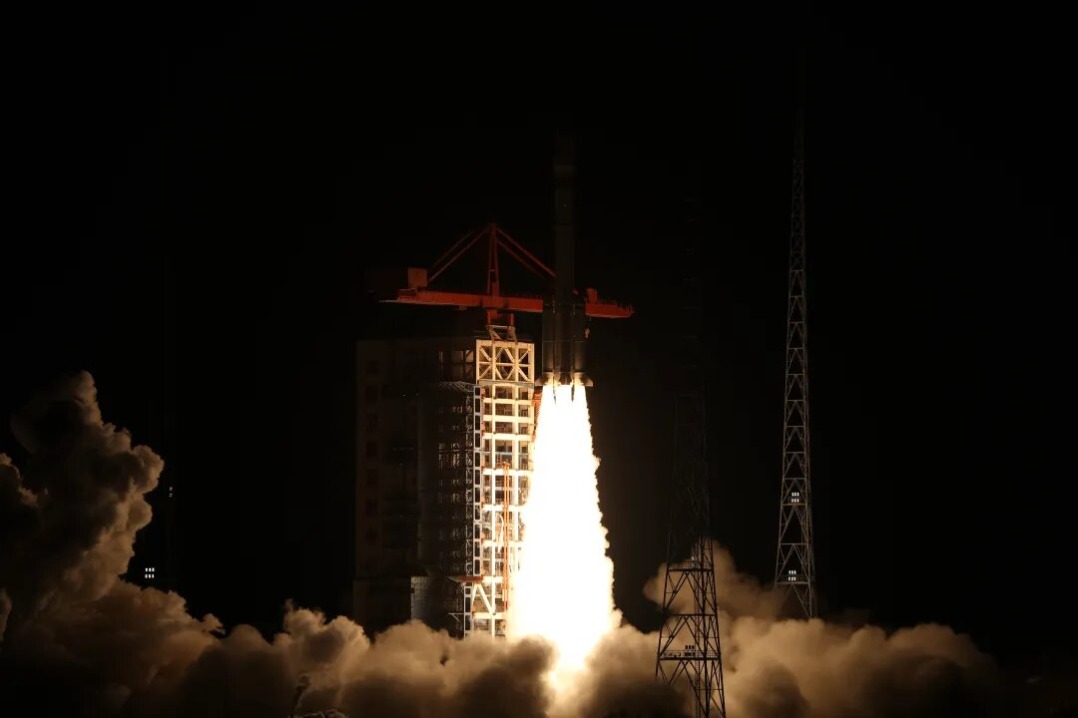
China’s aerospace program achieved another milestone on Sunday evening with the successful deployment of the Yaogan 50B remote-sensing satellite into orbit. The launch occurred at precisely 9:22 PM from the Taiyuan Satellite Launch Center in Shanxi province, utilizing the Long March 6A carrier rocket developed by the China Aerospace Science and Technology Corp.
The newly deployed satellite, engineered by the China Academy of Space Technology, represents China’s expanding capabilities in Earth observation technology. The Yaogan 50B is designed to capture critical data that will support numerous practical applications including comprehensive land resource surveys, accurate agricultural yield forecasting, and enhanced disaster prevention and mitigation strategies.
This launch signifies the 15th space mission conducted by China in the current year and marks the 633rd overall flight of the Long March rocket series, demonstrating the country’s consistent and growing presence in space operations.
The Yaogan satellite family constitutes China’s most extensive Earth-observation satellite network, featuring diverse payload configurations that include advanced radar systems and high-resolution optical lenses. The information gathered by these satellites has proven invaluable across multiple sectors, serving governmental agencies, public service organizations, and commercial enterprises with essential geospatial intelligence.
The Long March 6A medium-lift launch vehicle, a product of the Shanghai Academy of Spaceflight Technology, incorporates innovative design elements with its 50-meter liquid-propelled core booster accompanied by four solid-fuel side boosters. With a substantial liftoff weight of 530 metric tons, this versatile rocket platform demonstrates China’s technical proficiency in delivering payloads to various orbital configurations including sun-synchronous, low-Earth, and intermediate circular orbits.