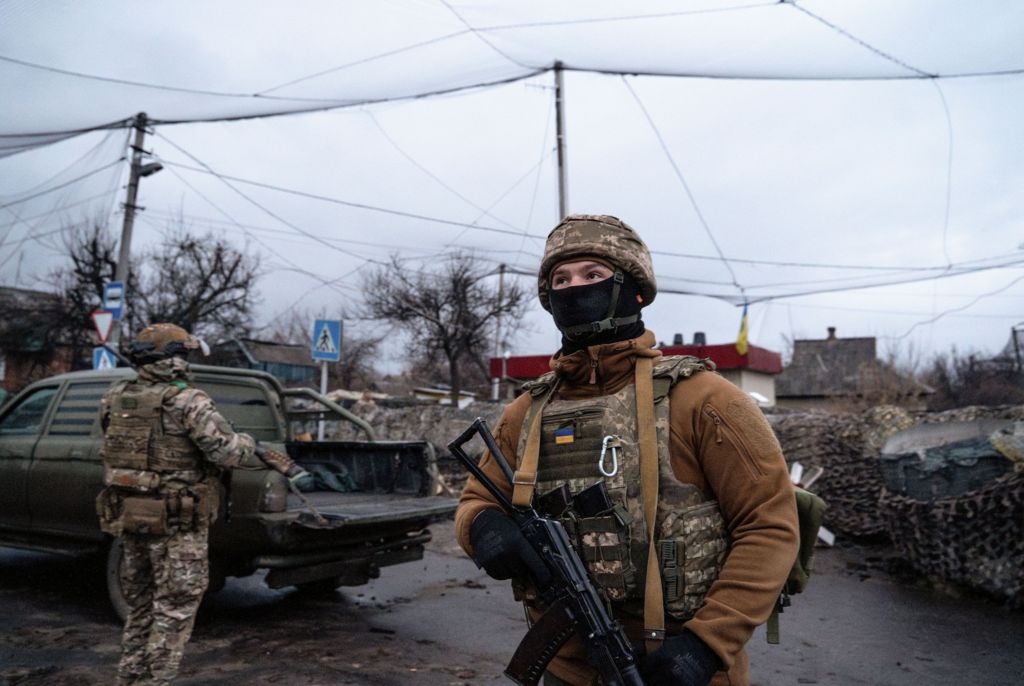
While Ukrainian soldiers continue their defense against Russian aggression, the government in Kyiv is simultaneously waging a crucial economic battle to secure the nation’s financial stability and future prosperity. This economic frontline represents an unseen but equally critical theater in the ongoing conflict.
Ukraine’s Finance Minister Sergii Marchenko emphasizes the strategic importance of economic resilience, stating, “Our strong army depends on our strong economy because all internally mobilized resources are channeled toward national defense.” The minister articulates a vision beyond immediate survival, expressing Ukraine’s ambition to evolve from being “just a poor neighbor” to becoming a valuable provider of military expertise to Europe.
International financial support has become the lifeline sustaining Ukraine’s economy. A monumental €90 billion ($105 billion) EU loan, approved by the European Parliament, forms the centerpiece of a $136.5 billion international support package. The first tranche is anticipated in April, providing critical budgetary support. Concurrently, the International Monetary Fund has approved an $8.1 billion loan program, with an initial $1.5 billion disbursement already received.
These external funds are particularly crucial since American financial assistance has diminished. Minister Marchenko acknowledges that without international support, Ukraine cannot survive given its current circumstances. However, he emphasizes that Ukrainian taxpayers remain the primary contributors to military funding.
Domestic revenue mobilization has intensified through controversial tax increases implemented in December 2024—the first since the war began—affecting personal incomes, small businesses, and financial institutions. These measures are projected to generate $67.5 billion in government revenue this year, representing a 15% increase from the previous year.
Despite these efforts, Ukraine faces a significant budgetary shortfall. The 2026 budget outlines $112 billion in spending, with approximately 60% allocated to military expenditures. This creates a $45 billion gap that the government aims to bridge through additional tax legislation, including increased taxation on digital platforms and reduced VAT exemptions as stipulated by IMF conditions.
The path to economic stability faces multiple obstacles. Hungary’s Prime Minister Viktor Orban has temporarily blocked EU financial assistance amid accusations of an “oil blockade” from Ukraine. Kyiv attributes pipeline repair delays to Russian attacks that have injured repair crews. The outcome of upcoming Hungarian elections may significantly influence this diplomatic and economic standoff.
Energy infrastructure damage presents another formidable challenge. Finance Minister Marchenko identifies electricity insufficiency as the economy’s primary constraint, forcing businesses to rely on generators and reducing productivity while increasing costs. Common sights of generators outside businesses underscore the energy sector’s difficulties, which the central bank acknowledges will “restrain business activity for a long time.”
Civilian economic hardships persist despite decreasing inflation from its wartime peak of 26.6% to the current 7.4%. Pensioners like 65-year-old Tetiana describe working additional jobs because pensions prove insufficient amid rising food and utility prices. Restaurant worker Mykyta, 19, reports staffing challenges and operational difficulties during power outages.
The reconstruction outlook appears daunting. A collaborative assessment by the Ukrainian government, EU, World Bank, and UN estimates recovery costs at $588 billion—nearly two-and-a-half times Ukraine’s entire economy—encompassing housing, infrastructure repair, and mine clearance.
Despite these challenges, optimism persists within business circles. Gennadiy Chyzhykov, President of the Ukrainian Chamber of Commerce and Industry, reports growing foreign business interest and investment inquiries. “They believe in victory and they believe in good business in Ukraine,” he states, noting increased delegations investigating post-war reconstruction opportunities.
The European Bank for Reconstruction and Development has committed over $10 billion in Ukraine since the conflict began. President Odile Renaud-Basso acknowledges the “immense” challenges but expresses confidence in their management, emphasizing that “a real, just peace, credible peace settlement will be key” for investor confidence.
Labor shortages present additional reconstruction hurdles. The UN’s International Labor Organization projects a deficit of 8.7 million workers, with millions having either joined military forces or left the country. Business leaders suggest importing foreign workers as a potential solution.
Through these multifaceted challenges, Finance Minister Marchenko maintains that wartime economic pressures are driving transformations that could ultimately create “a better economy for the future.” He concludes with determined resolve: “The Ukrainian people, our government, and economy are resilient and determined to fight this war because we defend ourselves and we will.”