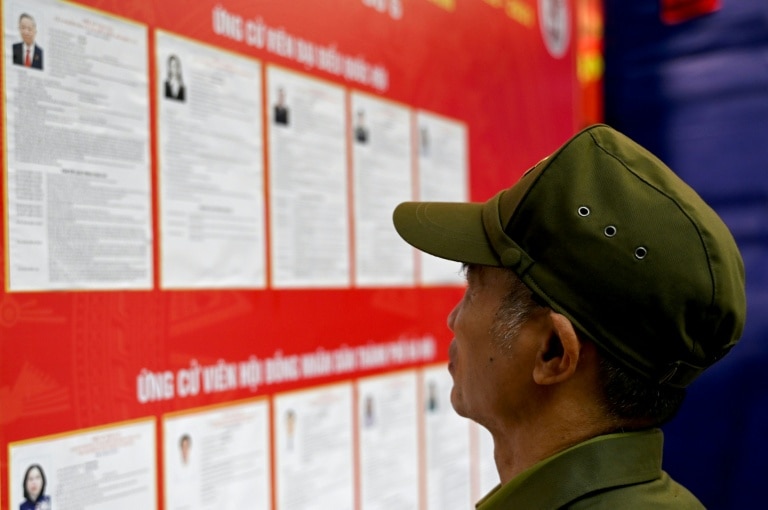
Vietnam conducted its parliamentary elections on Sunday to select members of the National Assembly, the country’s highest legislative body that primarily functions to endorse decisions made by the ruling Communist Party. The Southeast Asian nation of 100 million people presents a paradox: it boasts impressive economic achievements with eight percent growth last year while maintaining a repressive one-party system that frequently imprisons dissenting voices.
Out of 864 candidates competing for 500 parliamentary seats, merely 65 are not affiliated with the Communist Party—a decrease from 74 non-party candidates in the previous election five years ago. The capital city of Hanoi displayed patriotic red-and-yellow banners celebrating what authorities term the “national festival” where citizens “eagerly cast ballots.”
However, in a political landscape where major policies and projects are predetermined by senior party cadres, many Vietnamese citizens exhibit considerable ambivalence toward the electoral process. Phuong Anh, a 25-year-old administrative worker from Da Nang, expressed a common sentiment: “I don’t vote because I think my vote doesn’t matter.” She added that many people in her social circle share this perspective, feeling compelled to accept whoever assumes power due to the system’s inherent structure.
Quynh Anh, a 24-year-old office worker in Ho Chi Minh City, represented a different viewpoint, stating she might participate this year “because I have never done it before.” While not particularly enthusiastic, she described the election as “a new experience that I haven’t had, so I’m curious to try it and see what it’s like.”
Political analysts note that the new parliament’s initial responsibilities when it convenes next month will include confirming top leaders previously selected during the party’s twice-a-decade congress in January. Top leader To Lam was reaffirmed as general secretary and is widely anticipated to assume the presidency as well—a position requiring formal approval by lawmakers.
Nguyen Khac Giang of the ISEAS–Yusof Ishak Institute in Singapore characterized the National Assembly as “more or less a window-dressing institution” where no significant surprises are expected. However, he noted that “top personnel selections—particularly the prime minister and the president—will carry significant implications for the ongoing reform process.”
Lam has implemented substantial changes during his nearly two-year leadership, reducing bureaucratic red tape and advancing major infrastructure investments to stimulate economic growth. The party consolidated behind his ambitious vision at the January congress, electing several of Lam’s allies to its highest decision-making body. Notably, the party did not publicly announce the other main “pillars” of Vietnam’s collective leadership structure beyond Lam’s reappointment as general secretary. The president, prime minister, and head of the national assembly will all require confirmation through lawmakers’ votes, with Lam potentially becoming the first individual to secure the top two positions directly through a party congress rather than through succession following a predecessor’s death.