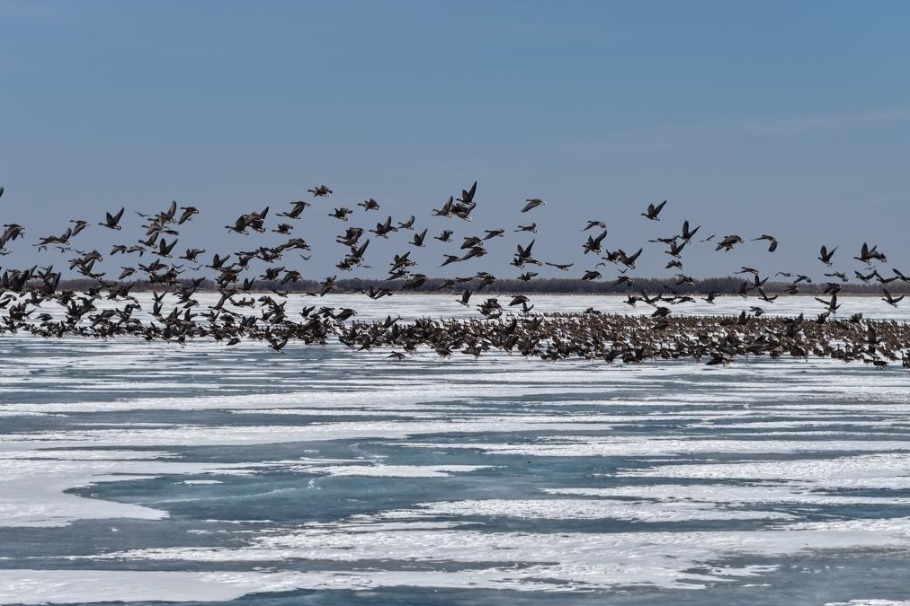
In an encouraging environmental development, Xingkai Lake in northeastern China’s Heilongjiang province has witnessed the premature return of migratory birds this spring. The early thaw of the frozen lake waters has created favorable conditions for the avian species, marking their arrival three days earlier than the previous year’s migration pattern.
Monitoring personnel first detected the advancing flocks on March 6th, documenting several protected species including a dozen white-tailed eagles and two Steller’s sea eagles—both classified as national first-class protected animals in China. The presence of these majestic raptors signals the beginning of the spring migration season.
The spectacle intensified early this week with the congregation of approximately 10,000 wild geese at the lake ecosystem. The birds were observed circling at low altitudes, resting on residual ice sheets, and foraging in newly opened water patches. Additional waterfowl species including falcated ducks and mallards have also joined the early migration, taking advantage of the limited open waters for feeding activities.
Ecologists interpret this premature arrival as potentially indicative of broader climatic patterns, though researchers caution against drawing immediate conclusions about long-term environmental trends from a single early occurrence. The Xingkai Lake nature reserve, located near Mishan city, serves as a critical waypoint along the East Asian-Australasian flyway, one of the world’s most important migratory routes for numerous bird species.
Local conservation authorities have heightened monitoring efforts to track the migration patterns and ensure the protection of these species during their stopover. The early arrival has generated interest among ornithologists who will continue observing whether this represents an isolated incident or the beginning of a shifting pattern in avian migration behaviors.