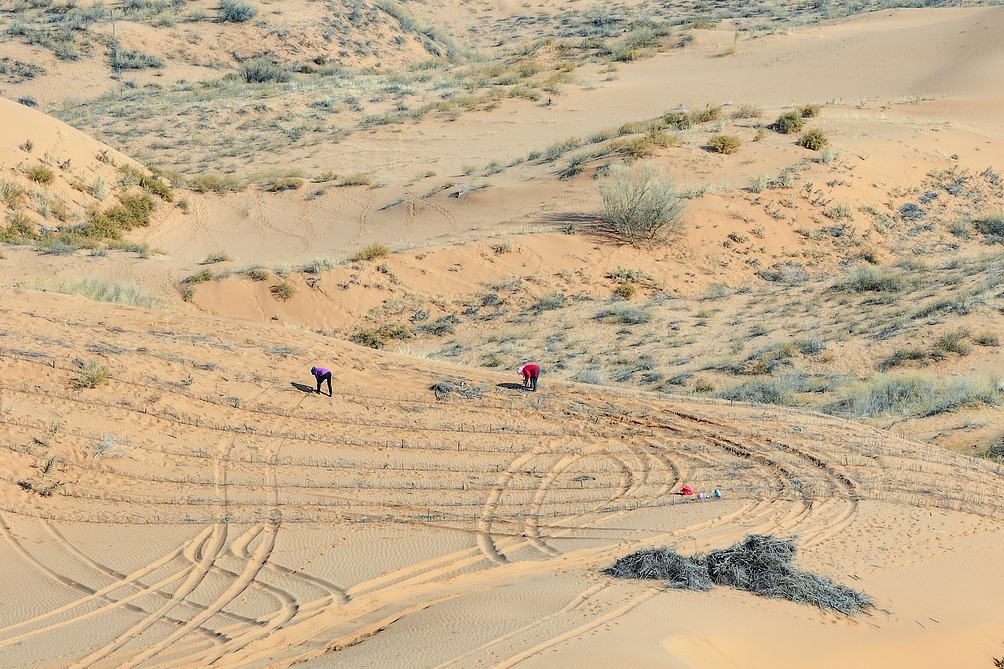
On the arid frontiers of Inner Mongolia, a technological revolution is transforming China’s centuries-old battle against encroaching deserts. Veteran farmer Zhang Zhanjiang, among over 100 new recruits in Ordos City’s afforestation campaign, now operates planting machines guided by real-time remote sensing data instead of traditional shovels. Overhead, drone squadrons conduct aerial monitoring and supply transportation, representing a seismic shift from manual labor to precision ecological engineering.
This operation forms the frontline of China’s intensified 2026 desertification offensive, coinciding with the nation’s 48th National Tree Planting Day. The National Greening Commission reports forest and grass coverage has surpassed 56% nationwide, achieved through coordinated human mobilization and technological innovation.
The Three-North Shelterbelt Forest Program, launched in 1978 as the planet’s largest afforestation endeavor, continues its scheduled 2050 completion timeline. Inner Mongolia, having accomplished 8.2 million hectares of ecological construction during the 14th Five-Year Plan period, plans three major campaigns targeting 40 million mu (approximately 2.7 million hectares) this year.
In Alshaa League, sophisticated equipment generates dramatic results: drone-dispersed seeds and large-scale desert control machinery have elevated vegetation coverage from under 5% to over 40% in targeted zones. Annual sediment inflow into rivers simultaneously plummeted from 500,000 tons to 300,000 tons between 2016 and 2025.
Meanwhile, in Ningxia’s Yanchi county, strategic planting timing based on soil moisture metrics maximizes sapling survival rates. The transformed landscape tells a compelling story—where 54 annual sandstorm days once plagued residents, now fewer than 10 occur. Over 2 million mu of reclaimed sandy terrain and 1.5 million mu of restored grassland have yielded unexpected economic dividends: caragana shrub pellet feeds now sustain 210,000 sheep annually, generating ¥110 million ($16 million) in output value, while eco-tourism emerges as a new growth catalyst.
As Deputy Director Guan Yuanbo emphasizes, Yanchi’s strategic position at the Yellow River’s turning point necessitates persistent greening efforts: ‘Only through tree-planting can we effectively safeguard our mother river.’