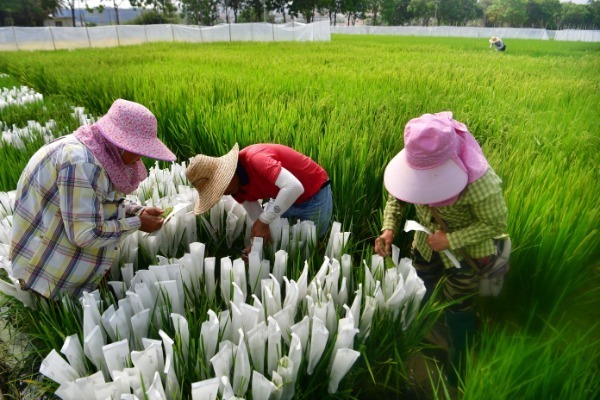
At the Yazhouwan experimental fields in Sanya, Hainan province, artificial intelligence is fundamentally transforming agricultural practices that have remained largely unchanged for centuries. The traditional art of crop breeding, which typically required a decade of meticulous work guided by human intuition, is being reimagined as a data-driven precision science.
The catalyst for this agricultural revolution is the ‘Future Agriculture Nexus’ (Fan), an innovative AI platform developed through a collaboration between the Yazhouwan National Laboratory and technology giant Huawei. Launched in November 2025, this sophisticated system functions as a centralized neural network for agricultural data, specifically designed to overcome the critical challenge of fragmented information in seed development.
Chen Fan, deputy director of the Yazhouwan National Laboratory and National People’s Congress deputy, emphasized the laboratory’s strategic mission: ‘As China’s sole national-level agricultural laboratory, our objective is to develop major strategic crop varieties that address real-world demands.’
The platform represents a paradigm shift from experience-dependent traditional breeding to data-powered precision agriculture. By aggregating and standardizing disparate datasets on genotype, phenotype, and environmental factors—previously isolated in what experts term ‘data silos’—Fan creates a unified analytical framework. Leveraging Huawei’s advanced AI data lake technology, the platform automates complex analytical workflows and screens information with unprecedented efficiency.
The operational benefits are substantial. According to Yuan Yuan, president of Huawei’s data storage product line, the system can compress the breeding cycle for crops like rice from the conventional 8-10 years to just 3-4 years—achieving a 50% reduction in time requirements and a 30% improvement in overall efficiency.
‘We are deploying AI to enhance productivity across the entire breeding pipeline,’ Chen explained. ‘The Fan initiative establishes a foundational platform enabling the development of specialized vertical models and AI agents tailored to specific agricultural challenges.’
This technological advancement aligns with China’s strategic emphasis on seed security, often described as the ‘semiconductor equivalent’ in global agriculture. The laboratory is constructing China’s most comprehensive biological breeding innovation platform, featuring unprecedented scale, scope, and infrastructure integration.
Concurrently, the laboratory is expanding its international footprint through strategic partnerships with Global South nations. The China-LAC Sustainable Food Innovation Center, established with Yazhouwan’s support, inaugurated key branches in Brazil, Argentina, and Uruguay in August 2025. The Brazil division serves as a pivotal collaboration hub, leveraging geographical symmetries between Hainan’s position at 18 degrees north latitude and Brazil’s location at 18 degrees south—creating nearly identical sunshine and temperature conditions ideal for joint crop research.
This geographical advantage enables the cooperative development of soybean varieties in Sanya that demonstrate direct applicability to Brazilian farm conditions. Additionally, the favorable policies of the Hainan Free Trade Port may facilitate future imports of these collaboratively developed soybeans into China.