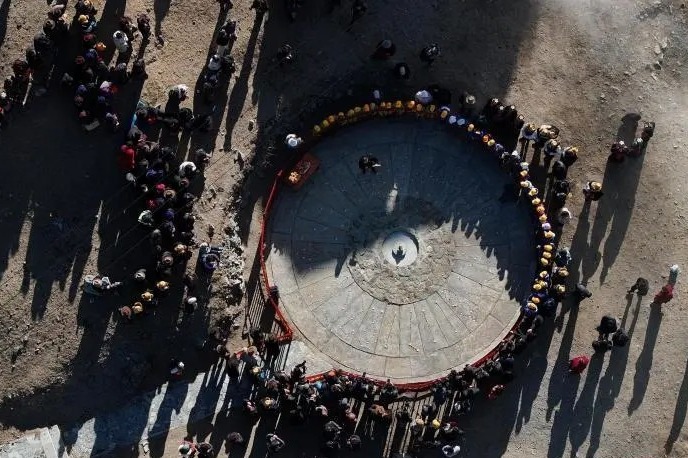
In the highlands of Tibet, an ancient astronomical tradition marking the agricultural new year resumed with ceremonial grandeur at the historic Dakpo Observatory in Maldrogungkar county. On Thursday, corresponding to the 21st day of the first Tibetan month, local farmers and herders gathered at this centuries-old site to witness the precise celestial alignment that traditionally inaugurates the spring sowing season.
Dressed in vibrant traditional attire, participants brought ritual offerings including butter tea and chemar—a ceremonial vessel filled with grains symbolizing prosperity and abundance. The pivotal moment occurred as the first beam of sunlight penetrated through a specially designed aperture in the observatory structure, striking a calibrated measuring stone with exact precision. This photometric event, meticulously calculated through ancestral astronomical knowledge, serves as Tibet’s official natural signal for initiating spring planting and irrigation activities across the region’s central agricultural zones.
Dorje, assistant researcher at the Xizang Institute of Astronomy and Calendrical Calculation and secretary-general of the Xizang Astronomy and Calendar Society, emphasized the site’s unique cultural significance. “The Dakpo platform represents the only operational astronomy observatory of its kind in the region, maintaining an uninterrupted 300-year legacy,” he stated. “It functions as a comprehensive system integrating celestial observation, mathematical calculation, and temporal guidance—a cornerstone of Tibet’s distinctive astronomical traditions.”
Beyond its agricultural scheduling function, the observatory’s sophisticated methodology enables calculation of solar terms, seasonal pattern monitoring, and even weather prediction capabilities. The ritual celebration incorporated educational components including scientific lectures, cultural performances, and community services such as free medical consultations, blending ancient wisdom with contemporary community engagement. This enduring practice demonstrates the sophisticated integration of astronomical science with agricultural practicality, preserving a living cultural heritage that continues to guide Tibet’s farming communities in harmonious synchronization with natural cycles.