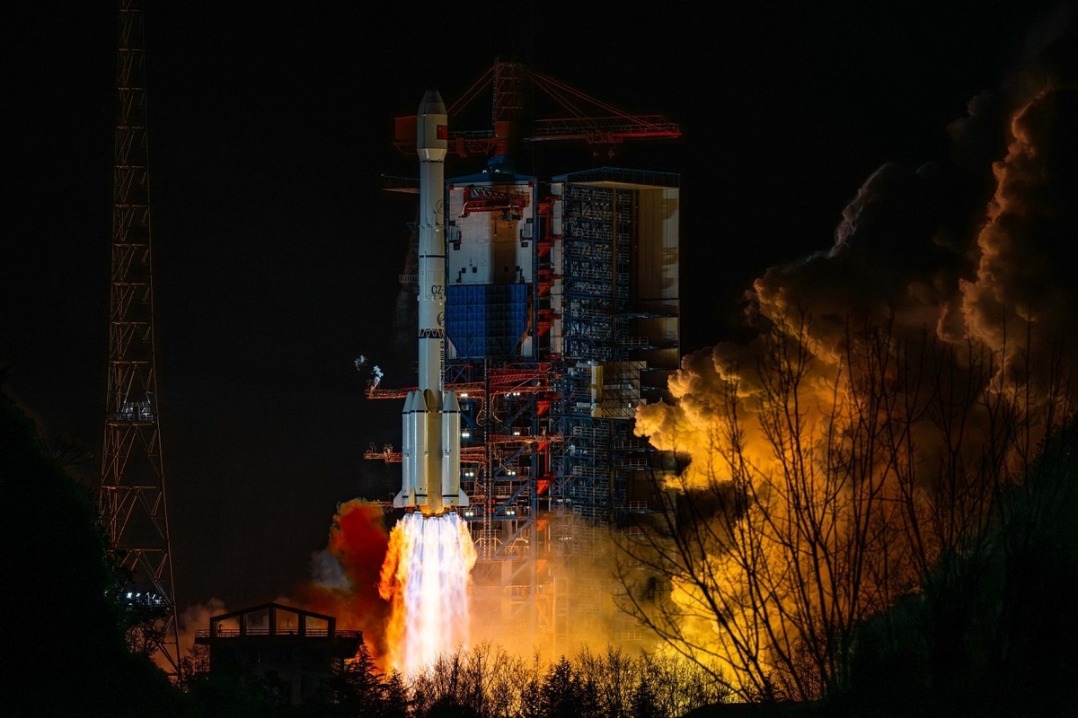
China is making significant strides in reusable rocket technology with two distinct recovery systems currently under development by the nation’s premier space contractor. China Aerospace Science and Technology Corporation (CASC) is advancing parallel programs featuring fundamentally different retrieval methodologies for rocket boosters, according to senior rocket scientist Jiang Jie.
The technical approaches represent divergent paths to achieving reusable launch capabilities. One configuration employs ground-based vertical landing technology where the first-stage booster returns to a designated terrestrial landing site using its engines and deploys landing legs for stabilization. The contrasting system utilizes maritime net-assisted recovery, wherein a specialized vessel captures the descending booster mid-air using an engineered net system.
Jiang Jie, a prominent researcher at the China Academy of Launch Vehicle Technology (CALT) and academician of the Chinese Academy of Sciences, emphasized that reusable launch vehicles constitute the exclusive pathway toward achieving cost-effective, high-frequency access to space with heavy payload capacity. She made these statements during the ongoing National People’s Congress session in Beijing.
The technological development follows China’s recent milestone achievement in February 2026, when a prototype Long March 10 rocket successfully completed its inaugural launch-and-recovery test. The vehicle’s first-stage booster ascended to space before executing a controlled return trajectory using engine burns and aerodynamic grid fins, ultimately achieving a precise splashdown in the South China Sea. This accomplishment positioned China as only the second nation after the United States to demonstrate operational reusable rocket technology.
CASC is intensifying efforts to overcome critical technological barriers and achieve full operational capability for reusable boosters. The state-owned enterprise plans to conduct the first net-recovery test for the Long March 10 booster in coming months. Beyond governmental programs, private aerospace firms including Land-Space and Space Pioneer are concurrently developing competing reusable systems, anticipating substantial contracts from state satellite operators planning extensive orbital constellations.