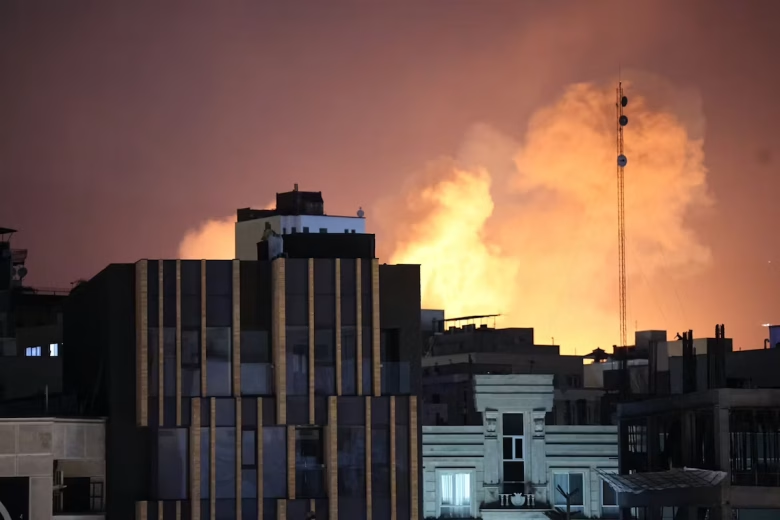
The recent escalation of military operations between US-Israeli forces and Iran has created unexpected economic beneficiaries amidst widespread geopolitical turmoil. While the immediate human and economic costs continue to mount, a paradoxical financial ecosystem thrives on the perpetuation of conflict.
Defense contractors have emerged as primary beneficiaries, with Lockheed Martin, Northrop Grumman, and RTX collectively gaining $25-30 billion in shareholder value within a single trading session. Israeli defense firm Elbit Systems witnessed a remarkable 45% surge in its stock value since January, briefly becoming the nation’s most valuable publicly traded company. European defense equities similarly outperformed declining broader markets.
The conflict has produced significant political dividends for incumbent administrations. The initiation of military action effectively diverted public attention from ongoing controversies, including the Epstein files scandal that had previously dominated media cycles and web searches.
Paradoxically, Iran’s Islamic Revolutionary Guard Corps (IRGC) has strengthened its economic position despite international sanctions. Controlling approximately half of Iran’s oil exports through its engineering subsidiary Khatam al-Anbiya, the IRGC has expanded its dominance across construction, telecommunications, agriculture, and energy sectors. Meanwhile, World Bank data indicates nearly 10 million ordinary Iranians descended into poverty between 2011-2020 due to economic restrictions.
Energy markets have experienced immediate disruption, with Hormuz Strait tanker traffic declining by approximately 90% and Qatar suspending liquefied natural gas production indefinitely. This has created unexpected windfalls for US energy exporters and Gulf states with bypass pipeline infrastructure. Russia benefits from diverted energy purchases by price-sensitive markets like India and China.
The conflict presents a complex challenge for green energy transition, as elevated fossil fuel prices simultaneously bolster renewable energy arguments while making traditional extraction more profitable. This economic tension potentially slows the pace of sustainable energy adoption.
Potential solutions include implementing windfall taxes on corporations benefiting disproportionately from warfare, following the UK’s energy profits levy model. Coordinated releases of strategic petroleum reserves could mitigate price spikes, while strengthened democratic institutions could reduce political exploitation of conflict situations.
The United Kingdom faces particular economic vulnerability, with pre-conflict GDP growth projections already downgraded to 1.1% for 2026. Household energy bills may increase by over £500 annually despite limited direct gas imports from the region, while fiscal headroom of £23.6 billion faces rapid erosion.
This analysis reveals the fundamental paradox of modern conflict: those with greatest capacity to resolve hostilities often possess significant financial incentives for their continuation.