Financial markets worldwide exhibited fragmented performance on Wednesday as the recent rally lost momentum and crude prices resumed their upward trajectory amidst escalating Middle East tensions. The persistent military conflict involving Iran continues to generate substantial uncertainty across global exchanges, with energy markets experiencing particularly pronounced fluctuations.
Benchmark oil prices demonstrated significant volatility, with Brent crude advancing 2.6% to $90.11 per barrel while U.S. benchmark crude climbed 3.2% to $86.08. These movements occurred despite prices remaining substantially below Monday’s peak near $120, which had represented the highest level since 2022.
European markets registered broad declines, with Germany’s DAX index retreating 1.6% to 23,600.11 and France’s CAC 40 dropping 1% to 7,980.45. Britain’s FTSE 100 similarly declined by 1% to 10,307.63.
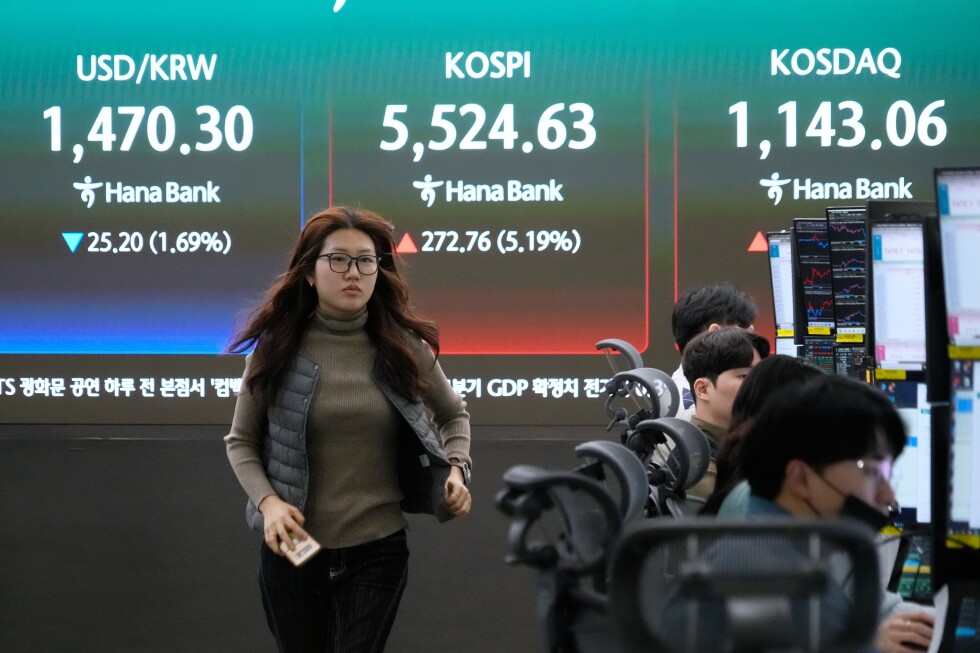
Asian markets presented a more varied landscape. Japan’s Nikkei 225 advanced 1.4% to 55,025.37, while South Korea’s Kospi gained 1.4% to 5,609.95 after earlier surging more than 3%. China’s Shanghai Composite rose 0.3% to 4,133.43, contrasting with Hong Kong’s Hang Seng index which dipped 0.2% to 25,898.76. Australia’s S&P/ASX 200 increased 0.6% to 8,743.50, with Taiwan’s benchmark surging 4.1% while India’s Sensex declined 1.5%.
The geopolitical situation intensified as the United States reported neutralizing more than a dozen Iranian minelaying vessels, prompting Tehran’s vow to block regional oil exports completely. This development threatens the critical Strait of Hormuz, through which approximately 20% of global oil shipments typically transit.
Oracle Corporation emerged as a notable outperformer, with shares surging 12% in premarket trading following better-than-expected quarterly results that showed both earnings and revenue increasing by 20%.
Market analysts note that historical patterns show equities typically recover relatively quickly from military conflicts, provided oil prices don’t remain elevated for extended periods. The current environment of extreme price swings reflects deep uncertainty about whether this pattern will hold, raising concerns about potential stagflation scenarios where economic growth stagnates amid persistently high inflation.