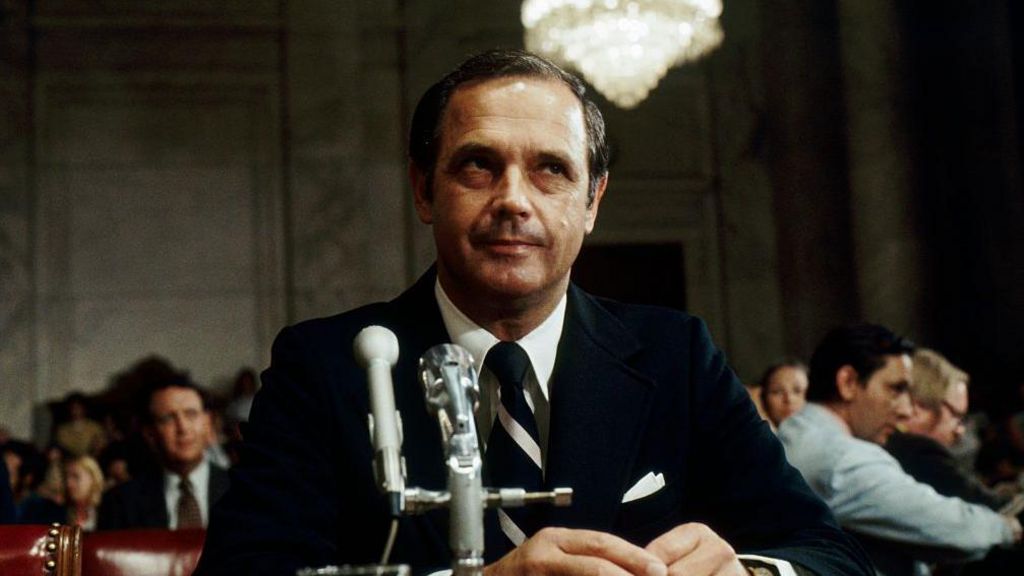
Alexander Butterfield, the pivotal White House official whose congressional testimony unveiled the secret recording system that ultimately ended Richard Nixon’s presidency, passed away at age 99 on Monday. His wife Kim confirmed his death to U.S. media outlets.
Butterfield, who served as White House deputy chief of staff and later headed the Federal Aviation Administration, delivered one of the most consequential disclosures in American political history during Senate hearings in July 1973. When questioned by Republican Senator Fred Thompson about listening devices in the Oval Office, Butterfield revealed that President Nixon had maintained a comprehensive audio recording system that documented all presidential conversations.
This testimony proved catastrophic for the Nixon administration, providing investigators with irrefutable evidence of the president’s involvement in the Watergate cover-up. The scandal originated from the 1972 break-in at the Democratic National Committee headquarters, where five operatives with White House connections attempted to install surveillance equipment.
Butterfield, an Air Force veteran entrusted with White House security, had personally supervised the installation of the recording system under Nixon’s directives. His admission that “everything was taped… as long as the president was in attendance” triggered a constitutional crisis and year-long legal battle that culminated in the Supreme Court ordering Nixon to surrender the tapes.
The audio evidence proved so damaging that Nixon resigned in August 1974—the only U.S. president to do so—facing certain impeachment by the House of Representatives. Thousands of hours of recordings eventually became public through the National Archives.
In later reflections, Butterfield told the Associated Press he recognized the tapes contained “dynamite” but hadn’t anticipated Nixon’s resignation, noting “it had never happened before.” John Dean, another former Nixon aide, praised Butterfield for upholding his “heavy responsibility of revealing something he was sworn to secrecy on… He stood up and told the truth.”
After resigning from the FAA in 1975, Butterfield transitioned to California’s private business sector, leaving behind a legacy that permanently altered the relationship between the American presidency and governmental transparency.