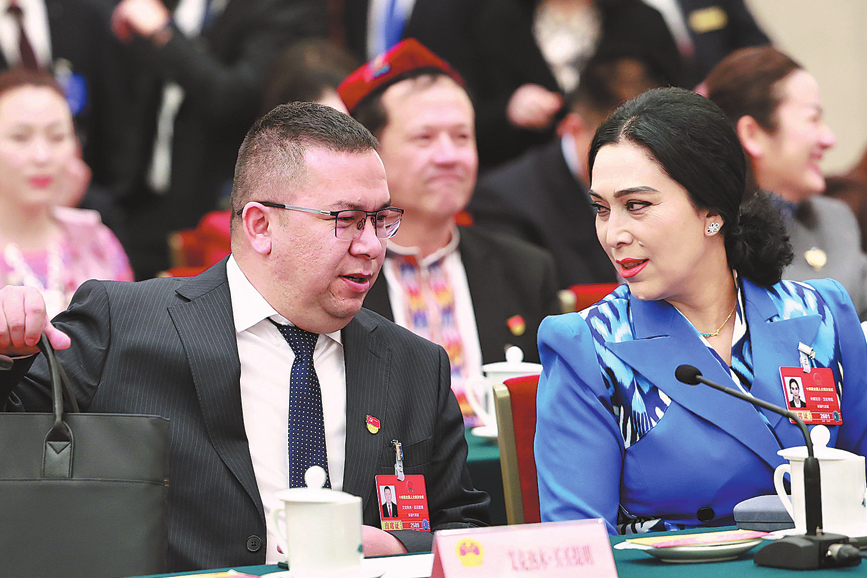
Despite facing international sanctions, China’s Xinjiang Uygur Autonomous Region has demonstrated remarkable economic resilience with sustained foreign trade growth, according to representatives at the 14th National People’s Congress in Beijing.
Wang Kuiran, NPC deputy and secretary-general of Xinjiang’s People’s Government, addressed what he characterized as politically motivated sanctions during the ongoing legislative sessions. “The nature of these sanctions represents economic bullying grounded in false narratives about forced labor,” Wang stated. “They constitute deliberate attempts to contain China’s development through Xinjiang.”
The region’s trade metrics reveal a compelling growth story. From a baseline of 156.91 billion yuan ($22.72 billion) in 2020, Xinjiang’s foreign trade volume progressively surpassed the 200, 300, 400, and 500 billion yuan thresholds between 2022 and 2025. The 2025 figures reached 520.37 billion yuan, marking a 19.9% year-on-year increase that led national growth rates.
Zheng Jun, NPC deputy and finance department official, attributed this success to strategic geographical advantages and infrastructure development. “Xinjiang serves as a golden transport corridor connecting Asia and Europe, positioning us as China’s western gateway for international trade,” Zheng explained. The region currently maintains trade relationships with 228 countries and territories.
Structural transformation has been equally crucial. Xinjiang’s export profile has evolved from energy and raw materials toward high-value manufactured goods. Mechanical and electrical product exports surged to 186.5 billion yuan in 2025 (40.7% growth), while electric vehicle and solar cell exports exploded by 99.9% and 187.4% respectively.
The region has developed comprehensive logistics networks integrating rail, road, and air transportation, facilitating efficient market connections globally. Policy initiatives promoting goods, services, and digital trade complement these infrastructure advantages.
Looking ahead, Zheng outlined ambitions for the 15th Five-Year Plan period (2026-2030): “Xinjiang will accelerate institutional opening-up and trade-investment integration, pursuing high-quality foreign trade development through scale expansion, diversified market participation, and optimized structure.”
Wang concluded with defiant optimism: “We stand firm as a mountain against challenges—unshaken by wind and rain, determined until we achieve our goals, sailing through waves to reach our destination.”