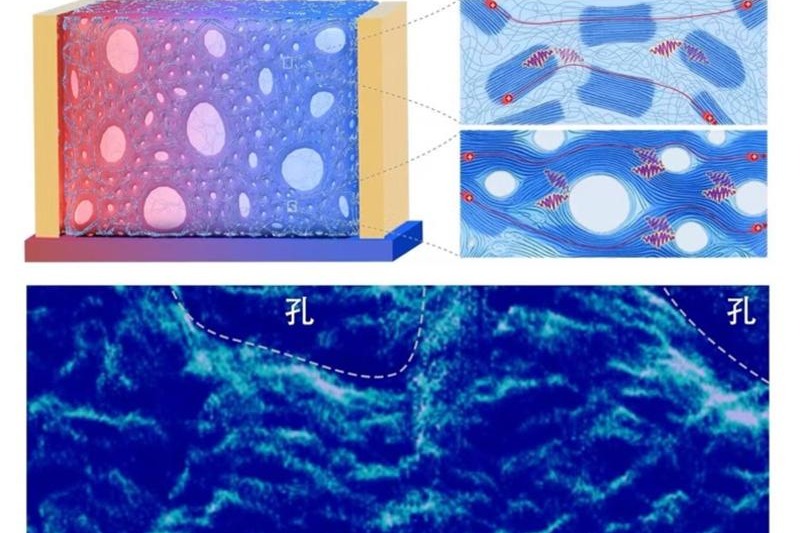
A groundbreaking advancement in energy technology has emerged from China, where scientists have developed a revolutionary flexible polymer material capable of generating electricity from waste heat. Published in the prestigious journal Science, this innovation represents a significant leap forward in thermoelectric material performance.
The research team from the Chinese Academy of Sciences’ Institute of Chemistry, led by Professors Zhu Daoben and Di Chong’an, has created what they term an Irregular Hierarchical-Porous Thermoelectric Polymer (IHP-TEP). This novel material achieves an unprecedented thermoelectric figure of merit (ZT value) of 1.64 at 343 Kelvin (approximately 70°C), establishing a new performance standard for flexible thermoelectric materials in this temperature range.
Thermoelectric technology enables direct conversion between thermal and electrical energy, offering both power generation and cooling capabilities without fuel consumption or pollution. With global energy systems losing over 60% of generated energy as waste heat, this technology holds immense potential for energy conservation and emission reduction efforts worldwide.
The IHP-TEP’s unique architecture represents a engineering marvel, featuring an irregular porous structure that effectively suppresses heat conduction while maintaining exceptional electrical conductivity. This creates charge-transport channels that approach the theoretical ideal for thermoelectric materials. The material’s compatibility with spray-coating technology enables large-scale, cost-effective manufacturing processes comparable to newspaper printing.
This flexibility allows the material to conform to various curved surfaces, opening vast application possibilities in wearable technology, adhesive refrigeration systems, and Internet of Things sensors. The technology promises to revolutionize power supply solutions for distributed sensors, enabling continuous operation wherever temperature differentials exist – whether on human skin, building exteriors, or in field environments.
The development addresses critical limitations of existing thermoelectric materials, where flexible inorganic variants typically achieve ZT values around 1.4 and organic materials reach approximately 1.2, both hampered by complex manufacturing processes. This breakthrough effectively eliminates previous performance bottlenecks while simplifying production methods.