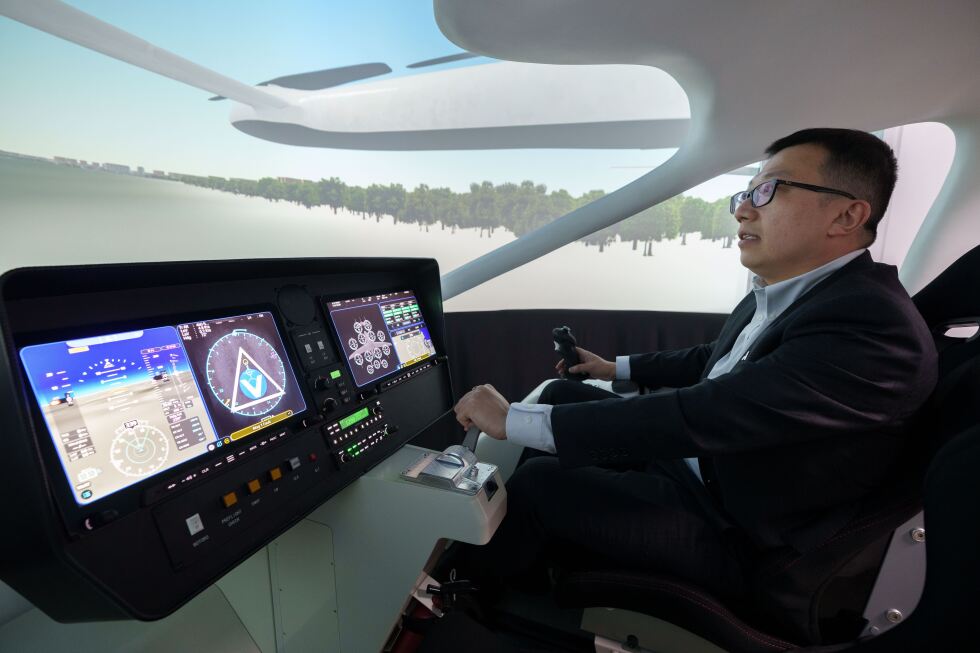
KUNSHAN, China — A groundbreaking demonstration in southeastern China offered a compelling vision of urban air mobility’s future. At a low-altitude flight test facility in Kunshan, approximately 60 kilometers west of Shanghai, Chinese aviation company AutoFlight showcased its massive Matrix aircraft—a 5-ton electric vertical takeoff and landing (eVTOL) vehicle recognized as China’s largest electric aircraft to date.
The Matrix prototype, developed since AutoFlight’s 2017 founding, represents a significant engineering achievement with its substantial dimensions: a 20-meter wingspan, 17.1-meter length, and 3.3-meter height. The electric aircraft boasts capacity for up to 10 passengers and can operate for one hour on a single charge.
During a recent demonstration observed by The Associated Press, the colossal eVTOL executed a flawless performance. After meticulous pre-flight checks, the aircraft ascended smoothly from a helipad, generating noticeably less noise than conventional helicopters. The Matrix completed two circuits around the test facility before executing a perfect landing after approximately 10 minutes of flight.
Despite the successful demonstration, significant regulatory challenges remain before such aircraft can transform into operational air taxis. AutoFlight Senior Vice President Steven Yang acknowledged the uncertainty surrounding commercialization timelines, noting the company anticipates securing crucial type certification from regulators by 2027—confirming the aircraft’s compliance with safety standards. Additional operator certifications would subsequently be required before passenger transport can commence.
The Chinese eVTOL landscape continues evolving, with Guangdong-based EHANG having already received certification for commercial passenger services, though operational implementation remains pending. Industry experts emphasize that beyond aircraft certification, developing supporting infrastructure represents a critical hurdle. The emerging ‘low-altitude economy’ already demonstrates practical applications through drone-based food delivery services in cities like Shenzhen.
Gary Ng, senior economist at Natixis Corporate and Investment Banking, highlighted various challenges including safety assurance, infrastructure development, and logistical coordination. ‘The entire ecosystem surrounding this technology remains underdeveloped currently,’ Ng observed, projecting that at least three additional years will be necessary before viable commercial operations emerge.
While the Matrix demonstration makes electric air transportation appear increasingly feasible, Yang emphasized that realizing this future requires collective effort: ‘We truly believe it will happen, but this is not AutoFlight’s job alone—it’s about developing the entire ecosystem.’