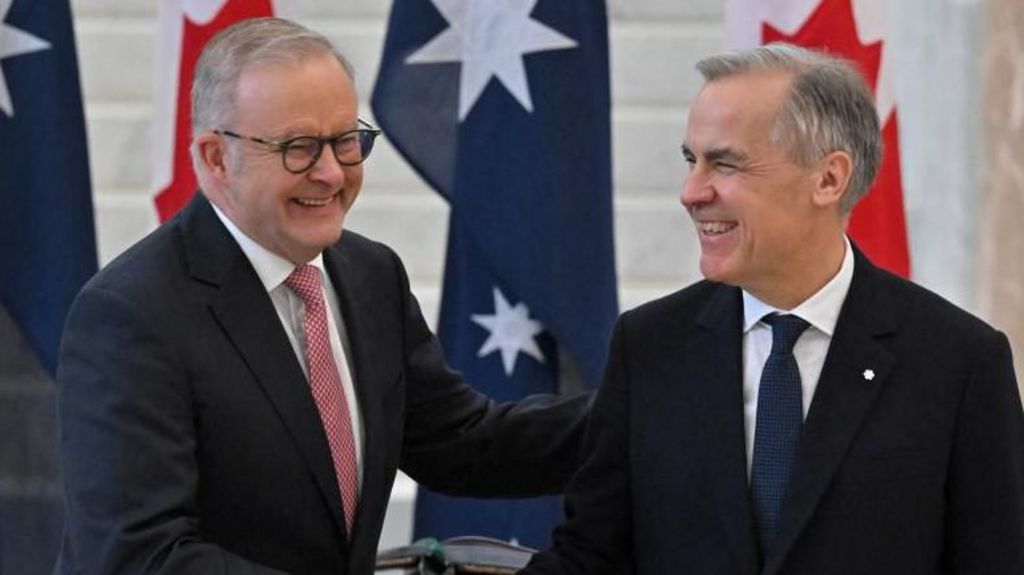
In a historic address to Australia’s Parliament in Canberra—the first by a Canadian leader in nearly two decades—Prime Minister Mark Carney emphasized the urgent need for middle powers to collaborate as “strategic cousins” in response to the collapse of the post-war global order. Speaking before lawmakers, Carney warned that consecutive international crises have eroded existing frameworks, creating a vacuum where either middle nations collectively shape new rules or risk having outcomes dictated by hegemons.
The two leaders, Carney and Australian Prime Minister Anthony Albanese, announced a series of agreements aimed at deepening cooperation in defense, artificial intelligence, and critical minerals. Australia formally joined the G7 Critical Minerals Alliance, which Carney hailed as the world’s largest coalition of trusted democratic mineral reserves. Together, the two nations supply one-third of global uranium and lithium and over 40% of iron ore.
Albanese underscored the shared values and convictions binding the countries, stating, “Australia and Canada must seek and create new ways to stand with—and for—each other.”
On Middle Eastern tensions, both leaders expressed support for recent strikes on Iran while calling for regional de-escalation. They insisted, however, that any ceasefire must be contingent on Iran no longer possessing nuclear weapon capabilities. Albanese cited Iran’s influence as a factor in antisemitic attacks in Australia last year.
Carney’s visit follows a four-day diplomatic trip to India, where he signed multibillion-dollar agreements, marking a thaw in relations previously strained by allegations linking India to an assassination on Canadian soil. The tour will conclude with meetings in Japan with Prime Minister Sanae Takaichi.