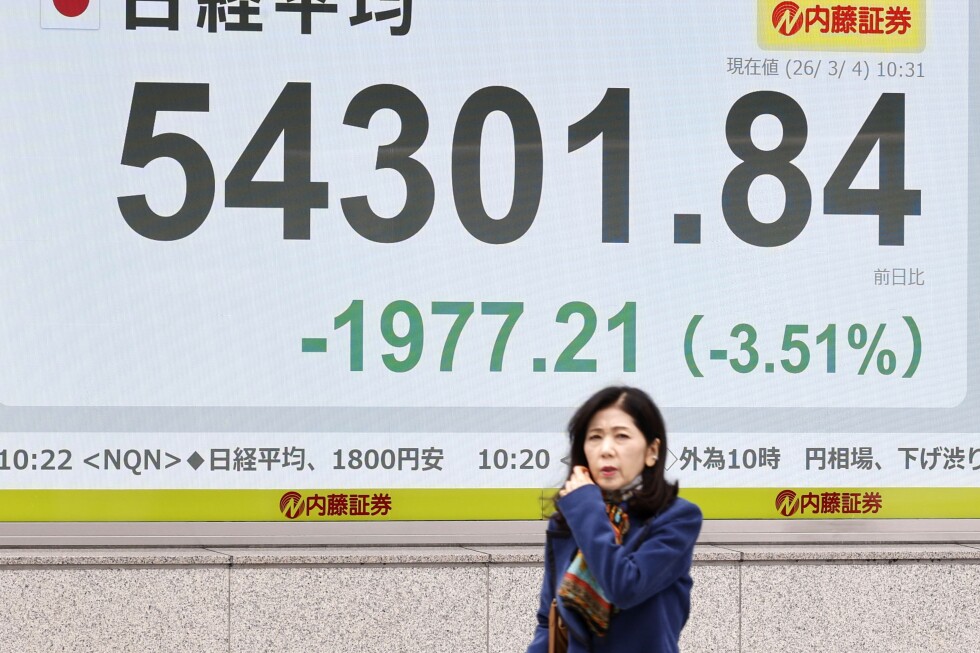
Financial markets across Asia experienced severe declines on Wednesday as escalating geopolitical tensions with Iran triggered a massive global sell-off. The crisis hammered stock indices while sending oil prices sharply higher, creating a perfect storm of economic uncertainty.
South Korea’s Kospi index led the regional downturn, plummeting 8.1% to 5,321.38 – a drop so severe it triggered automatic trading suspensions. This dramatic collapse came despite ongoing optimism about artificial intelligence boosting tech giants like Samsung Electronics and SK Hynix, demonstrating how energy security concerns are overwhelming sector-specific positive developments.
Japan’s Nikkei 225 fell 3.4% to 54,346.73, with both Japan and South Korea facing particular vulnerability due to their heavy reliance on Middle Eastern oil and natural gas imports currently threatened in the Persian Gulf region.
The sell-off extended throughout Asian markets: Hong Kong’s Hang Seng declined 1.4% to 25,408.27, China’s Shanghai Composite dropped 0.5% to 4,100.46, Australia’s S&P/ASX 200 fell 1.8% to 9,130.90, and Taiwan’s Taiex lost 2.9%.
This Asian market turmoil followed Tuesday’s substantial losses on Wall Street, where the S&P 500 finished 0.9% lower after experiencing an intraday plunge of 2.5%. The Dow Jones Industrial Average pared losses to 0.8%, while the Nasdaq composite declined 1%.
The core concern driving market behavior centers on how sustained oil price increases might exacerbate global inflation. Benchmark U.S. crude oil climbed 1.2% to $75.46 per barrel, while Brent crude, the international standard, gained 1.5% to $82.61 per barrel.
These developments have created a complex dilemma for the Federal Reserve, as persistent inflationary pressures could restrict the central bank’s ability to implement planned interest rate cuts in 2026. Such cuts would typically stimulate economic growth and job markets but risk worsening inflation if implemented amid energy-driven price surges.
Currency markets showed relative stability amid the equity turmoil, with the dollar holding nearly unchanged at 157.55 Japanese yen and the euro experiencing a modest decline to $1.1599.