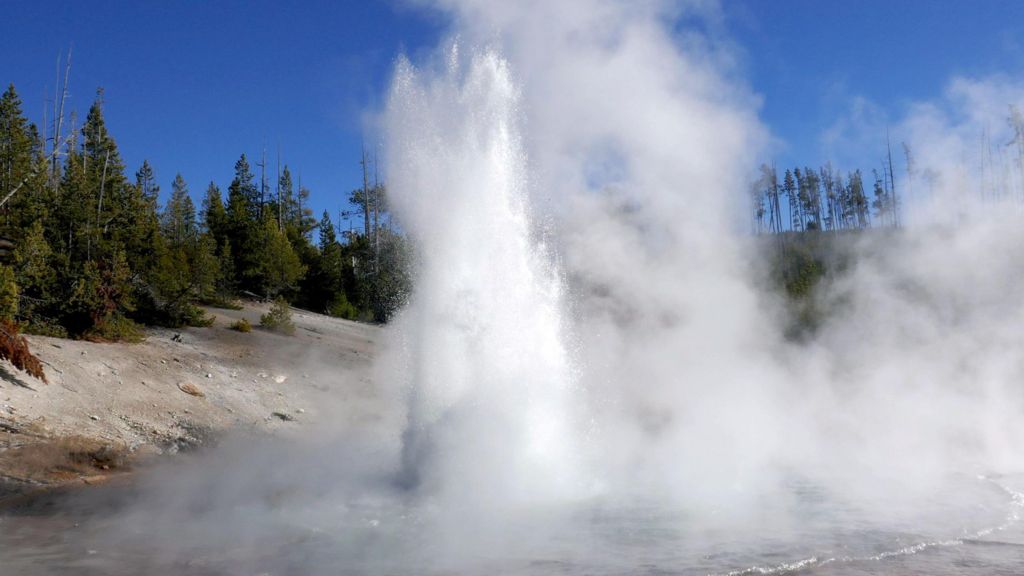
Yellowstone National Park’s renowned Echinus Geyser has spectacularly resumed activity after an unprecedented six-year hiatus, marking its first eruption since 2020. Located within the park’s Norris Geyser Basin, this geological marvel represents the world’s largest acidic geyser, though scientists remain uncertain whether the current activity will persist through the summer tourist season.
According to the U.S. Geological Survey, geysers naturally cycle through active and dormant phases. “Geysers are always turning on and off. That’s Yellowstone being Yellowstone!” the agency noted in a social media update.
The geological mechanism behind geyser formation involves a tube-like structure extending deep into the Earth’s crust, filled with water that becomes superheated near magma sources. This pressurized water eventually erupts violently through the surface opening, then gradually drains back to restart the cycle.
Echinus Geyser historically displayed remarkable regularity, with 1970s eruptions occurring every 40-80 minutes and sometimes lasting 90 minutes while projecting water 75 feet (23 meters) skyward. The eruptions—which could spray vertically or at angles—often drenched spectators with warm mineral water.
However, the geyser’s pattern became increasingly irregular in recent years, with only one eruption recorded in 2018, one in 2019, and two in 2020. The current activity period began on February 7th, with eruptions now matching 2017 frequency levels, though with shorter durations of up to three minutes and reduced height of approximately 30 feet.
The geyser derives its name from surrounding rocks resembling sea urchins (echinoderms). Its unique acidic composition—compared by scientists to orange juice or vinegar—results from mixing acidic gases with neutral waters. This mild acidity prevents the corrosive damage typical of acid geysers, which usually degrade their own rock conduits over time.
Researchers caution that the geyser may already be returning to dormancy following no recorded activity in late February, consistent with its pattern of brief active periods lasting one to two months.