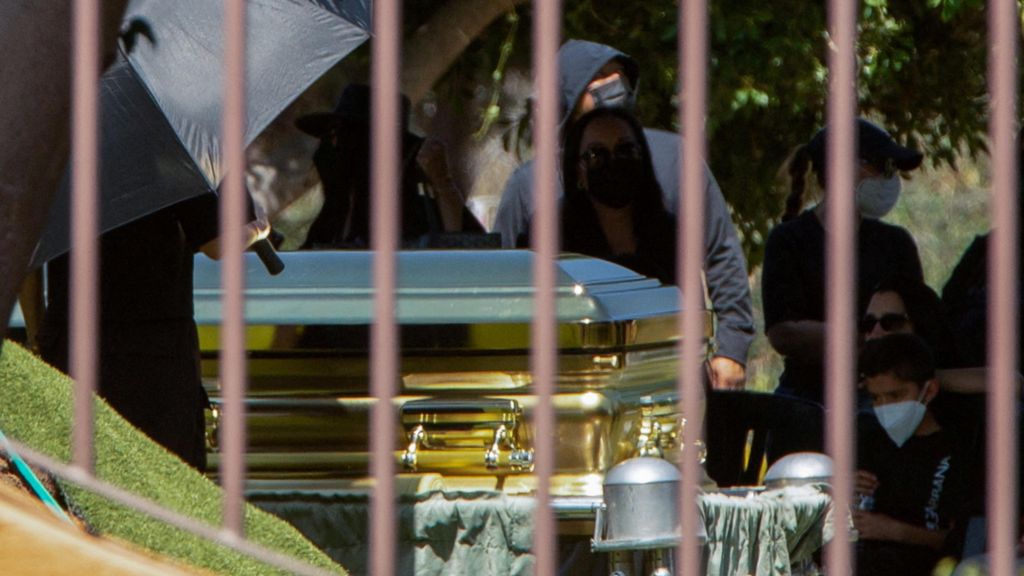
In a lavish ceremony underscoring the persistent influence of organized crime, the notorious Jalisco New Generation Cartel (CJNG) founder Nemesio Oseguera Cervantes, alias “El Mencho,” was laid to rest in a golden casket on Monday. The 59-year-old drug lord, Mexico’s most-wanted criminal with a $15 million U.S. bounty on his head, died following a late February firefight between his armed guards and Mexican special forces operatives attempting his capture.
The funeral proceedings near Guadalajara in CJNG’s home state of Jalisco unfolded under heavy National Guard surveillance, reflecting authorities’ concerns about retaliatory violence. Despite security measures, the event displayed extravagant narco-culture symbolism, including monumental floral arrangements requiring multiple transport vehicles. Among these was a prominent rooster-shaped tribute nodding to Oseguera’s passion for cockfighting.
Local media reported the funeral procession featured narcocorridos—ballads glorifying drug traffickers—and traditional ranchero music, with the song “El Muchacho Alegre” (The Cheerful Boy) accompanying the golden casket’s arrival at the cemetery chapel. Many attendees concealed their identities with face masks during the hour-long ceremony, highlighting the pervasive climate of fear and anonymity surrounding cartel activities.
While the burial plot was noted as relatively modest compared to the grandiose mausoleums of other narcos, the spectacle contrasted sharply with the violence that followed Oseguera’s death. Cartel members previously unleashed coordinated attacks across 20 Mexican states, torching vehicles and blockading roads in retaliatory strikes.
El Mencho’s death represents both a tactical victory for President Claudia Sheinbaum’s administration—which faces mounting pressure from the U.S. to combat drug trafficking—and a potential catalyst for escalated violence. Security analysts warn that power struggles within the tens-of-thousands-strong CJNG could trigger intensified factional conflicts, creating new security challenges for Mexican authorities.