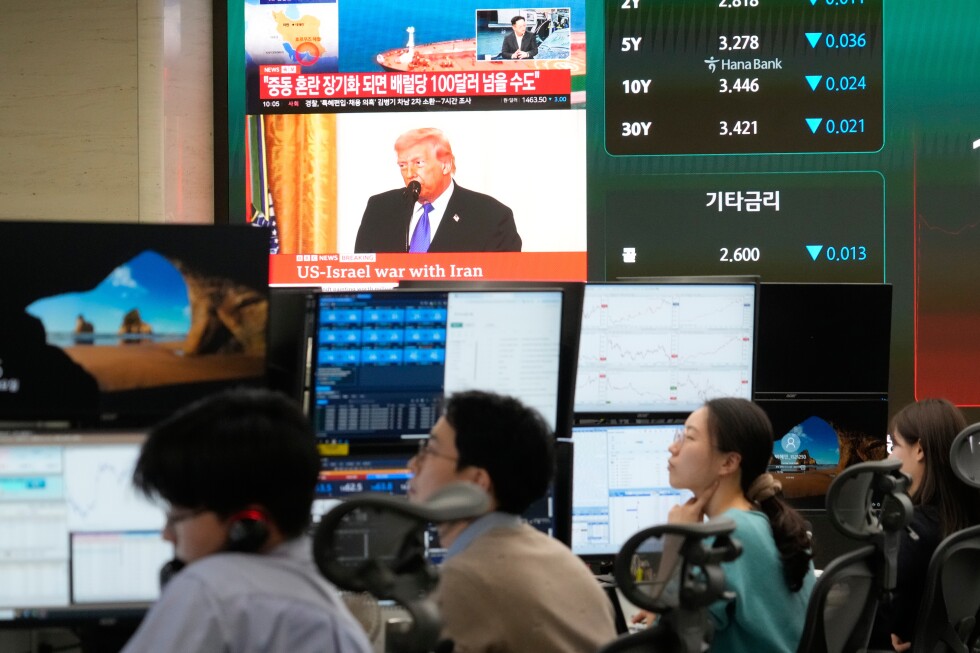
Financial markets across Asia experienced significant declines Tuesday as escalating military conflict in Iran triggered widespread concerns about regional energy security and potential supply disruptions. The turmoil sent shockwaves through trading floors, with major indices posting substantial losses amid heightened investor anxiety.
South Korea’s benchmark index plummeted 4.8% to 5,946.06 as trading resumed following a holiday closure, while Japan’s Nikkei 225 dropped 2.1% to 56,853.48. Australian markets followed the downward trend with the S&P/ASX 200 declining 1.2% to 9,089.50. Hong Kong and Shanghai indices recorded more modest decreases of 0.1% and 0.3% respectively.
The energy sector emerged as a primary focal point, with crude prices continuing their upward trajectory. Benchmark U.S. crude advanced by 77 cents to reach $72.00 per barrel, while Brent crude, the international standard, gained $1.10 to trade at $78.84. These increases built upon Monday’s substantial price jumps, reflecting persistent worries that prolonged conflict could obstruct vital crude shipping routes through the Strait of Hormuz.
Japanese energy companies suffered particularly severe losses, with Eneos Corp. plunging nearly 6% and Idemitsu Kosan dropping approximately 4%. The sell-off extended to defense-related stocks despite recent gains fueled by expectations of increased military spending. Mitsubishi Heavy Industries plummeted 5%, while IHI declined 4% as investors moved to secure profits from previous sessions.
Airline stocks faced additional pressure throughout Asian trading sessions, mirroring Monday’s substantial losses on Wall Street. Japan Airlines fell 5.2%, ANA Holdings declined 2.4%, Korean Air dropped 8.9%, and Qantas Airways lost 2.9% as rising fuel costs threatened to exacerbate already significant operational expenses.
Market analysts noted that despite the pronounced volatility, reactions remained relatively measured compared to historical Middle East conflicts. According to Morgan Stanley strategists led by Michael Wilson, sustained oil prices exceeding $100 per barrel would likely be necessary to generate prolonged market impacts. Stephen Innes of SPI Asset Management observed that energy shocks typically require both severity and duration to substantially derail equity markets, citing 22 single-day oil price spikes exceeding 10% since 2000.
U.S. markets demonstrated resilience Monday, with the S&P 500 ultimately posting a marginal gain of less than 0.1% at 6,881.62 after recovering from an early 1.2% decline. The Dow Jones Industrial Average dipped slightly by 0.1%, while the Nasdaq Composite advanced 0.4%. Strength in oil producers, defense contractors, and technology shares helped offset broader market concerns, with Exxon Mobil climbing 1.1% and Nvidia rising 2.9%.
Safe-haven assets attracted increased interest, with gold prices advancing 1.2% as investors sought stability. Bond markets saw the 10-year Treasury yield rise to 4.04% from 3.97%, partially driven by better-than-expected U.S. manufacturing data. Currency markets showed minimal movement, with the U.S. dollar trading at 157.32 Japanese yen and the euro edging upward to $1.1693.