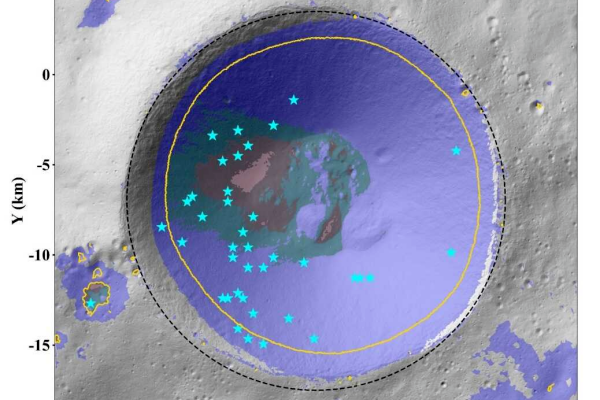
Chinese space researchers have achieved a significant technological advancement in lunar exploration by creating a sophisticated high-resolution model designed to pinpoint thermally stable water ice deposits in the moon’s southern polar region. This development emerges from the Key Laboratory of Solar Activity and Space Weather at the National Space Science Center (NSSC) under the Chinese Academy of Sciences.
The innovative lunar polar water-ice thermal stability model incorporates previously unaccounted thermal properties of lunar soil under extreme low-temperature conditions. This enables precise simulation of surface radiation patterns, soil temperature variations, and identification of regions where water ice can remain stable over geological timescales without sublimating into space.
Published in the Planetary Science Journal, the research specifically targets the Shackleton Crater area, which has been designated as a primary candidate landing zone for China’s upcoming Chang’e 7 mission scheduled for launch in 2026. The mission’s core scientific objective involves conducting unprecedented high-precision remote sensing and in-situ analysis of lunar water ice deposits.
According to the research team, this model represents a substantial improvement over previous assessment methods by providing a detailed ‘treasure map’ of potential ice preservation sites. The technology calculates illumination distribution, lunar soil temperature gradients, and stable zones for volatile compounds including water ice with remarkable accuracy.
The practical applications extend beyond mere mapping—the model will directly guide the Chang’e 7 mission’s detection strategies, helping mission planners identify optimal locations for ice sampling and analysis. This capability is crucial for the mission’s success in locating and characterizing one of the moon’s most valuable resources.
As Tang Yuhua, deputy chief designer of the Chang’e 7 mission, previously emphasized, the discovery of accessible lunar water ice would dramatically reduce the economic and logistical constraints of transporting water from Earth. Such a finding would enable sustainable human presence on the moon and serve as a critical stepping stone for deeper space exploration, including potential missions to Mars and beyond.