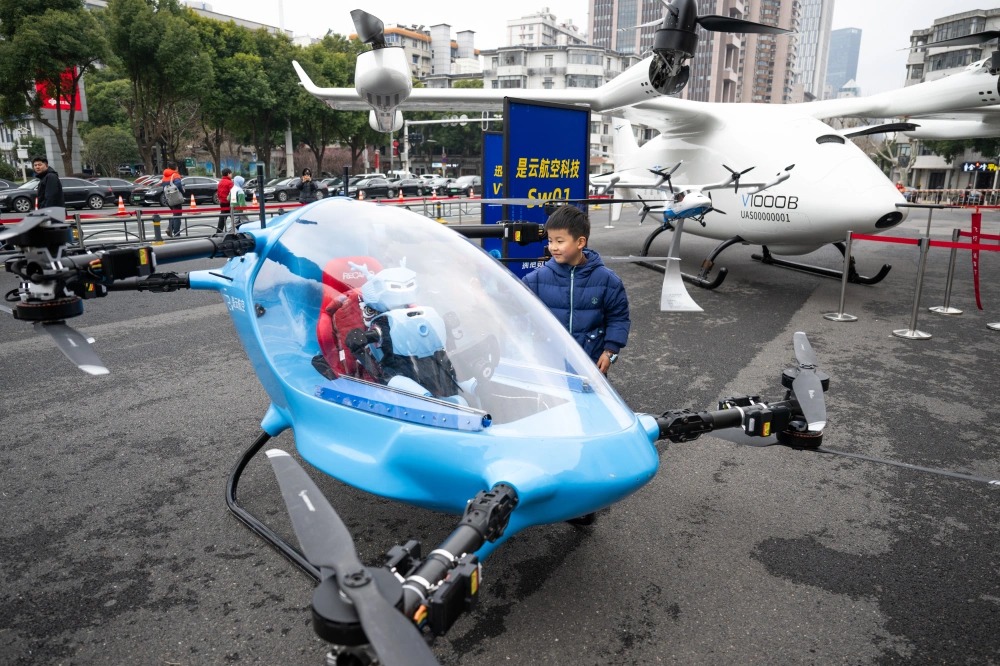
WUHAN — China’s ambitious low-altitude economy initiative transitioned from theoretical concept to tangible reality as multiple electric vertical takeoff and landing (eVTOL) aircraft demonstrated their capabilities in downtown Wuhan. The late February exhibition, strategically timed following the Spring Festival holiday, featured four distinct homegrown aircraft models that represent the cutting edge of urban air mobility technology.
The showcase, held outside Hongshan Auditorium during Hubei province’s economic planning session, highlighted China’s determined push to establish global leadership in the emerging low-altitude transportation sector. Industry executives and regulators have identified 2026 as the critical commercialization threshold for eVTOL technology, with multiple manufacturers racing toward type certification and mass production.
Among the displayed innovations, E-HAWK Technology presented a 1.2-ton vehicle featuring enclosed rotors for enhanced ground safety. Company Chairman Cai Xiaodong outlined a dual approach to market penetration: direct sales projected below 2 million yuan ($280,000) or a ride-sharing model comparable to current ground transportation services. “Future users will simply use their smartphones to summon aerial taxis from residential compounds or parks,” Cai explained, noting a two-seat version targeting logistics and tourism applications would debut this year.
Wuhan Xunqi Technology showcased their hybrid tilt-rotor V1000 model, engineered to address the range limitations of purely electric alternatives. With an exceptional range exceeding 1,000 kilometers, the craft can travel from Wuhan to Beijing, Guangzhou, or Shanghai without recharging. “We’ve solved the range anxiety problem through a hybrid range-extender system,” stated Deputy Chief Designer Li Jia. The 400kg-capacity vehicle has received type certificate application acceptance from the Civil Aviation Administration of China, with initial test flights scheduled for 2026.
Perhaps most innovatively, Wuhan Fusheng General Aviation unveiled a flying “micro-intensive care unit” designed to revolutionize emergency medical services. Unlike conventional helicopters that incur approximately 10,000 yuan ($1,443) per hour operating costs, this pure-electric aircraft reduces expenses to approximately 2,200 yuan. Executive President Chen Zhaoyan emphasized its unique capability to perform in-flight triage, monitoring, and data synchronization while accommodating a stretcher and portable CT scanner. The company will collaborate with Zhongnan Hospital of Wuhan University later this year to test medical transport capabilities.
Complementing these specialized models, the compact SW01 featuring a transparent canopy and automobile-style controls demonstrated the potential for personal aerial mobility. With a target price below 500,000 yuan, developers envision recreational flights over parks and lakes becoming accessible to the public.
This technological demonstration occurs alongside significant regulatory developments. Newly revised civil aviation law effective July 2026 will establish clear management rules for airspace below 300 meters, while five government departments have jointly mandated that ground mobile networks cover at least 90% of low-altitude public airways by 2027.
Hubei province has emerged as a central hub in this national initiative, with nine eVTOL models currently in development—four having completed test flights—and key Wuhan-based aviation manufacturers reporting revenue growth exceeding 30% in 2026, building on the city’s 9.6 billion yuan aviation industry output from 2025.