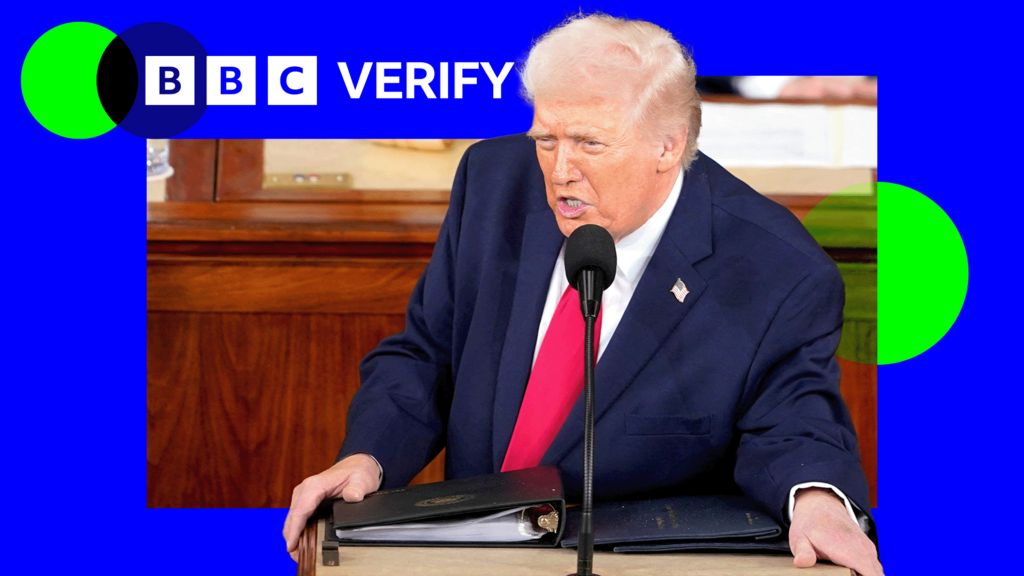
In his lengthiest congressional address to date, President Donald Trump addressed U.S. lawmakers for one hour and forty-seven minutes, declaring that “the country is winning again” while highlighting his administration’s economic and policy achievements. The speech, among the longest delivered to Congress in decades, centered on economic revitalization, immigration control, and foreign policy accomplishments.
Economic indicators presented a mixed picture: while inflation has moderated to 2.4% as of January 2026—down from 3% during President Biden’s final year—certain Trump policies have faced criticism for potentially exacerbating price pressures. Harvard economists estimated that tariffs implemented in 2025 elevated consumer price inflation by approximately 0.92 percentage points.
The President specifically highlighted declining prices for grocery items, noting beef prices were “starting to come down significantly,” though government data revealed a 15% increase in beef prices over the twelve months to January 2026. Egg prices demonstrated a more substantial decline, falling 34% during the same period.
Employment figures reached record levels with 158 million people employed, though the employment-to-population ratio slightly declined from 60.1% to 59.8% since Biden’s departure. The unemployment rate edged upward from 4.1% to 4.3% over the same timeframe.
Immigration claims received partial validation, with Homeland Security confirming zero migrant releases into the U.S. for nine consecutive months. Border apprehensions plummeted to 6,070 in January 2026—a dramatic reduction from the 124,215 recorded under Biden in January 2024.
The administration’s assertion of ending eight international conflicts underwent rigorous verification. While Trump successfully brokered an Israel-Hamas ceasefire, several referenced conflicts involved minimal actual combat or pre-dated his administration. The White House list included disputes between Pakistan-India, Rwanda-DRC, Thailand-Cambodia, Armenia-Azerbaijan, Egypt-Ethiopia, and Serbia-Kosovo, though many represented brief flare-ups rather than sustained military engagements.
Investment tracking showed discrepancies between presidential claims and official data. While Trump referenced trillions in manufacturing investments, the White House’s own tracker documented $9.7 trillion—substantial yet significantly lower than asserted. Experts noted included pledges might not materialize, particularly given recent tariff disruptions.
Voter fraud allegations lacked substantiation, with Heritage Foundation records identifying only 1,620 proven cases nationwide since 1982. Multiple studies indicate non-citizen voting remains exceptionally rare in U.S. elections.