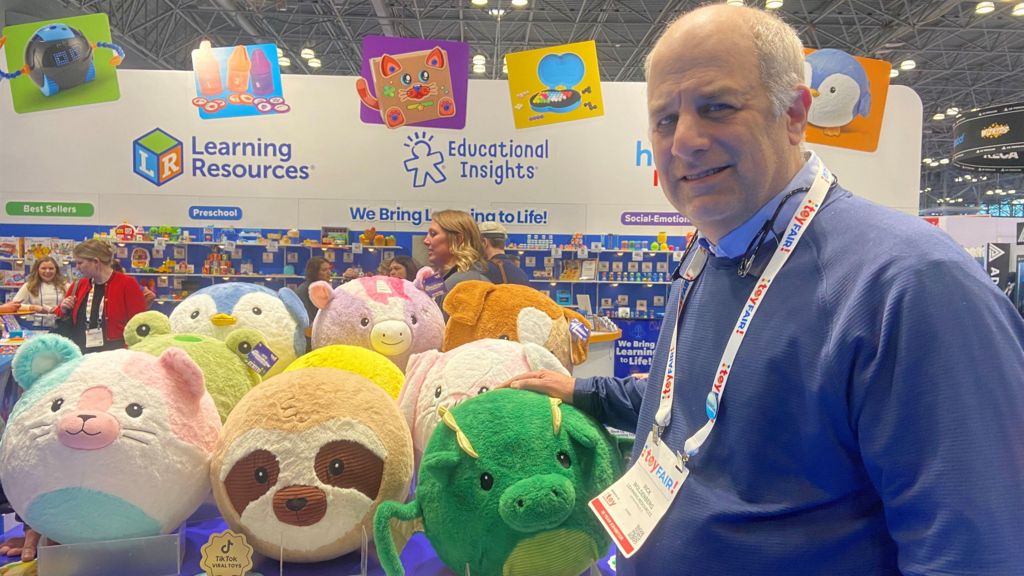
NEW YORK — At the recent annual Toy Fair convention, industry executives gathered under the shadow of persistent trade policy anxieties, with one figure drawing particular attention: Rick Woldenberg, CEO of educational toy firm Learning Resources. His legal confrontation with the Trump administration has positioned him as an unlikely champion for manufacturers grappling with import tariffs.
Woldenberg’s lawsuit challenges the sweeping global tariffs imposed by former President Donald Trump, which at one point reached 145% on Chinese goods. The Supreme Court is poised to issue a ruling on the case imminently, a decision that could force the government to refund billions of dollars collected from businesses and potentially reshape U.S. trade policy.
The toy industry, heavily reliant on Chinese manufacturing, found itself disproportionately vulnerable to these import taxes. Many firms absorbed significant profit losses and were compelled to implement price increases—a move Learning Resources and others hope might be reversible should the court rule against the administration.
Despite initial fears, the overall consumer impact has been more moderate than anticipated. Harvard Business School Professor Alberto Cavallo, who tracks tariff effects on pricing, notes that while cheaper items have seen noticeable increases, the measures have had “little impact” on overall toy prices. The average tariff on Chinese imports has stabilized around 20%, partly due to White House exemptions and rate adjustments.
Interviews with numerous executives at the Toy Fair revealed a sector cautiously optimistic about avoiding further price hikes in 2026, yet few are complacent. Jay Foreman, CEO of Basic Fun—which suffered a 65% profit drop last year—expressed industry-wide apprehension: “We’re still on edge. We’ll be on edge for at least another three years.” His company raised the price of its iconic Tonka truck from $30 to $35, a level he expects to maintain.
Sensory toy company Glo Pals implemented its first price increase in six years last April, raising its bestselling light-up cubes by 20% to $12.99. Co-founder Anna Barker described the economic landscape as “completely temperamental,” emphasizing that “all that uncertainty is still omnipresent for us.”
The White House has indicated it will pursue alternative mechanisms to impose tariffs should the Supreme Court invalidate the current measures. For international manufacturers like Tim Hislop of UK-based Floss & Rock, whose majority revenue comes from the U.S. market, a favorable ruling could lower future costs even if refunds remain unlikely. “I have a little prayer every night,” Hislop remarked wryly.
As the industry awaits the judicial decision, Woldenberg’s legal stand represents both a specific challenge to presidential trade authority and a symbol of the broader business community’s struggle to adapt to an era of unpredictable economic policy.