Groundbreaking research stemming from China’s Chang’e-6 lunar mission has fundamentally challenged established theories about the Moon’s geological history and impact distribution. Analysis of the 1,935 grams of samples retrieved from the Moon’s far side has revealed that impact rates between the near and far sides are essentially identical, contradicting the long-standing hypothesis that the far side served as a protective shield for Earth.
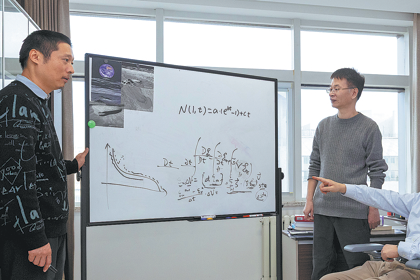
The research, published in Science Advances, has enabled Chinese scientists to develop a new lunar crater chronology model that provides unprecedented accuracy in dating unsampled lunar regions. Led by Professor Yue Zongyu from the Chinese Academy of Sciences’ Institute of Geology and Geophysics, the international team combined radiometric dating of the far side samples with high-resolution remote sensing data and historical information from Apollo, Luna, and previous Chang’e missions.
The samples included norites dating back 4.25 billion years, corresponding to the age of the South Pole-Aitken basin—the Moon’s largest and oldest impact crater. This discovery is particularly significant as previous chronology models relied exclusively on near-side samples from surfaces less than 4 billion years old, creating limitations in understanding lunar evolutionary history.
Perhaps most notably, the findings challenge the controversial ‘Late Heavy Bombardment’ hypothesis that proposed a massive lunar cataclysm approximately 3.9 billion years ago. The new model suggests Apollo samples clustering around that period may reflect local events rather than global phenomena, indicating instead a smooth decline in impact frequency over time.
This research establishes a universal framework for lunar science that will enhance our understanding of impact processes throughout the solar system, with the Moon serving as a critical historical record of planetary evolution.