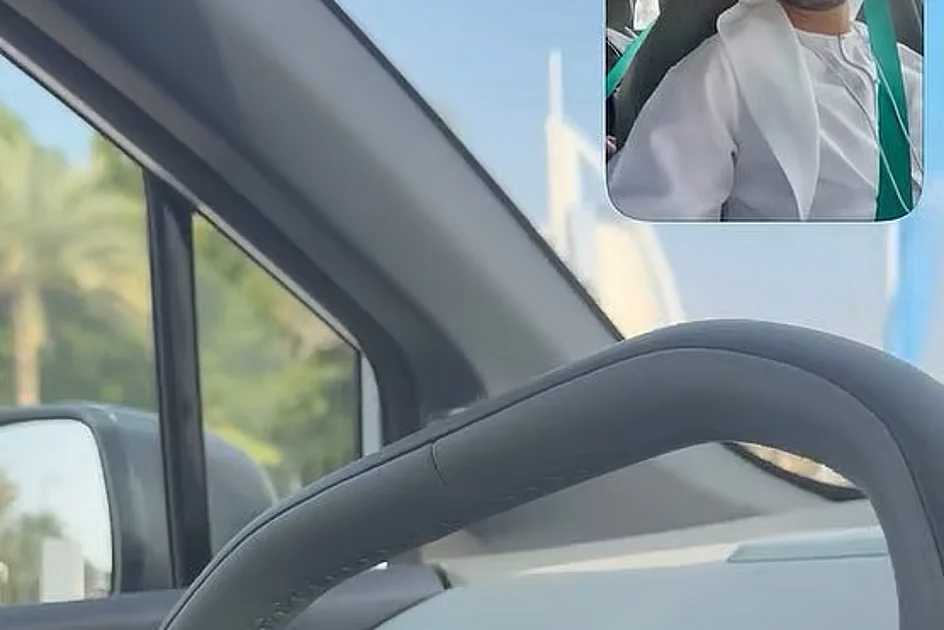
Dubai has officially entered the era of autonomous transportation with Crown Prince Sheikh Hamdan bin Mohammed bin Rashid Al Maktoum personally inaugurating the city’s first driverless taxi service. In a significant demonstration of confidence, Sheikh Hamdan took an actual ride in the autonomous vehicle to attend the World Governments Summit at Madinat Jumeirah, marking a transformative moment in urban mobility.
The RT6 taxi, developed by Chinese technology giant Baidu Apollo Go, represents cutting-edge autonomous vehicle technology. The vehicle operates entirely without human intervention, utilizing artificial intelligence to make real-time driving decisions. Equipped with an impressive array of more than 40 sensors including LiDAR, radar systems, and intelligent cameras, the vehicle maintains constant environmental awareness, effectively serving as its visual and auditory perception system.
Beyond mere sensor technology, the autonomous taxi leverages live data processing capabilities and high-definition mapping systems to navigate dynamic road conditions. Unlike fixed-route autonomous vehicles, Dubai’s new taxi service adapts to real-time traffic situations, safely adjusting to changing circumstances on busy urban roads.
The sixth-generation autonomous vehicle has been specifically engineered for mass public deployment and has already accumulated substantial operational experience. Prior to its Dubai deployment, Baidu’s autonomous vehicles completed over 150 million kilometers of safe driving across multiple cities, encompassing more than 10 million passenger trips.
Supporting this technological rollout, Baidu has established its first international autonomous vehicle operations center outside China at Dubai Science Park. The 2,000-square-meter facility serves as the nerve center for monitoring vehicle performance, implementing software updates, conducting safety verification, and managing daily operational logistics.
The service is projected to become available to the general public during the first quarter of 2026, positioning Dubai at the forefront of smart city transportation solutions and setting a new standard for urban mobility in the Middle East.