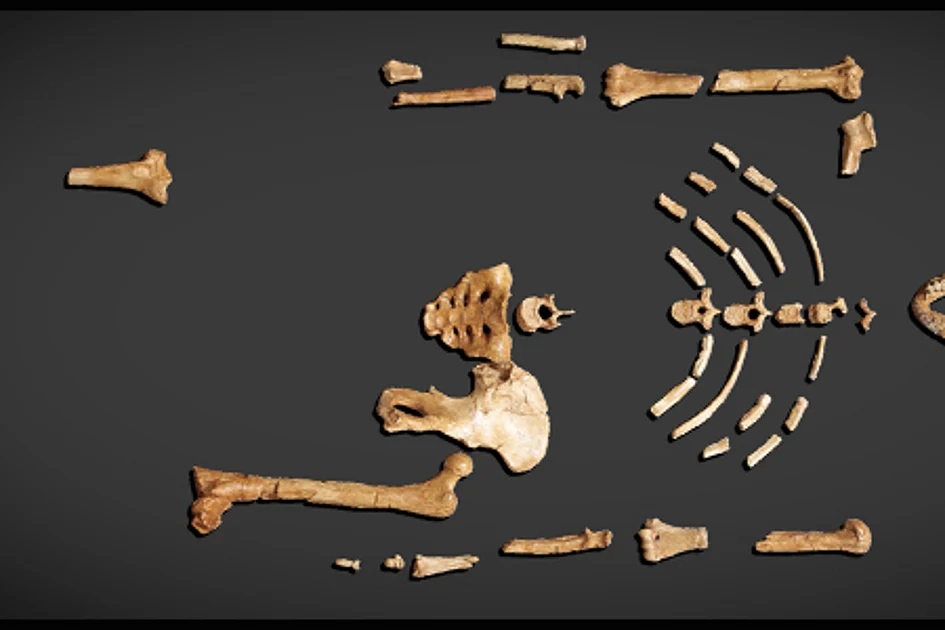
Abu Dhabi’s newly inaugurated Natural History Museum has unveiled its crown jewel—the legendary Lucy fossil, a 3.2-million-year-old anthropological marvel that continues to reshape scientific understanding of human evolution. This extraordinary exhibition marks the first time the globally renowned Australopithecus afarensis specimen has been displayed in the Middle East, offering visitors unprecedented access to one of paleoanthropology’s most significant discoveries.
Discovered in Ethiopia’s Afar region in 1974, Lucy represents a watershed moment in evolutionary science. The remarkably preserved skeleton—approximately 40% complete—provides critical anatomical evidence demonstrating how early hominins transitioned to bipedal locomotion. Her pelvic structure, femoral alignment, and spinal characteristics conclusively established that upright walking predated brain expansion in human evolutionary development.
Dr. Mark Jonathan Beech, Scientific Research Lead at the museum, emphasizes the specimen’s profound significance: “To stand beside a 3.2-million-year-old individual whose bones record intricate details about her physiology, movement patterns, and environmental adaptations constitutes an extraordinary scientific privilege. Lucy remains among the most comprehensively studied fossil skeletons ever unearthed.”
The exhibition presents Lucy within a sophisticated contextual framework, featuring both the original fossil remains and a scientifically informed reconstruction depicting how this young female hominin may have appeared during her lifetime. The specimen, on loan from the Ethiopian government through a special cultural partnership, is affectionately known as Dinkinesh (‘you are marvellous’) in Ethiopia’s Amharic language—a reference to its exceptional preservation state.
Lucy’s display forms the centerpiece of the museum’s Human Story gallery, which charts cosmological and biological evolution from the universe’s inception 13.8 billion years ago through modern times. The exhibition enhances Abu Dhabi’s growing stature as a global cultural destination, complementing other notable installations including Stan the Tyrannosaurus rex and positioning Saadiyat Island as a emerging hub for scientific and heritage tourism.