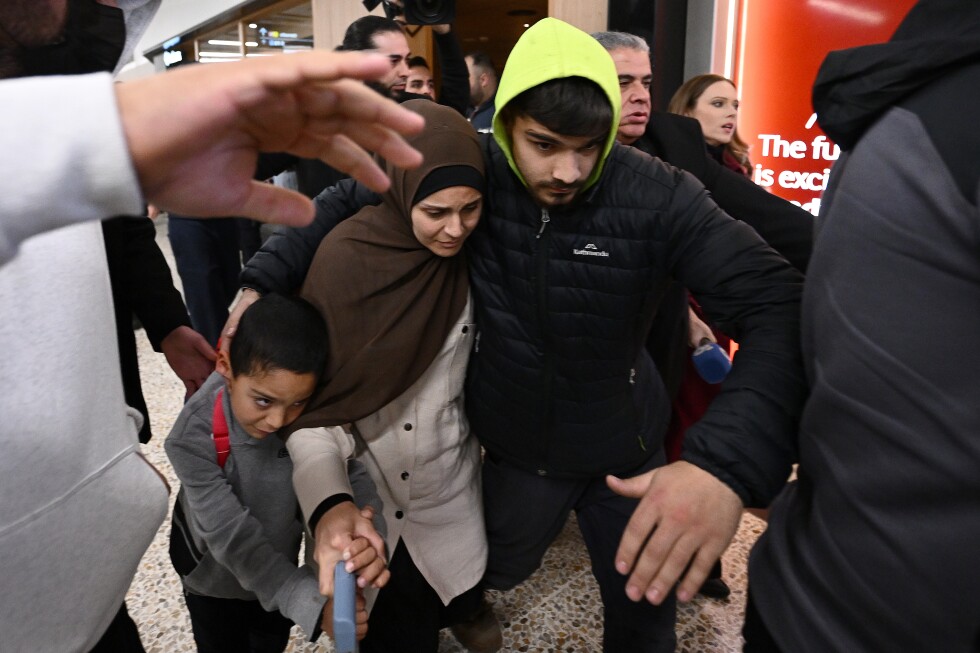
On a Thursday late last week, four Australian women and nine children touched down in Melbourne on two Qatar Airways flights originating from Doha, capping years of detention in the squalid, desert-side Roj Camp in northern Syria. What made their homecoming extraordinary was the fact it came despite explicit warnings from the Australian federal government that any citizens linked to the Islamic State (IS) group returning from the former IS caliphate would face immediate prosecution. By the following day, three of those four women had been arrested and slapped with serious slavery, terrorism and crimes against humanity charges that carry decades of potential prison time.
The most severe allegations center on 53-year-old Kawsar Abbas and her 31-year-old daughter Zeinab Ahmed, who appeared in a Melbourne Magistrates Court on Friday following their arrival. According to official statements released by Australian police, the entire Abbas family migrated from Australia to Syria in 2014, when IS declared its self-styled caliphate centered on the northern Syrian city of Raqqa. Investigators allege the family purchased a young Yazidi woman as a slave for $10,000 USD, and held the captive in their family home while they resided in IS-controlled territory. Kawsar Abbas is accused of being an active accomplice in the purchase and unlawful detention of the enslaved woman.
As a result of the allegations, Abbas faces four separate counts of crimes against humanity under Australian federal law, while Ahmed faces two counts of slavery offenses. Each individual charge carries a maximum penalty of 25 years behind bars, meaning both women could face life sentences if convicted. Their legal representation confirmed the pair will submit formal bail applications at a scheduled hearing on the following Monday.
The third woman charged, a 32-year-old who was taken into custody at Sydney Airport after the group’s arrival, faces a separate set of terrorism-related charges. Police allege she traveled to Syria to join her partner, who was an active IS fighter. Under Australian law in place between 2014 and 2017, travel to Raqqa – the former IS stronghold – without a valid official reason was a criminal offense. She is charged with being a member of a designated terrorist organization and knowingly entering and remaining in territory controlled by the group. Each of those charges carries a 10-year maximum prison sentence, and she is scheduled to appear in a Sydney court for a bail hearing later the same day.
The three women had been held in Kurdish custody since 2019, when IS’s territorial rule collapsed across northern Syria and Iraq, and had remained detained at Roj Camp ever since. The Australian government has repeatedly condemned citizens who traveled to Syria to support IS, and it refused to provide any official assistance to facilitate the group’s repatriation. Still, this arrival marks only the latest in a series of returns of Australian citizens held in Syrian detention camps: the federal government has organized two formal repatriation operations in recent years, and other citizens have made their own way back to Australia without state support.
Currently, 21 more Australian citizens – 11 women and 10 children – remain detained in Roj Camp, located in northeast Syria just kilometers from the Iraqi border. Advocacy groups supporting the detainees have confirmed they are working to secure the repatriation of this remaining group within the next several weeks. Among those still held is one woman who is currently blocked from returning to Australia under a temporary exclusion order, a legal tool introduced in 2019 legislation designed to bar high-risk former IS affiliates from re-entering the country. The order allows the government to bar eligible citizens from returning for up to two years, and this marks one of the first times the power has been used since it was enacted. Temporary exclusion orders cannot be applied to children under the age of 14, and Australian officials have ruled out separating children from their mothers to enforce the orders, leaving the government with little option but to allow the entire family unit to remain detained if the mother is barred.