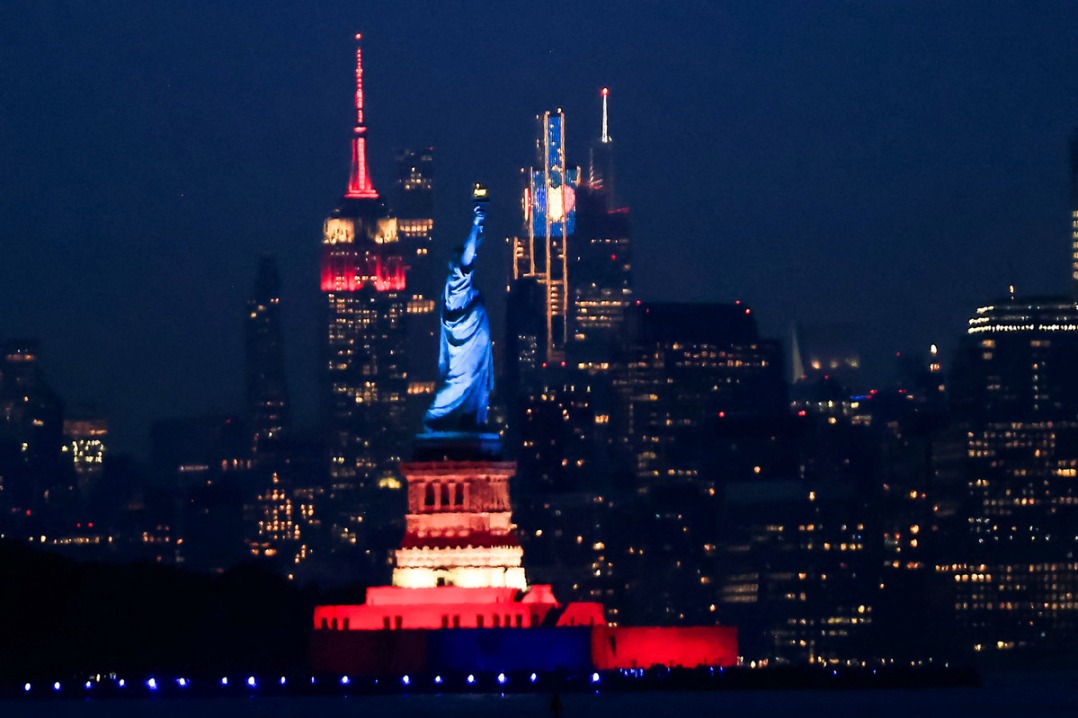
As the United States prepares to mark the 250th anniversary of its 1776 Declaration of Independence this Saturday, the nation finds itself at a defining crossroads, with public opinion fractured by deep political polarization, competing visions of national identity, and growing economic uncertainty that have reshaped how Americans view their country’s legacy and future.
For Richard Woo, a former technology executive who arrived in Southern California from Taiwan, China as an international student nearly 50 years ago, the contrast between the U.S. he first encountered and today’s nation is stark. When Woo first immigrated, the country projected unrivaled economic strength, widespread accessibility, and widespread optimism, he says. Today, he argues, widening partisan divides and social fractures have eroded many of the traditional values and institutional foundations that once defined the country. “America’s traditional values are facing significant challenges,” Woo told China Daily, noting that the country’s post-war global leadership was built on abundant natural resources, geographic advantage, and an open society that drew global talent to drive successive waves of technological innovation — strengths he says have been weakened by modern divides.
Woo’s perspective echoes broader public sentiment captured in recent national opinion polls. A joint survey by AP and NORC found that while most Americans retain pride in the nation’s founding principles, large shares express deep anxiety over political division, the state of U.S. democracy, and the country’s trajectory. Gallup polling echoes this mixed picture: a majority of Americans still view the American Dream as a goal worth pursuing, but fewer than ever believe the system provides equal opportunity to achieve it.
This mix of pride and introspection crosses diverse demographic and ideological lines. Duane Mitchell, a Vietnam veteran based in Montana, plans to mark the holiday by driving his restored 1954 Chevrolet in a local Independence Day parade, saying the anniversary serves as a persistent reminder that “freedom is not free.” In contrast, Chicago resident Laura Davis has openly questioned what she calls “American grandiosity,” while Sydney Crispin of Maine argues the milestone should both celebrate the nation’s progress and push for reflection on unaddressed shortcomings.
Stanley Renshon, a political science professor at the City University of New York and an expert on presidential leadership and political psychology, explains that these divergent views stem from a deeper national reckoning over core questions of identity, rather than routine policy disagreements. Today’s disputes over immigration, education, cultural values, and the role of government are not just partisan fights, he argues — they are conflicts over fundamentally different understandings of what America is, and what it should become.
Even amid these divisions, polling shows broad cross-partisan consensus around many founding ideals. The AP-NORC survey finds that large majorities of both Democratic and Republican respondents identify core freedoms such as free speech and religious liberty as central to U.S. national identity, even as they disagree sharply over whether those ideals are fully realized for all Americans today.
The 250th anniversary has become a flashpoint for competing national visions, particularly as the administration of President Donald Trump has positioned the official America250 commemoration as a centerpiece of its second term. Trump kicked off anniversary events with a campaign-style rally on the National Mall, centered on themes of patriotism and his iconic “Make America Great Again” message. Supporters frame the event as a long-overdue celebration of U.S. history, while critics warn it blurs the line between nonpartisan national commemoration and partisan political gain. Renshon notes that Trump’s vision represents one of two dominant competing outlooks shaping modern America: his movement resonates with voters who seek to preserve what they see as the nation’s traditional institutions and identity, opposing what they view as rapid cultural shifts that erode core national values. The opposing camp holds fundamentally different visions of a more inclusive, progressive American future.
Economic opportunity remains one of the most pressing themes shaping public sentiment around the anniversary. Beyond just political divides, multiple polls confirm widespread economic anxiety: Pew Research Center surveys rank inflation, healthcare costs, and the growing federal deficit among the top concerns for most U.S. households. CBS News polling found that only half of all Americans now believe the American Dream is still attainable, a marked decline from previous decades. Renshon argues that this economic insecurity directly drives declining confidence in national institutions. “When people feel less secure economically, they’re also more likely to question whether institutions are working for them,” he explained.
The anniversary also arrives at a moment of shifting international perceptions of U.S. global standing. A 2026 Pew Research Center survey of global public opinion found declining confidence in the U.S. as a reliable international partner across most surveyed countries, a trend that analysts tie directly to domestic political volatility and shifts in U.S. foreign policy leadership. Renshon noted that global perceptions of U.S. influence change over time, and argued that the country’s global standing should be assessed over the long term, rather than judged by the policies of any single presidential administration.
As celebrations and protests unfold across the country this Independence Day, the 250th milestone stands not as a unified moment of national celebration, but as a mirror reflecting the deep, unresolved debates that will define the United States’ next chapter.