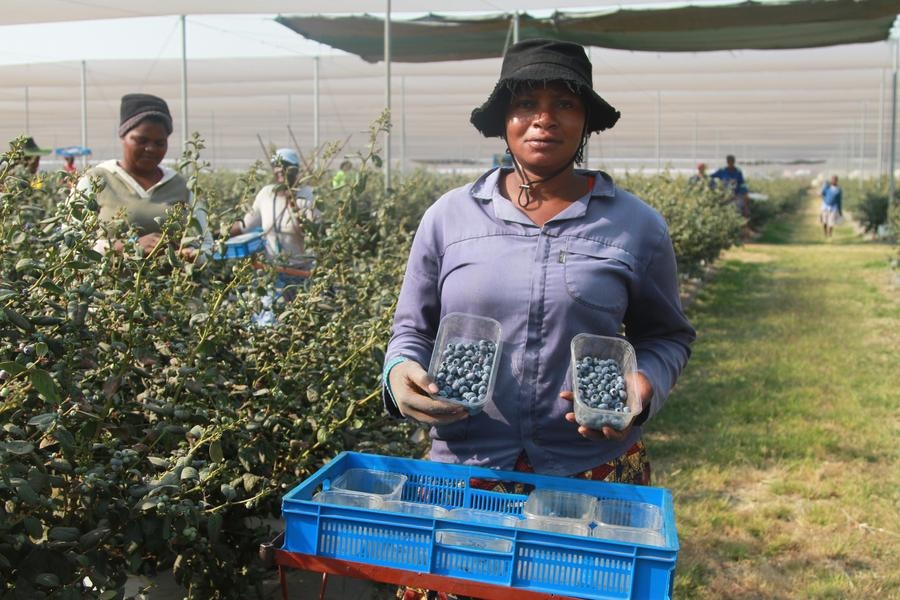
A landmark milestone for Zimbabwe’s horticultural sector has put the southern African nation on a new path of agricultural trade expansion, as it dispatched its first ever commercial consignment of blueberries to the Chinese market in 2026. This breakthrough comes after Beijing and Harare finalized a bilateral phytosanitary protocol in September 2025, formally clearing the way for Zimbabwean blueberry producers to access one of the globe’s largest and fastest-growing consumer markets.
Beyond market access, Zimbabwean producers are set to gain an additional competitive edge from China’s zero-tariff policy, which applies to qualifying export products from Zimbabwe. This policy eliminates import duties for the fruit, making Zimbabwean blueberries more affordable and attractive to Chinese buyers when stacked against competing international suppliers. Currently ranked as Africa’s third-largest blueberry producer, trailing only Morocco and South Africa, Zimbabwe is projecting its total 2026 blueberry exports to hit 12,000 metric tons, a notable increase from the 9,500 tons exported in 2025.
In response to this new trade opening, Zimbabwe’s Horticultural Development Council (HDC) has called on local blueberry growers to ramp up production output to match the expected demand from China’s 1.4-billion-consumer market. “China has opened the door,” HDC Chief Executive Officer Linda Nielsen noted at a recent investment gathering in Harare. “As Zimbabwe, we must now make sure we have enough product to walk through it.”
Nielsen emphasized that China’s broader zero-tariff initiative, which extends to eligible goods from 53 African countries that maintain diplomatic relations with Beijing, creates a transformative, long-term opportunity for Zimbabwe’s entire agricultural export sector. She added that for local producers, the barrier to growth is not lack of market access, but the challenge of scaling production to meet existing and new demand.
To date, industry data from the HDC shows that Zimbabwe has already expanded its blueberry cultivation area from 650 hectares in 2025 to 850 hectares in 2026, a shift that reflects rising investor confidence in the high-value, nutrient-dense fruit. Alistair Campbell, a representative of the Zimbabwe Berry Growers Association, noted that the country is quickly solidifying its position as one of Africa’s top blueberry producers. The fast-expanding blueberry sector already makes a substantial contribution to Zimbabwe’s national economy, while generating much-needed jobs for rural communities across the country. Today, blueberries stand as one of Zimbabwe’s emerging high-value horticultural crops, with commercial production concentrated in the Mashonaland East, Mashonaland West, and Mashonaland Central provinces.