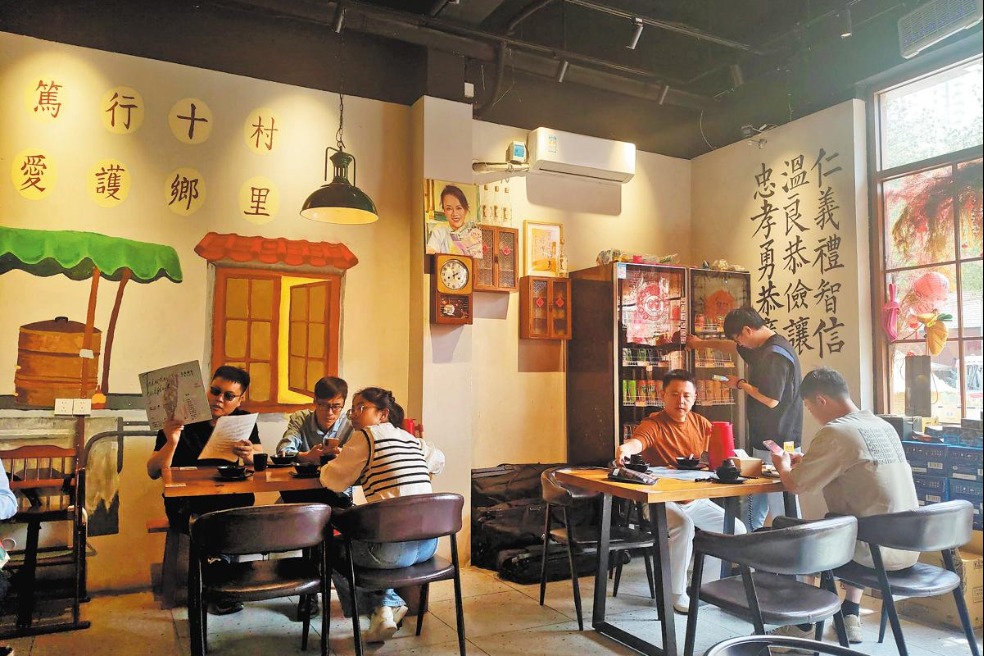
Tucked away in a quiet corner of a cultural and creative park in Zhengzhou, the capital of China’s central Henan Province, Daodao Guilai restaurant offers far more than authentic Taiwanese cuisine. For visitors and regulars alike, it is a warm harbor of homely comfort, and a quiet, powerful bond that brings together people from both sides of the Taiwan Strait.
Founded in 2024 by 46-year-old Lan Wen-chuan, a native of Yilan County, Taiwan, the restaurant carries layers of personal and cross-generational meaning. Lan’s maternal roots stretch back to Luohe, Henan, where her grandparents left decades ago to build a new life and run a family restaurant in Taiwan. It was not until more than 20 years ago, when Lan moved to Zhengzhou for a work posting, that she fully grasped the depth of this family connection.
“For my family, this wasn’t leaving home—it was coming home,” Lan explained. After years of building an online business and putting down roots in Henan, Lan decided to open the restaurant when friends, both Taiwanese and local Zhengzhou residents, told her the city was missing a spot serving real, traditional Taiwanese flavors. Drawing on decades of her family’s restaurant expertise, she set out to craft a space that feels like a home away from home for anyone who misses Taiwan.
Every detail of the restaurant’s decor is curated to evoke Taiwanese cultural memory: vintage radios, retro promotional posters, and hand-painted murals line the walls, each small element adding to the warm, familiar atmosphere. “I wanted every detail to tell a story of the shared memories we hold across the Strait,” Lan said.
The menu centers on beloved Taiwanese street food and home-style dishes: Taipei-style braised pork rice, crispy oyster omelette, chewy beef noodles, aromatic three-cup chicken, and crunchy shrimp crackers. To perfect her oyster omelette recipe, Lan traveled back to Taiwan to train with more than a dozen seasoned night market vendors, refining her technique to match the authentic flavors she grew up with. For Lan, one of the greatest joys of running the restaurant is hearing small, satisfying moments: “One of my happiest moments is hearing a parent say their picky child finished a whole bowl of braised pork rice,” she shared.
Beyond serving food, the restaurant has grown into a beloved community hub for young Taiwanese people living and working in Henan. Lan makes a point of supporting new arrivals as they adapt to life on the Chinese mainland, helping with everything from applying for residence permits and enrolling in medical insurance to sharing practical career advice. She actively encourages Taiwanese people to come experience the mainland for themselves, instead of forming opinions based on secondhand reports.
“Don’t understand the world only through what you hear. Come and see it with your own eyes,” she said. Lan notes that many young Taiwanese visitors are caught off guard by how advanced daily life is on the mainland, from the ultra-convenience of mobile delivery apps to the rapid pace of development. “What they see here is completely different from what they heard back home,” she added.
Xu Chu-qiao, a 24-year-old new graduate from Kaohsiung who got a job at the restaurant after finishing her degree at Zhengzhou University, echoes this view. “For me, coming to the Chinese mainland to study and work is also a process of broadening my horizons,” Xu said. “It’s best if you come and see for yourself — that’s the only way to truly experience and understand.”
Displayed prominently on one of the restaurant’s main walls is a plaque that reads: “People on both sides of the Strait are one family.” For Hsi Yun-lung, a diner who grew up in New Taipei, that sentiment feels tangible every time he visits. “The familiar decor and flavors remind me of home,” he said. “It feels like being back in my hometown. Being able to eat these dishes in Zhengzhou is truly special.”
For Lan, food has always been the most natural, approachable bridge between people. “Many dishes from Taiwan originated on the mainland and then developed their own unique local character, much like simplified and traditional Chinese characters,” she explained. “Different in form, but the same at heart.”