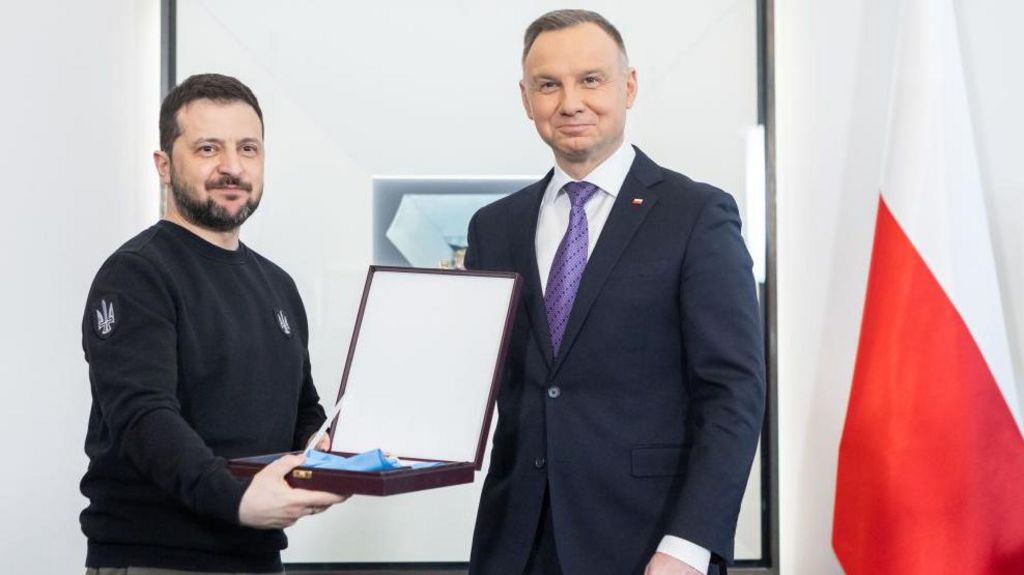
A bitter diplomatic dispute has erupted between Poland and Ukraine, two long-time aligned partners in Kyiv’s defense against Russian full-scale invasion, after Poland stripped Ukrainian President Volodymyr Zelensky of the Order of the White Eagle, Poland’s highest civilian and military state honor. The revocation comes in response to Kyiv’s late-May decision to name a new Ukrainian military unit after the World War II-era Ukrainian Insurgent Army (UPA), a move that has reignited decades of tension over conflicting historical memories of the group.
Polish President Karol Nawrocki publicly condemned Ukraine’s naming decision in an official video address posted to his presidency’s website, calling the choice “outrageous, incomprehensible and deeply disappointing.” For Poland and the overwhelming majority of its population, the UPA is inextricably linked to the 1943-1945 Volhynia massacres, where Warsaw documents that roughly 100,000 ethnic Polish civilians were killed in atrocities the country classifies as genocide. Nawrocki emphasized that the Ukrainian government’s choice to glorify the UPA wounds Polish collective historical memory and erodes years of carefully built mutual trust between the two nations.
Despite the sharp rebuke and honor revocation, Nawrocki was quick to clarify that the diplomatic dispute would not alter Poland’s unwavering support for Ukraine against Russia’s invasion. He reminded the public that Poland has stood with Kyiv since day one of the 2022 full-scale invasion, opening its borders, homes, and communities to more than a million Ukrainian refugees fleeing the war. Nawrocki also tied the dispute to Ukraine’s ongoing European Union accession process, noting that a path to EU membership requires all candidate states to honestly confront and address dark, divisive chapters of their shared history. “A united Europe was built on the rejection of totalitarianism and the cult of violence,” he said. “These principles must apply to everyone. For those who do not understand this, there can be no place in the European Union, and Poland will certainly not allow it.” Ukraine is currently advancing its accession bid, holding the first round of membership negotiations in Luxembourg just this week.
Ukrainian officials have pushed back hard against Warsaw’s decision, denouncing the revocation as a politically motivated move that only serves Moscow’s interests. Ukrainian Foreign Minister Andrii Sybiha called the revocation a “strategic mistake” and an act of “disrespect” toward Ukraine. In a reciprocal move, Sybiha announced he would return a state honor he received from Poland in 2022, stressing that no foreign leader has the right to dictate how Ukraine remembers its own history. For many Ukrainians, the UPA is a revered symbol of national independence: the 1940s-1950s insurgent group fought against multiple occupying forces, including Nazi Germany, the Soviet Red Army, and pre-war Polish authorities, making the group a core part of modern Ukrainian national identity. That legacy remains visible today, with the UPA’s signature red-and-black flag carried regularly by frontline Ukrainian troops fighting Russian forces; Zelensky justified the unit naming as an effort to “restore the historical traditions of the national army.”
The dispute has already drawn intervention from senior Polish leadership seeking to de-escalate tensions. Polish Prime Minister Donald Tusk, a former European Council president, took to social media Friday to urge both sides to lower tensions, noting that the feud only delights Russian President Vladimir Putin and advances Moscow’s goals to divide European support for Ukraine. Tusk called on both Zelensky and Nawrocki to “calm emotions, not to stoke tensions.” As of now, Zelensky has not issued a direct public response to the honor revocation. The Order of the White Eagle was originally awarded to Zelensky in 2023 by then-Polish President Andrzej Duda, at a time when bilateral relations between the two neighbors were largely unified in opposing Russian aggression.