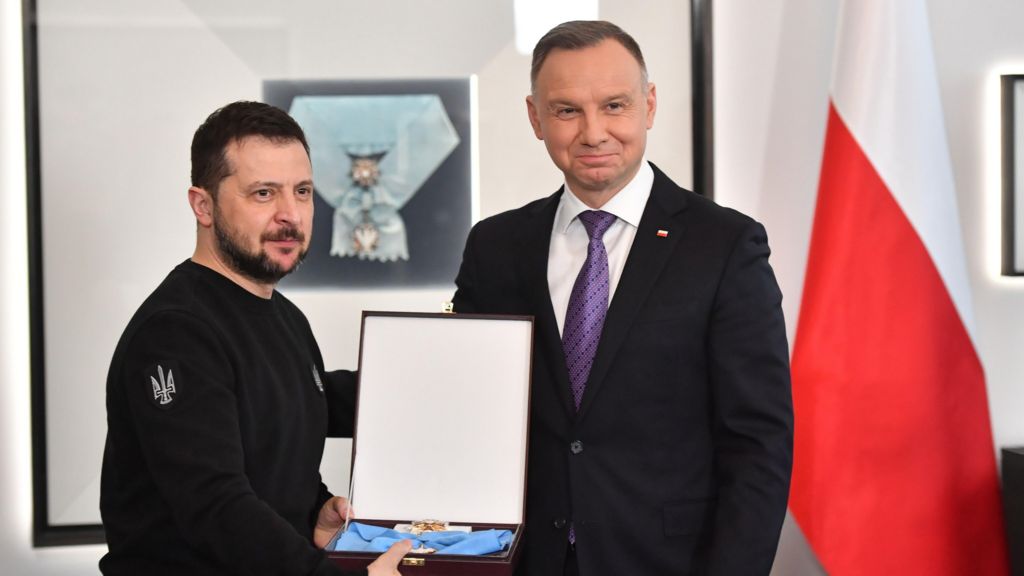
A new diplomatic rift has emerged between two key Eastern European partners, Ukraine and Poland, after Poland’s newly appointed president Karol Nawrocki announced he would strip Ukrainian President Volodymyr Zelensky of Poland’s highest state honor, the Order of the White Eagle. In response, Zelensky confirmed he has already returned the award, and three senior Ukrainian government officials have followed suit, returning their own Polish-conferred honors in a show of solidarity with their leader.
The controversy traces back to a decision made by Kyiv late last month, when Ukrainian authorities renamed a frontline army unit in honor of the Ukrainian Insurgent Army (UPA), a mid-20th century nationalist movement that remains one of the most divisive topics in shared Polish-Ukrainian history. For many Ukrainians, the UPA, which operated from the 1940s into the 1950s, is celebrated as a heroic independence movement that fought against multiple occupying forces – Nazi Germany, the Soviet Red Army, and interwar Polish governance. Today, the group’s iconic red-and-black flag is widely displayed by Ukrainian soldiers fighting on the front lines against Russia’s full-scale invasion.
Poland, however, holds a sharply different interpretation of the UPA’s legacy. The Polish government accuses the organization of perpetrating a targeted genocide that killed an estimated 100,000 ethnic Polish civilians in the Volhynia region (now northwestern Ukraine) between 1943 and 1945. Nawrocki, who took office this year, condemned Kyiv’s naming decision in an official video statement, calling the move “outrageous”, “incomprehensible” and “deeply disappointing”. “For the overwhelming majority of Polish society, the UPA remains, above all, a formation responsible for the brutal crimes committed against citizens of the Republic of Poland during World War Two,” he said, adding that the decision harms shared historical memory and erodes years of carefully built trust between the two nations.
In his own social media statement responding to the honor revocation, Zelensky struck a conciliatory tone despite the escalating dispute. He emphasized that Ukraine “remain[s] open to all meaningful formats of engagement with Poland in order to try to avoid conflicting interpretations of the difficult and painful chapters of our shared past”, and reaffirmed Ukraine’s gratitude for the Polish people’s consistent support and cooperation since Russia launched its full-scale invasion in 2022.
Notably, both sides have moved quickly to stress that the diplomatic row will not undermine Poland’s longstanding military and humanitarian support for Ukraine, which has been a cornerstone of Kyiv’s war effort. Warsaw has stood as one of Kyiv’s most staunch allies throughout the conflict, hosting more than 600,000 Ukrainian refugees and serving as a critical logistics hub for Western military and humanitarian aid flowing into the country. Nawrocki explicitly stated that the disagreement over historical memory would not alter Poland’s commitment to backing Ukraine against Russian aggression.
Polish Prime Minister Donald Tusk also waded into the debate, warning that internal friction between the two neighboring allies only benefits Moscow. “Any feud [between Ukraine and Poland] delights [Vladimir] Putin,” Tusk wrote on social media, calling on both Zelensky and Nawrocki to “calm emotions, not to stoke tensions”.
The dispute comes at a sensitive moment for Ukraine, which this week opened the first round of official European Union accession negotiations in Luxembourg, a key milestone in Kyiv’s decades-long ambition to join the bloc. Poland has long supported Ukraine’s EU integration, but the historical controversy has laid bare the ongoing challenges of reconciling divergent national memories as the two countries navigate their close strategic partnership amid the ongoing war with Russia.
The Order of the White Eagle, Poland’s highest decoration, was originally awarded to Zelensky in 2023 by then-Polish president Andrzej Duda, in recognition of Ukraine’s fight for sovereignty and the deep bilateral ties between the two nations at the time.