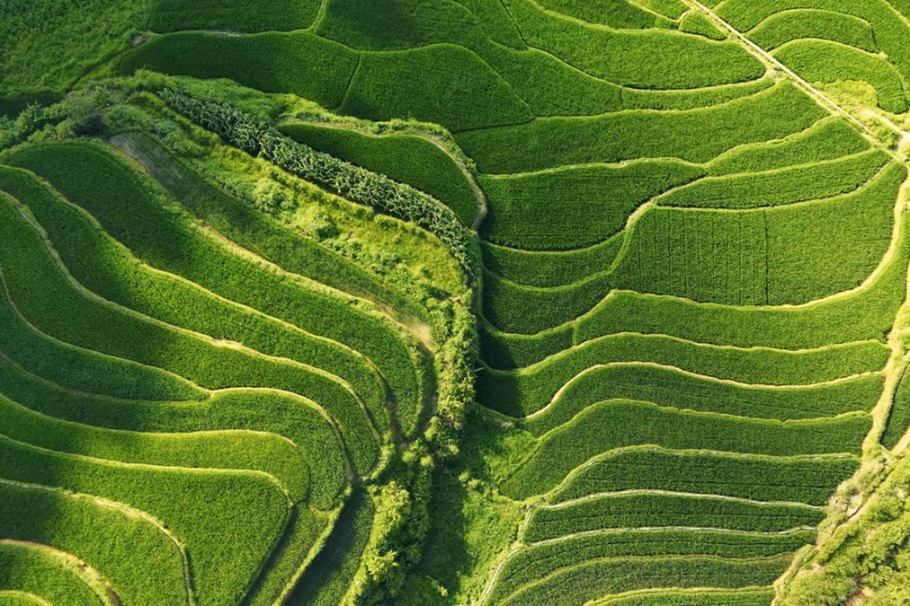
As the peak of summer settles over southwest China’s Yunnan province, the centuries-old terraced rice fields of Tangdaxin village, Guangnan county, have burst into a vibrant tapestry of green that draws the eye and calms the spirit. This layered agricultural landscape, a cultural staple of the local Zhuang ethnic community, has transformed rolling hillsides into a picture-perfect display of rural harmony between people and nature.
Freshly transplanted rice seedlings spread across the stepped slopes in overlapping swathes of bright lime and deep forest green, with light filtering through the summer sky to cast shifting shades across the water-filled paddies. When soft mountain winds drift down from the surrounding peaks, gentle ripples cascade from the valley floor all the way up to the village edge, and the soft rustle of rice leaves sways in the breeze, echoing across the quiet hills.
Unlike static scenic vistas, this landscape is alive with the quiet work of local farmers, who move between the paddies to tend to young seedlings and clear silt-clogged irrigation channels, their daily labor adding a warm, lively energy to the otherwise tranquil setting. In the distance, mist-dusted mountain ridges cluster behind scattered traditional village homes, all blending seamlessly into the rolling tiers of green to create an idyllic snapshot of sustainable rural life that has endured for generations in this corner of Yunnan.