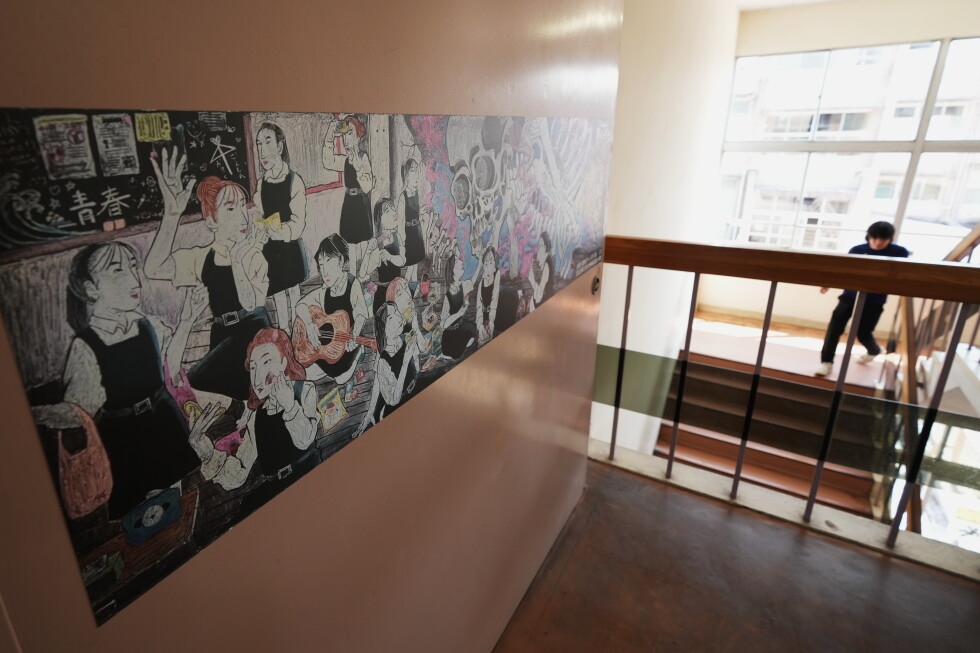
In the city of Kumagaya, located just northwest of Japan’s capital Tokyo, a group of young art students at Kumagaya Girls High School are huddled together this July, brainstorming their entry for one of the country’s most unique student art competitions: Kokuban Art Koshien, the annual national chalk-on-blackboard art championship for middle and high school creators.
Blending the Japanese word for blackboard, *kokuban*, with the name of Japan’s iconic high school baseball national tournament held at Koshien Stadium, the competition has grown steadily since its launch in 2015, drawing roughly 300 participating middle and high schools across the country every year. All works are created directly on classroom blackboards, typically during students’ summer break, and range wildly in scope and theme: from vibrant, dynamic renderings of dinosaurs, marine life and household pets, to reimaginations of classic manga scenes, reproductions of iconic masterworks from Hokusai’s Great Wave off Kanagawa to the Mona Lisa and Da Vinci’s Last Supper, and surreal original concepts like underwater classrooms. Even meta pieces depicting a person writing on a blackboard itself have made appearances. Every entry is a collaborative project, bringing together teams as small as two creators or as large as dozens of students, blending individual creativity with group coordination to bring a shared vision to life.
Unlike many established fine art forms that prioritize permanent, individual work, Kokuban Art Koshien stands out for its experimental, accessible nature. Kazunari Minamishima, an art instructor at Saitama Prefectural High School of the Arts whose students have competed for years, explains that the medium gives young creators freedom that oil painting, sculpture and other traditional forms do not. “It’s still a work in progress,” he notes of the evolving art form itself.
The competition was founded by Tokyo-based blackboard manufacturer Nichigaku Co., after company leaders spotted a viral, incredibly detailed replica of Da Vinci’s *Last Supper* drawn anonymously on a Japanese school blackboard. At the time, company president Tomohiro Yoshida explains, while casual chalk drawing was common in schools, there was no formal recognized genre of blackboard art. “Back then, there was graffiti, but there was no genre called blackboard art,” Yoshida says.
While the contest is not designed as a direct marketing push — all Japanese schools already equip their classrooms with blackboards, after all — Yoshida says he is proud to see many past contestants go on to build careers as professional artists. Because full blackboards cannot be transported for in-person judging, organizers collect high-resolution photographs of each completed work to evaluate, with winners set to be announced this coming November.
The unique medium of chalk on blackboard also allows for creative techniques that cannot be replicated with traditional paints. Artists dust loose chalk powder across the surface to create a soft, stardust-like glow, smudge pigment with fingers or tissue paper to build muted shadows and gradients, and can even replicate the translucent shine of a dragon’s eyeball with skilled shading. One past award-winning entry even mixed chalk pigment with water and sprayed it onto the blackboard in the style of abstract expressionist Jackson Pollock.
Open to all Japanese schools, including international institutions, organizers have even expressed hopes of expanding the competition to international participants in coming years. Unlike unpermitted street graffiti common in Western countries, all blackboard art pieces for the competition are created with explicit school permission, reflecting Japan’s emphasis on respect for public spaces and collective order. For participating students, the collaborative process is the biggest draw, even more than winning awards.
Kento Misumi, who competed in the contest as a high school student and now works for organizer Nichigaku, says the experience taught him far more than individual art creation ever could. “The challenge of trying to sort out the conflicting opinions of my two collaborators is the biggest memory about taking part in blackboard Koshien, as opposed to doing your own artwork,” he explained. Misumi recalled that even a single piece required multiple days of coordinated work from his team, a far more demanding process than many first-time competitors expect. “I want young people today to go through the experience,” he added.
That spirit of collaborative growth is on full display at Kumagaya Girls High School, where a team of first-time competitors are preparing their 2026 entry, building on the legacy of older students who have won top national prizes in past years. “I see it as a chance to deepen my relationships with my schoolmates,” said Chiho Ninomiya, one of the student participants. “It’s our first time so I’m not sure we will be able to do a good job. But even if we don’t win, it’d have been worth it as long as we become better friends while doing it.”
For this year’s entry, the team is brainstorming a playful concept: parody spinoffs of classic fine artworks by artists like Renoir, juxtaposed with vivid scenes of uniformed Japanese high school students capturing everyday campus life. Ninomiya notes that working with chalk on blackboard is a very different experience than drawing with pencils or paint, requiring constant adjustment, erasing, and reworking as the team learns the quirks of the medium.
It is true that after the contest is photographed and judged, every labor-intensive piece will eventually be erased to make the blackboard usable for classes again. Proponents of the competition say this impermanence is part of its unique educational power: it teaches students a quiet lesson about the fragility of creation, the transient nature of life, and the courage to create even when a work will not last forever. For the community of Kokuban Art Koshien, a blackboard chalk drawing is only truly complete the moment it is erased.