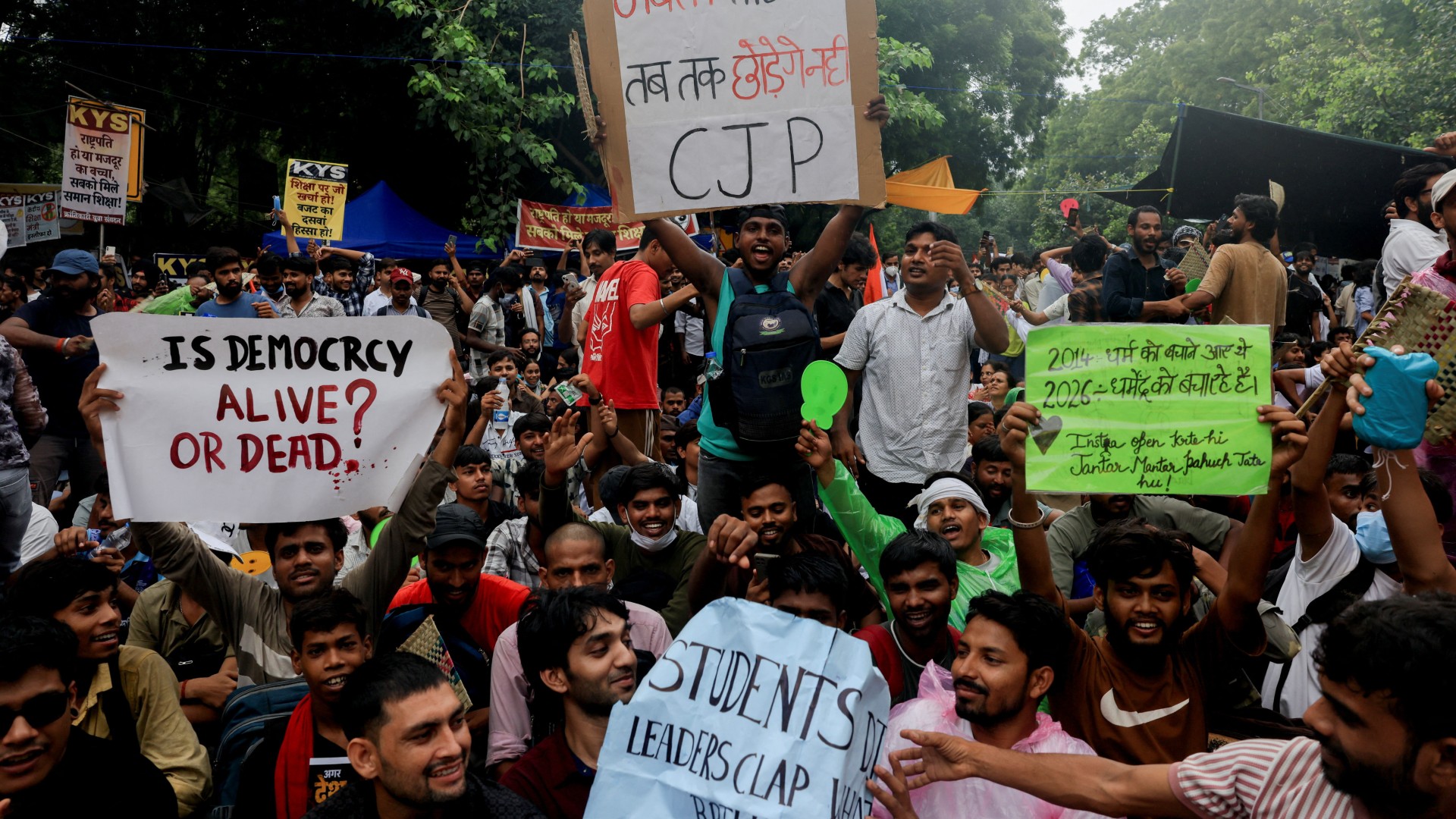
In a bustling New Delhi public square, 18-year-old Arya Singh sits cross-legged on the pavement, strumming a tambourine as thousands of mostly student protesters crowd around her, chanting in unified roar: “Throw out the incompetent government” and “Long live people’s revolution.” For nearly four weeks, this growing demonstration has centered at Jantar Mantar, a historic 18th-century astronomical observatory that serves as India’s capital’s official designated space for public protest, drawing students from every corner of the country.
The core demand of the movement is unambiguous: the immediate resignation of Dharmendra Pradhan, senior Bharatiya Janata Party (BJP) leader and India’s federal education minister in Prime Minister Narendra Modi’s cabinet. The trigger for the protest was the high-profile leak of the National Eligibility-cum-Entrance Test (NEET), one of the world’s largest high-stakes entrance examinations that determines admission to 137,000 undergraduate medical seats across the country.
More than 2.3 million aspirants sat for the OMR-based NEET exam on May 3. But weeks later, an intelligence investigation uncovered that the question paper had been widely shared via the messaging app Telegram across the state of Rajasthan, forcing national exam authorities to cancel the original test and order a full re-examination on June 21. In the chaotic gap between cancellation and the retest, at least 12 students died by suicide, driven by crippling stress, shattered career hopes, and crippling uncertainty, an Indian Express investigation confirmed. Additional self-inflicted deaths have been recorded in the weeks since.
“These 20 young people gave up every part of their lives—sports, trips, time with family—to prepare for this exam. This is not suicide. This is murder,” Singh told Middle East Eye in an on-site interview. “If this same scandal had happened anywhere else, the minister would have taken responsibility and stepped down immediately. But here in India, he clings to his post without a shred of accountability.”
The movement, which has drawn widespread Gen Z support, carries the deliberate satirical name the “Cockroach Janta Party (CJP).” The label originated after India’s Chief Justice Surya Kant sparked national outrage during an open court hearing, when he compared unemployed young activists and job-seeking youth to “parasites” and “pests” attacking India’s political system. “There are youngsters like cockroaches who don’t get any employment or have any place in the profession. Some of them become media, some become social media, RTI activists and other activists, and they start attacking everyone,” Kant said in his original remarks. The judge later walked back the comment, clarifying he had targeted only individuals holding fraudulent degrees, not India’s youth, whom he described as “the pillars of a developed India.” But the damage was done, and young activists reclaimed the insult as a badge of honor.
“They call us cockroaches, and maybe we are, because the system is decayed. What else can they expect such a rotten system to produce? The more rotten the system becomes, the more cockroaches it will produce,” Singh said. “That is why we are here: to show what happens when a government refuses to take accountability for its failures.”
The movement gained national momentum after prominent Ladakh-based engineer, education reformer, and climate activist Sonam Wangchuk joined the protests in solidarity, launching a 26-day hunger strike that concluded on July 24. In the final hours of his strike, Delhi Police forcibly removed the 50-year-old activist from the protest site and admitted him to a local hospital. Wangchuk agreed to end his fast only after authorities gave formal assurances that police would end the use of force against demonstrators, drop all pending charges against protesters, and open formal negotiations with government representatives.
Abhigyan, a 26-year-old New Delhi resident and one of the protest’s lead organizers, says the movement is rooted in broader anger over systemic corruption, institutional injustice, and rising religious intolerance under 12 years of BJP rule. He accuses the ruling party of using brutal, authoritarian tactics to suppress the demonstration. “This is not the response expected from a democratic nation but from a fascist regime, and that is what we are witnessing,” he said. Abhigyan alleges that on July 20, when protesters attempted to march toward India’s Parliament building, Delhi Police used iron-studded batons to beat demonstrators, erected electrified iron barricades to shock crowd members, and fired pellet guns to disperse the gathering. Delhi Police has denied all these allegations in an official post on X, calling the claims “completely false and misleading.” Abhigyan counters that three protesters have confirmed pellet gun injuries, 65 demonstrators were admitted to Delhi’s Ram Manohar Lohia Hospital, and 15 of those were in critical condition. He holds Prime Minister Modi and Home Minister Amit Shah directly responsible for the escalation of violence, noting “protesters never had the resources to escalate this crisis—this is entirely on the government.”
Across the protest site, young aspirants like 21-year-old aspiring doctor Vijay Ratawal say the government’s use of force has pushed even undecided young people firmly into opposition. Reciting a collective protest poem that translates to “Leaked papers have now crossed eighty. What kind of government is this?”, Ratawal points to independent research that records nearly 70 major exam paper leaks across India during Modi’s 12-year tenure. “The use of force is making us reconsider whether the BJP should remain in power. There were doubts earlier, but now everything is clear: there are those who work for ordinary people, and those who only want to cling to power,” Ratawal said. “BJP is turning the majority of the Indian population, the youth, against them. The entire BJP cabinet is incompetent; they have set the country on fire on every front, from the Gujarat farmer protests to the Manipur ethnic violence to the tribal funeral pyre protests in Madhya Pradesh.” He added that families of protesters have lost all trust in the system, not only over exam leaks but across a slate of policies that harm ordinary citizens, and called for the BJP government to step aside to make way for competent, accountable leadership.
The protest has drawn cross-generational support, including from 72-year-old farmer Jankabi Krishnakumar Nirmohi, who traveled from Bihar’s Bhojpur district to join the demonstration. “In 1974, we had the Navnirman and JP movements against inflation, food scarcity, and corruption, demanding systemic change. Those protests were far larger than this one, but the cruelty the BJP has unleashed on students today has no parallel in Indian history,” Nirmohi said. “When parliament loses its way, the streets begin to speak, and that is when decisions are made. It is shameless that Modi publicly praised the education minister on his birthday while students were protesting against him, and he never even mourned the 20 young people who died. That makes it very clear where his loyalties lie.”
In recent years, South Asia has seen a wave of mass Gen Z-led protests that have toppled sitting governments in Sri Lanka, Nepal, and Bangladesh. Prominent Indian political scientist and Centre for the Study of Developing Societies professor Sanjay Kumar says the current protest sends a clear signal of widespread youth discontent with the BJP government. Opposition parties have visited the protest site to express solidarity, but Kumar says the movement was not initiated or organized by opposition groups. “My assessment is that it was neither started nor organised by opposition parties. However, once the movement began, the opposition saw it as an opportunity and tried to take advantage of it by sending a message to the youth that they are the ones looking after their interests,” he explained. He also cautions against drawing direct parallels to the regime-change movements in other South Asian countries, noting that “those are smaller countries, and something happening in the capital here has very different implications for the country. If you speak to people in rural areas, which make up nearly 70 percent of the population, I do not think this movement will have much resonance. The momentum is issue-specific and limited to a particular section of the population, mainly the youth of the country.”
Former University of Kashmir political science professor Noor Ahmad Baba argues that the BJP’s refusal to demand Pradhan’s resignation stems from a desire to avoid appearing weak in the face of public pressure. For his part, Pradhan has struck back at critics, accusing the main opposition party, the Indian National Congress, of exploiting students as political pawns to disrupt the parliament’s Monsoon Session. “Even after the government conveyed its readiness for a comprehensive discussion, the Congress chose political spectacle over democratic debate. Their objective was never solutions for students; it was disruption for political headlines,” Pradhan wrote in an official X post. “The students of India deserve far better than being treated as tools in a political campaign. They deserve certainty over chaos, solutions over slogans and responsibility over disruption. We owe our students more than outrage. We owe them answers, reforms and accountability. That is exactly what our government remains committed to delivering.”
Baba notes that the BJP has never faced a youth-led protest of this scale, and it remains committed to avoiding any sign of weakness by forcing Pradhan’s exit. “It will be interesting to see how the BJP handles this situation,” he said. “Having no precedent in the past does not necessarily ensure that a new precedent can’t be created.”