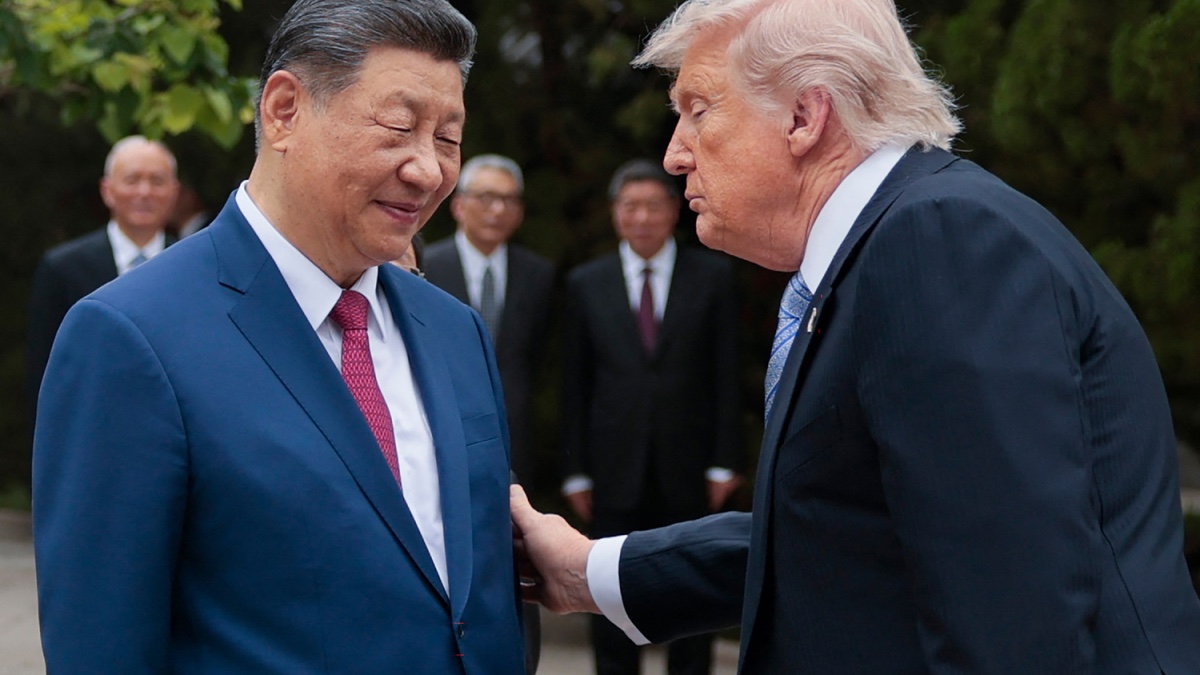
Last month’s high-profile Xi-Trump summit in Beijing produced one particularly consequential, if intangible, outcome: Chinese President Xi Jinping unveiled a new authoritative policy formulation, or tífǎ, to frame the future of US-China relations.
For decades, these standardized, authoritative concepts have served as a core communication tool for the Communist Party of China, allowing the top leadership to articulate its strategic priorities, policy assessments, historical judgments, and core governance agendas at key junctures. Historically, tífǎ have also acted as reliable leading indicators of shifting ideological and policy directions, enabling top leaders to outline and consolidate their political priorities across all areas of governance. This tradition has only expanded under Xi Jinping’s leadership, with official formulations now released to guide policy across domains ranging from ethnic minority governance to global diplomatic strategy.
The new framing put forward for bilateral ties is “constructive strategic stability”, a guiding concept structured around four distinct pillars, according to official reporting from China’s state-run news agency Xinhua. These four layers are: “positive stability with cooperation as the mainstay”, “stability with moderate competition”, “stability with manageable differences,” and “an enduring stability with promises of peace.” Chinese Foreign Minister Wang Yi later expanded on each of these pillars in a post-summit press briefing.
Wang explained that the first pillar – cooperation-centric positive stability – forms the baseline for healthy bilateral relations, a reflection of the deep economic interdependence that binds the two largest economies in the world, where “neither can cut the other out, nor prosper without the other.” The second pillar, stability with bounded moderate competition, signals Beijing’s clear preference for establishing formal guardrails around bilateral rivalry, to ensure that competition “is kept within proper limits and is not turned into a zero-sum game.”
Wang went on to outline the non-negotiable bottom line that defines these “proper limits”: both nations must “respect each other’s social systems and development paths, respect each other’s core interests and major concerns, and respect each other’s right to development.” Only when this bottom line is fully honored can the two sides achieve the overarching final goal of the framework: long-term, enduring stability for bilateral ties.
Analysts note that this new formulation carries major strategic significance for at least two key reasons. First, it marks a clear shift in Beijing’s approach to managed competition: while China has long acknowledged that US-China relations contain a substantial competitive element, the new framework formalizes Beijing’s commitment to keeping that competition bounded and controlled.
This represents a noticeable shift from China’s position during most of the Biden administration, when it was the United States that pushed aggressively for the creation of competition guardrails, while China was far less receptive to the idea. At that time, Beijing’s stance was shaped by the widespread perception within the Chinese leadership that the United States was a declining power, a view encapsulated by Xi’s 2021 assertion that “time is on our side.”
With Donald Trump’s return to the White House, Beijing has not abandoned its view that U.S. power is in decline. Instead, this perception has evolved: Chinese analysts now argue that a declining U.S. is far more likely to leverage military pressure and coercive diplomacy to compensate for its eroding economic competitiveness. As Jin Canrong, vice dean of Renmin University’s School of International Studies, argues, “America’s current toughness and arrogance do not reflect a true rise in strength” but rather demonstrate the acceleration of its decline through the “self-depletion” of its military, economic and diplomatic resources. In this new context, as Wang Yi put it, guardrails are now necessary to prevent the bilateral relationship from veering wildly “like a roller coaster.”
The second, and arguably more impactful, dimension of the new framework is that it positions China as an equal peer to the United States in its contribution to global order and international stability. “A positive outlook of China-US cooperation,” Wang argued, “will provide more certainty for both countries’ development and for the international situation.” As such, “constructive strategic stability” should “be a goal both sides uphold.” As scholar Zongyuan Zoe Liu notes, the clear implication of this framing is that “the United States should respect China’s core interests, refrain from defining the relationship primarily as strategic competition and manage disputes within limits acceptable to Beijing.”
With the Trump administration signaling acceptance of this new phraseology, even if it has not yet formally signed on to its full substance, Beijing is widely expected to view this outcome as a significant win in its campaign to define the acceptable boundaries of US-China rivalry on terms that align with Chinese core priorities. This analysis is by Dr. Michael Clarke, associate professor of international politics and strategy at the Centre for Future Defence and National Security, Deakin University, and adjunct associate professor at the Australia-China Relations Institute, University of Technology Sydney.