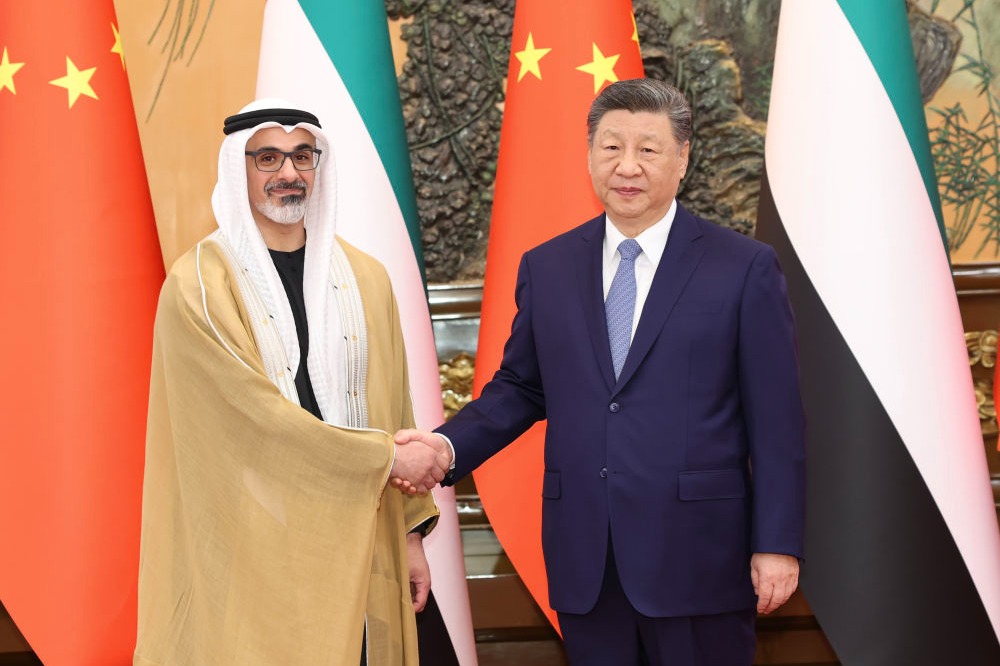
BEIJING — In a high-profile bilateral meeting held in the Chinese capital on Tuesday, President Xi Jinping laid out a structured four-point proposal designed to advance lasting peace and long-term stability across the Middle East. The talks took place during a working visit by Sheikh Khaled bin Mohamed bin Zayed Al Nahyan, Crown Prince of Abu Dhabi of the United Arab Emirates.
Against a backdrop of ongoing regional tensions and unresolved conflicts that have rippled across the globe, President Xi’s proposal outlines four core guiding principles to steer future peace efforts. First, it calls for universal adherence to the fundamental principle of peaceful coexistence between all regional states, regardless of differing political systems, religious traditions or strategic outlooks. Second, it emphasizes unwavering respect for the inviolable principle of national sovereignty, a cornerstone of modern international relations that underpins the territorial integrity of every nation in the region. Third, it prioritizes consistent commitment to the rule of law in international affairs, establishing clear, shared norms to govern interactions between states and resolve disputes through peaceful, rule-based channels. Finally, the proposal calls for coordinated, integrated advancement of development initiatives and security frameworks, recognizing that sustained economic progress and collective security are mutually reinforcing pillars of stable societies.
The proposal comes as China expands its diplomatic engagement in the Middle East, positioning itself as a neutral broker committed to de-escalation and inclusive dialogue between regional actors. The meeting between President Xi and the Abu Dhabi Crown Prince also underscores the deepening bilateral ties between China and the United Arab Emirates, spanning trade, energy, security and cultural cooperation.
Xi puts forward four-point proposal on promoting Middle East peace, stability