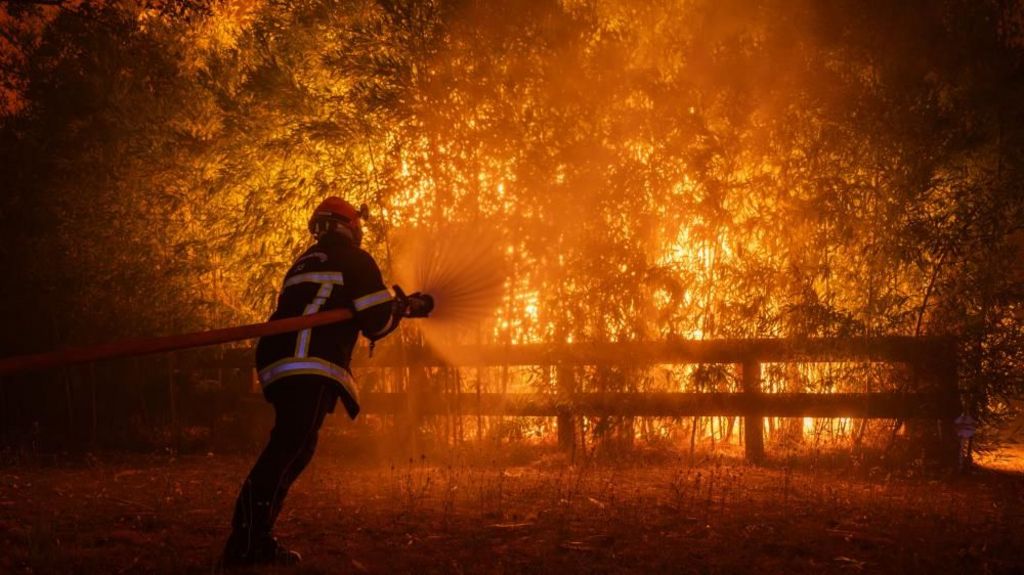
A fast-expanding wildfire that has already scorched tens of thousands of hectares of land is pushing toward the southwestern French city of Bordeaux, prompting President Emmanuel Macron to convene an emergency cabinet meeting on Monday to coordinate the national response to the growing crisis.
As of Sunday, the active fire line sat just 15 kilometers (9 miles) from Bordeaux’s city limits, where more than 850,000 residents currently remain under no evacuation orders, according to mayor Thomas Cazenave. However, officials warn an incoming second heatwave threatens to derail containment efforts, with forecasts predicting temperatures will surge to 40°C across parts of the country starting Tuesday. France’s Interior Minister Laurent Nuñez described the ongoing situation as “very unfavourable”, noting the blaze is moving “erratically” in the direction of the city. Tens of thousands of residents in outlying areas surrounding Bordeaux have already been forced to evacuate their homes over the past week.
The massive Gironde region fire has spawned an extremely rare and dangerous atmospheric phenomenon known as a pyrocumulonimbus – a fire-generated thunderstorm fueled by the blaze’s own intense winds and lightning, spokespeople for the National Firefighters Federation of France (FNSPF) confirmed. “We don’t know how the blaze will spread, the fire front is constantly shifting. We cannot fight it directly,” said FNSPF spokesman Eric Brocardi, framing the battle as a lopsided “David-versus-Goliath” scenario. Brocardi added that only two outcomes will bring the fire under control: three consecutive days of heavy rainfall, or deliberately steering the blaze toward a natural barrier like the ocean where it will burn itself out.
To date, the Gironde fire has destroyed roughly 42,000 hectares of land, marking one of the largest wildfire events in France since the end of World War II. Across the entire country, more than 98,000 hectares have burned since the start of 2026, and over 220,000 people have been displaced from fire-risk zones in southwestern regions alone. Speaking on Saturday, President Macron reaffirmed the national government’s commitment to supporting affected communities, stating France would “rebuild” and that his administration would “be there for as long as is needed”.
This crisis is not isolated to France. Over the past week, uncontrolled wildfires have swept across large swathes of Southern Europe, with neighboring Spain facing some of the most devastating conditions on record. Combined, more than 330,000 people have been evacuated across both countries.
In eastern Spain, firefighters worked through Sunday to contain a newly ignited blaze near the coastal city of Valencia that has already forced roughly 15,000 residents to flee. Pilar Bernabe, the central government’s delegate to Valencia, called the fire “very intense” and warned that worsening weather conditions would amplify challenges in the coming days. Spanish Interior Minister Fernando Grande-Marlaska, who is scheduled to tour the affected Valencia region on Monday, reported the fire is advancing slowly, while Prime Minister Pedro Sanchez warned “difficult hours lie ahead” during a visit to a fire zone in Ávila province, west of Madrid. Sanchez has also called for a sweeping national agreement to address the underlying climate emergency driving extreme wildfire events. During a tour of an emergency shelter in Villamanta, southwest of the capital, King Felipe VI stated the blazes have caused “incalculable” damage to Spain’s unique natural heritage.
The fire burning in the Ávila region is the largest wildfire in Spain’s recent history, according to Ecological Transition Minister Sara Aagesen. As of Sunday, Aagesen confirmed roughly 77,000 hectares of land across Spain have been burned by the ongoing outbreak, and more than 90,000 people have been evacuated from high-risk areas surrounding Madrid and Ávila.
For many displaced residents, the crisis has brought sudden, devastating upheaval. Olga Congacha, a 50-year-old resident who fled her village of Robledo de Chavela west of Madrid on short notice, described overwhelming panic when evacuation orders came. “I didn’t know whether to cry or what. It was a moment when you feel awful,” she said. When Congacha returned to her home briefly on Sunday to retrieve critical medication, she found the village streets empty and her home covered in a thick layer of ash. While authorities confirmed that winds are currently pushing the blaze near Madrid southward, away from the capital, the fire has already forced additional evacuations of small villages in its path.