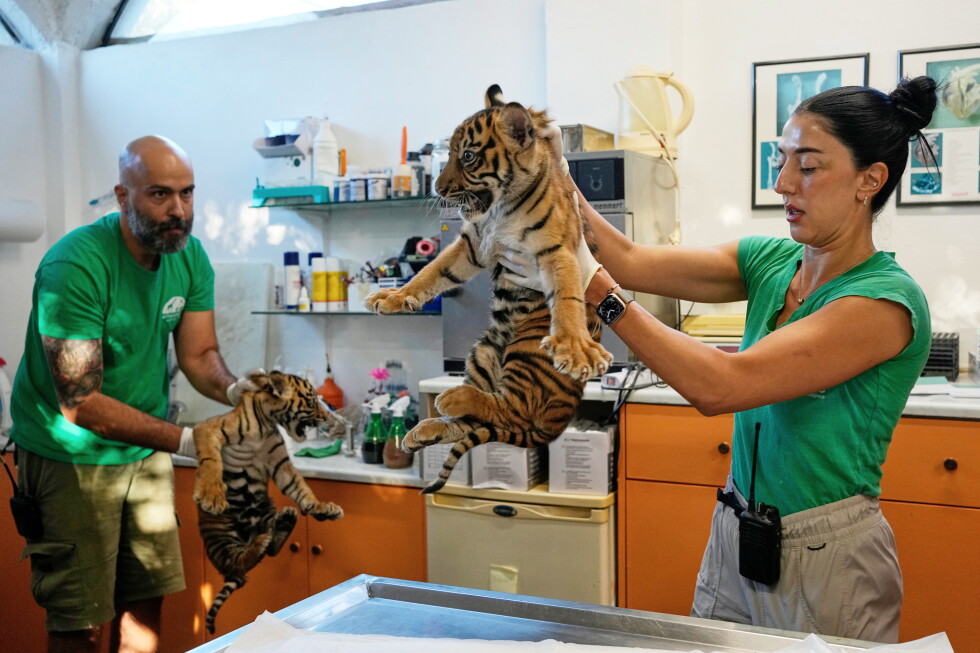
In a small, forested corner of the Attica Zoological Park near Athens, Greece, a groundbreaking conservation milestone has emerged for one of the planet’s most vulnerable big cat species: three Sumatran tiger cubs, born to first-time parents earlier this summer, are offering a lifeline for a predator on the brink of disappearing from the wild.
The 2-month-old cubs — two males and one female — completed their first major health check Tuesday, receiving embedded identification microchips and their initial round of protective vaccinations, as part of a coordinated international breeding program designed to preserve a genetically healthy backup population of the critically endangered subspecies. Only around 400 Sumatran tigers are estimated to survive in their native habitat on the Indonesian island of Sumatra, where rampant deforestation for agriculture and development has fragmented and destroyed more than half of the big cat’s natural forest range over the past three decades. Classified as Critically Endangered by the International Union for Conservation of Nature (IUCN) and leading global conservation groups, the subspecies is already lost from two other Indonesian islands, Java and Bali, making its survival all the more urgent.
“The Sumatran tiger ranks among the most threatened feline species on the planet,” explained Theodoros Babilis, head keeper for carnivores and primates at the Attica Zoological Park. Widespread deforestation has pushed wild populations into isolated, shrinking pockets, increasing the risk of inbreeding and human-wildlife conflict that further erodes numbers. That is why zoos across Europe, North America and beyond have built a coordinated, database-managed safety population: to preserve genetic diversity that could one day support reintroduction efforts if wild habitats are protected and restored.
The Sumatran tiger is the smallest of the world’s eight living tiger subspecies, a trait adapted to its dense island forest habitat, but full-grown males still reach up to 2.5 meters in length and weigh more than 140 kilograms. Agile climbers and powerful swimmers, each tiger carries a unique pattern of dark stripes across its orange coat — as individual as a human fingerprint — that helps it stalk prey through dense undergrowth, where it hunts deer, wild boar and small native mammals.
Even at just two months old, the newborn cubs have already developed sharp claws and teeth, making routine veterinary work a careful, high-stakes task. Born in early July to mother Toba and father Argos, who passed away from cancer shortly after the cubs’ birth, the trio was noticeably restless during Tuesday’s procedure. Veterinary staff required extra assistance to move the cubs between transport carriers on electric golf buggies, working as quickly as possible to limit stress for the young animals.
Zoo veterinarian Dr. Arsenoi Psaroudaki, who led the health check, noted that caring for these wild big cats is far more demanding than working with domestic animals. “The tigers don’t like to be handled. They’re very wild,” she explained, adding that the reward of the work far outweighs its challenges. For the team in Greece, this small new litter represents more than just a new addition to the zoo: it is tangible hope for safeguarding a species that is slipping away in the wild.
“It’s very humbling to be able to work with the rarest tiger species in the world,” Psaroudaki said. Zoo staff have announced the cubs will be given names drawn from characters in Homer’s *The Odyssey*, a nod to their Greek birthplace, as they grow and develop in the protected park environment. The cubs’ microchip data will be added to a global shared database that coordinates breeding across participating zoos, ensuring the long-term genetic health of the backup Sumatran tiger population.