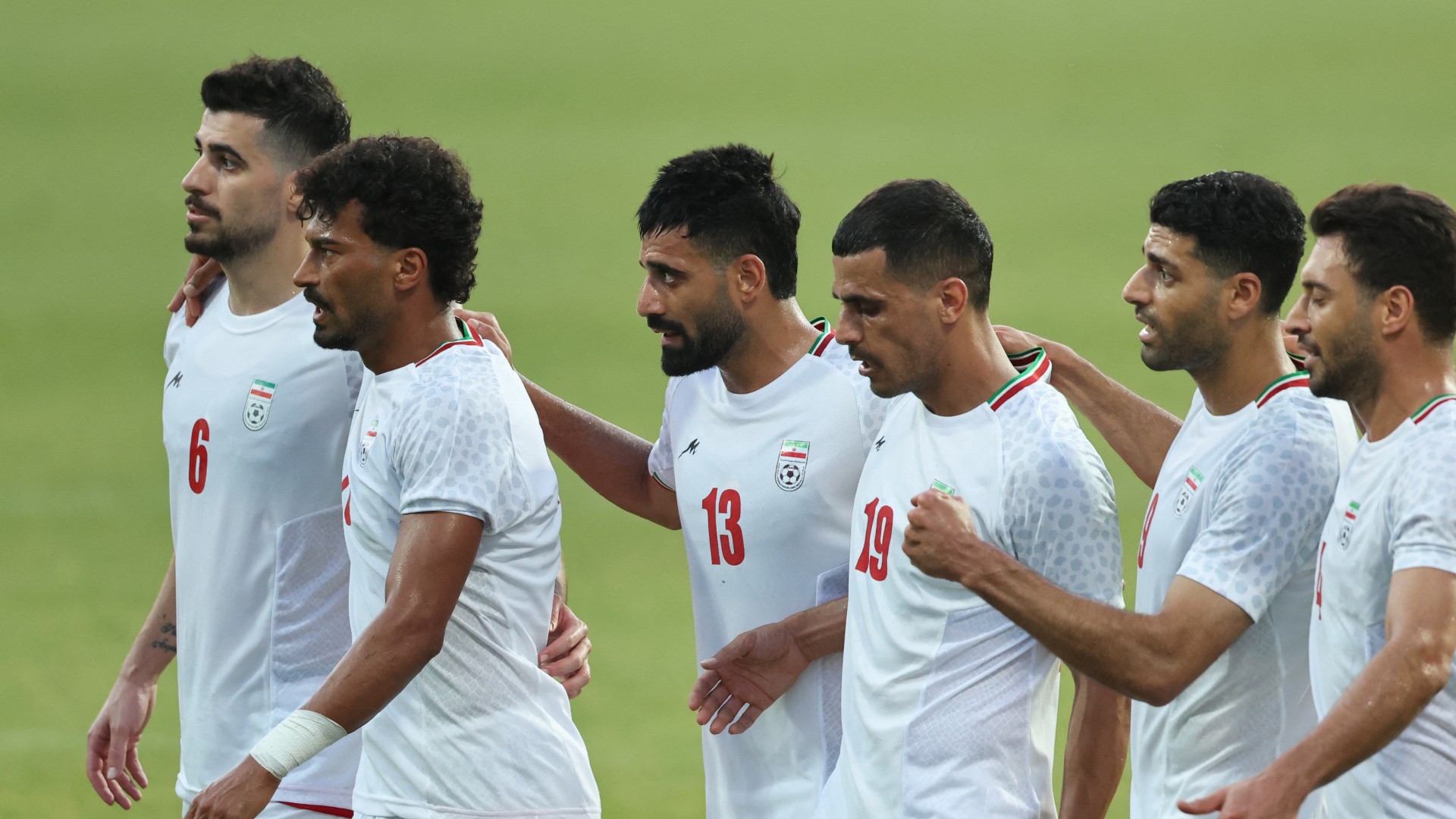
For decades, Iran’s journey in the FIFA World Cup has been inextricably intertwined with the nation’s political and social upheavals. But the 2026 tournament, hosted in part by the United States, has brought the country’s national team, Team Melli, into an uncharted maelstrom of competing pressures that no other side in the competition’s history has had to navigate.
Team Melli’s opening match against New Zealand in Los Angeles falls just one day after former U.S. President Donald Trump announced a landmark tentative deal with Iran’s government, a development that could bring a close to three and a half months of open conflict. The location of the match alone adds layers of tension: Los Angeles is widely nicknamed “Tehrangeles,” home to one of the largest Iranian diaspora communities in the world, the majority of which hold staunch anti-regime views. Back in Iran, public support for the national team is deeply divided, with many Iranians viewing the side as a symbol of the ruling government rather than a unifying national representative. This rift has deepened dramatically after the government’s reported crackdown on mass anti-government protests earlier this year that left thousands of demonstrators dead.
“There is a long history of politics mixing with football in Iran,” explained Jahanyar Mohebbi, a former head coach of Iran Pro League side Foolad FC. “The players feel the pressure from all sides – the politicians, the fans in the U.S. and at home.” This pattern of political entanglement stretches back to Iran’s very first World Cup appearance in 1978. As the squad traveled to Argentina for the tournament, revolution was already sweeping across the country, and the Shah’s government tried to insulate the team from growing domestic unrest. Iran’s star player Parviz Ghleechkhani, who passed away just last month, was barred from the tournament after the Shah’s secret police detained and questioned him over his outspoken political views. Even the team’s legendary goalkeeper Nasser Hejazi, who turned heads with his standout performances in Argentina, missed out on a historic transfer to English powerhouse Manchester United after the revolution disrupted all transfer negotiations.
After the 1979 revolution established the Islamic Republic, the new government under Ayatollah Ali Khomeini remained wary of football, recognizing the sport’s unmatched ability to mobilize mass passion and public discontent. That wariness was validated in 1997, when Iran defeated Australia in a playoff in Melbourne to qualify for the 1998 World Cup. Widespread spontaneous celebrations across Iran grew so large that the team was ordered to delay their return home to let public tensions subside. That qualification set the stage for one of the most politically charged matches in World Cup history: Iran’s group stage clash with the United States in Lyon. Ahead of the game, then-U.S. President Bill Clinton released a public message of goodwill, and Iranian players presented flowers to their American opponents before securing a 2-1 victory. “Every day somebody from the government, from sports officials, they were asking about the game and demanding a win,” recalled Jalal Talebi, Iran’s head coach at the 1998 tournament. “What I tried to tell the players was, ‘Forget what they said – it’s all politics.’ I knew exactly how much pressure they were carrying.”
In the decades that followed, political undertones remained a constant in Iran’s World Cup campaigns. The 2006 tournament brought less international tension, but controversy emerged from within the squad, with reported deep divisions between supporters of star players Ali Daei and Ali Karimi. Karimi later made headlines during 2010 World Cup qualifiers when he and several other players wore green armbands, a gesture widely interpreted as a show of support for opposition protesters contesting the disputed re-election of President Mahmoud Ahmadinejad. Most recently, at the 2022 Qatar World Cup, protest took center stage again: following the death of 22-year-old Mahsa Amini in morality police custody for allegedly violating hijab laws, the entire Iranian squad refused to sing the national anthem before their opening match against England, a silent rebuke of the government that drew global attention.
Beyond the political and social pressures, longstanding international isolation has systematically held Iranian football back. On a practical level, the Iranian Football Federation frequently struggles to access prize money and funding from international governing bodies held in overseas accounts. There has been chronic underinvestment in training facilities and international training camps for the national team, the domestic league has fallen behind other top leagues in the Middle East, and leading international nations routinely refuse to schedule friendly matches against Iran. While Japan, the first team to qualify for 2026, has prepared for the tournament with high-profile tune-up matches against Brazil, England, the U.S. and Mexico, Iran has only been able to arrange warm-up games against Russia, Tanzania, Costarica, Nigeria and Gambia.
Yet for all these systemic obstacles, Iran has consistently qualified for World Cup tournaments and remains the second-highest ranked men’s national team in Asia, trailing only Japan. The 2026 campaign, however, represents the most daunting challenge the side has ever faced. Until just days before the tournament, there was open uncertainty over whether the entire Iranian squad would even be granted entry to the United States, forcing the team to relocate its pre-tournament training camp from Arizona to Tijuana, Mexico, on the U.S. border.
Mohebbi noted that the chaotic preparation has brought one unexpected upside: “Usually national teams arrive at the tournament exhausted after a long domestic season, but Iran have had a long break and have been training almost like a club side.” That advantage is outweighed by significant drawbacks, though: the Iranian domestic league was canceled back in February, leaving players without competitive match action for months, and constant logistical uncertainty has created pervasive anxiety. “The most challenging thing is the logistics,” Mohebbi added. “Will they even be allowed to train at the stadium a day in advance, or will they just show up for the match? That uncertainty makes everything much harder.”
Team captain Mehdi Taremi, who is competing at his third World Cup, echoed those frustrations after several members of the Iranian delegation were denied U.S. visas. “I’ve been to three World Cups, and they always say once you get off the plane and enter the host country, there’s just a unique atmosphere of friendliness and global connection,” Taremi told ESPN. “Unfortunately, I’m not feeling it right now. There’s a lot of tension right now in this World Cup, you can feel it in the atmosphere, and it’s because of actions like these visa denials.” Still, Taremi emphasized that the squad remains united, regardless of differing views on the Iranian government. “Obviously some people outside Iran, many here, are against the government, but we are all Iranian,” he said. “We are united and we are looking for peace. I think they will come there to support us, and we have to bring them joy.”
For the players, anxiety extends far beyond logistics and visa issues, as they remain constantly concerned about loved ones back in Iran amid ongoing unrest. “It’s been very difficult, I’ll be honest with you, for every single one of us with the whole situation back home,” said winger Alireza Jahanbakhsh. “You have to keep checking on your family, on your loved ones, on your people back home, and of course it’s affecting the whole group.” As the team takes the pitch in Los Angeles, all eyes will be on how the 11 players caught in the middle of global political conflict will perform under the weight of unprecedented pressure.