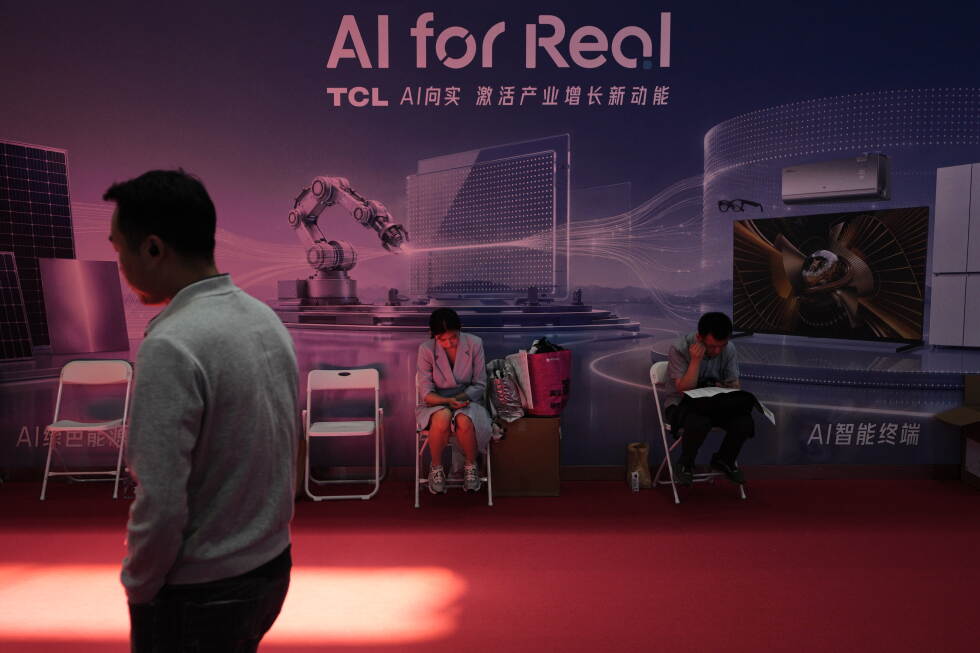
BEIJING – As China aggressively advances government-backed artificial intelligence integration across every major sector of its economy, the technology is triggering rapid, often unsettling shifts in the country’s massive labor market, leaving thousands of workers displaced and forcing widespread adaptation to a new employment landscape. The disruption has sparked debate among economists over AI’s long-term impact on China’s growth trajectory, social stability, and ability to offset its looming demographic challenges.
One of the earliest and most visible impacts of AI adoption has hit white-collar knowledge workers. For 40-year-old former Beijing-based programmer Fei Zhaojun, AI’s arrival came abruptly: just two weeks after his boss questioned whether AI could replace human coding teams, Fei was laid off alongside 160 of his colleagues. Today, Fei is using his career break to create vlog content focused on ordinary people’s experiences, while he navigates what comes next. He acknowledges that most mid-tier coding roles are already readily replaceable by modern AI tools, and has adopted a pragmatic approach: if AI is reshaping the industry, workers have no choice but to learn to work with it.
The disruption extends far beyond software development. Du Qinchun, a part-time translator based in Chengdu, now works to train AI translation models — a role that has brought him temporary new work, even as industry-wide translation pay has dropped by more than half from just a few years ago. This trend has reshaped higher education too: as AI-powered translation tools become ubiquitous, popular foreign language university programs have rapidly fallen out of favor with prospective students. In creative industries, generative AI has upended China’s booming short drama sector: industry data shows the number of live-action short-form vertical series for mobile platforms dropped roughly 75% year-over-year in the first quarter of this year, as AI handles more creation, production, and distribution tasks.
Official policy has positioned China at the forefront of global AI adoption. Through the national “AI Plus” initiative and a 2030 five-year development plan, Beijing is pushing to embed AI across all sectors to gain a competitive edge in its ongoing technology rivalry with the United States. This proactive policy support has led to explosive growth in enterprise AI integration: market intelligence firm IDC reports the share of Chinese industrial enterprises using AI models and autonomous agents jumped from just 9.6% in 2024 to 47.5% last year. IDC senior research manager Yanze Du notes that China’s dynamic open-source AI ecosystem has accelerated innovation in industrial applications, closing the gap between cutting-edge foundational model capabilities and real-world business value. Today, the technology is already moving beyond office and creative work: humanoid robots are sorting parcels in postal facilities on a small scale, testing capabilities for traffic direction and coffee preparation, while autonomous food delivery robots are expanding across urban areas, putting millions of delivery workers’ livelihoods at potential risk.
Unlike many Western economies where public pushback against AI-driven job displacement is more common, anti-AI sentiment remains muted in China, according to industry analysts. “There appears to be far less anti-AI sentiment in China than elsewhere. Most people seem either positive, neutral, or mildly interested in AI,” explained Shujing He, a Beijing-based senior analyst at research and advisory firm Plenum. “Individuals who worry about being replaced, as well as those who have already left traditional workplaces, are often eager to experiment with AI-enabled businesses and independent ventures. The level of interest is striking.” He added that workers with narrow, specialized roles in AI-vulnerable fields like software development and multimedia creation face the highest displacement risk, as AI can now complete tasks that once required years of specialized training for a fraction of the cost and time.
A recent International Labour Organization report adds another layer to the disruption: women in China face disproportionately higher risks of AI-driven job loss, as they are overrepresented in roles easily automated such as electronics assembly, and remain underrepresented in high-growth science and technology fields that are more resilient to automation.
For China’s already slowing economy, AI brings a mixed set of long-term outcomes. Years of sluggish growth have been compounded by a prolonged housing market downturn that has eroded household wealth, and AI-driven job uncertainty is further dragging on consumer spending as households cut back on purchases to prepare for potential unemployment. Cornell University economics and trade policy professor Eswar Prasad notes that while AI is driving major productivity gains across China’s tech sector, those gains have not translated to broad new job creation. “AI is likely to lift productivity across the board but could have a severe disruptive effect on employment, worsening the employment growth problem and resulting in a detrimental effect on social stability,” Prasad warned. Current labor market data underscores this uncertainty: while China’s headline urban unemployment rate holds around 5%, unemployment for 16 to 24-year-olds (excluding students) is roughly three times that figure. Major Chinese tech giants, much like their U.S. competitors, have already cut and restructured tens of thousands of roles in recent years, with AI integration cited as a key driving factor.
Yet some economists argue that AI could ultimately offset one of China’s biggest long-term economic challenges: its rapidly aging and shrinking population. By 2050, projections show China will have fewer than two working-age adults to support each retiree, compared to more than 2.5 in the United States. Xuenan Cao, a professor at San Francisco Bay University specializing in technology and society, argues that automation can fill critical gaps left by a shrinking workforce rather than acting purely as a threat to employment. “Automation could partially offset a shrinking workforce rather than being purely a threat to it,” Cao said.
For many displaced workers, the common approach has become “if you can’t beat them, join them.” Wang Zhicheng, a former scriptwriter for a children’s educational animation company, saw his employer lay off half of its 13-person writing team amid AI integration. He chose to resign and launch an independent studio creating illustrated children’s books, using AI as a productivity tool rather than viewing it as a replacement. “You can treat AI as a tool just like Microsoft Word,” Wang explained. “While AI can cut down on brainstorming and drafting time, the scripts it generates often feel formulaic, repetitive, and inconsistent in depth. Humans are still the decision makers on which one to pick or pursue among all that AI generates.”
Even in less affected fields, many workers see AI as a helpful complement rather than a threat. Yang Zheng, a 29-year-old high school chemistry teacher in China, says even though students now use AI to help with homework, the technology improves rather than undermines his work. “Teachers cannot be there all the time,” he said. “It is a good thing for students as it generates responses in real-time so that students can ask follow-up questions. It often gets things wrong, but it improves over time.”
As AI adoption continues to accelerate across China’s economy, the coming years will test whether the country can harness the technology’s productivity gains while mitigating its disruptive impact on employment and social cohesion.