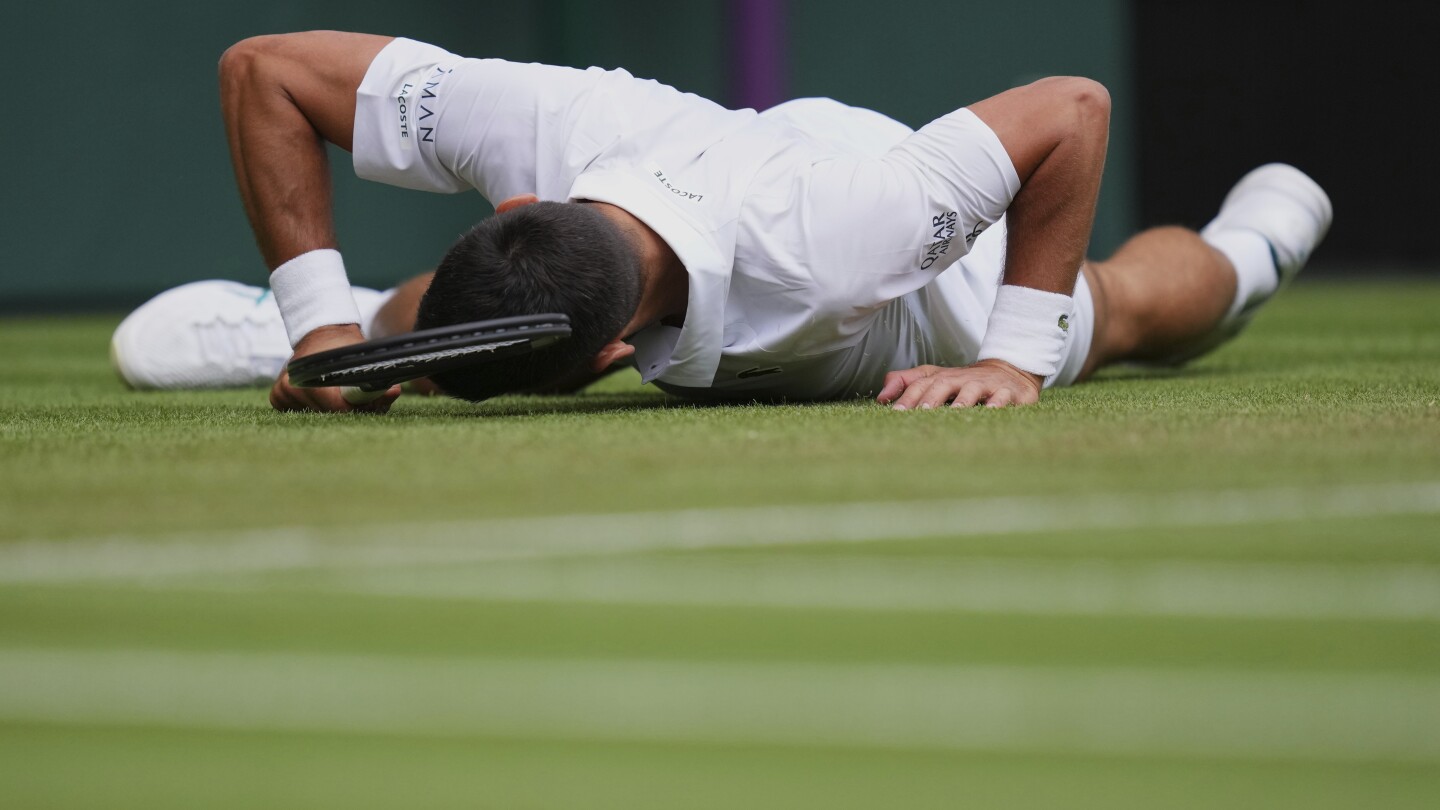
LONDON (AP) — Novak Djokovic, despite his remarkable success on Wimbledon’s grass courts with 100 wins and seven of his 24 Grand Slam titles, did not grow up playing on this surface. In fact, his first encounter with grass was in 2005, during a qualifying event at Roehampton, where he secured his debut at the All England Club at 18. ‘That was actually the first year I stepped out on the grass,’ Djokovic recalled. ‘It felt very natural for me to adapt, even though I grew up on clay.’ Djokovic is set to face Alex de Minaur in the quarterfinals on Monday. The unpredictability of grass courts has been a recurring theme at Wimbledon this year, with eight top-10 seeds—four women and four men—exiting in the first round, the highest number since 2001. Elena Rybakina, the 2022 champion, noted, ‘Grass is very unpredictable.’ With Rybakina’s third-round exit and defending champion Barbora Krejcikova’s loss to Emma Navarro, the women’s singles will crown a first-time winner for the ninth consecutive year. The All England Club’s grass courts pose unique challenges, as most players grow up on hard or clay courts. Grass courts, used for only about a month each year, require significant adaptation. ‘It’s a surface that requires a lot of adapting. You have to go by feeling,’ said Lorenzo Musetti, a semifinalist last year. The slippery footing, skidding balls, and inconsistent bounces make grass a demanding surface. Tommy Paul, who grew up playing on green clay, described grass as ‘the most fun surface to play on’ despite its challenges. Many top players, like Naomi Osaka and Iga Swiatek, have struggled on grass, with Osaka citing a past injury as a source of fear. Swiatek, despite a junior Wimbledon title, has found it her least successful Slam as a pro. ‘This year on grass, I had some moments where I just felt comfortable,’ Swiatek said. ‘It was just pretty smooth.’
Wimbledon: All the early upsets could stem from a lack of experience on grass courts