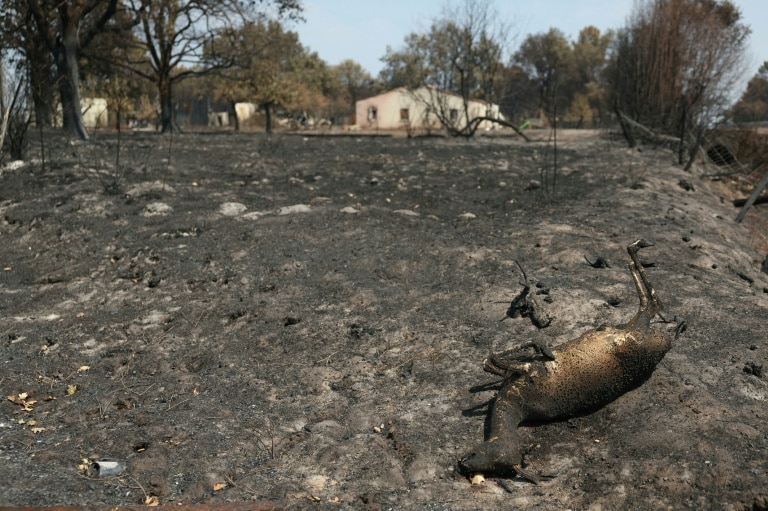
A massive wildfire that has torn through more than 42,000 hectares of forest west of Bordeaux, France, has left a trail of ecological destruction, with officials warning that wildlife populations face catastrophic, irreversible losses as a record heatwave threatens to reintensify the blaze.
The inferno, which ignited earlier this week, has already consumed residential properties, agricultural land and infrastructure across the Gironde region, but the ecological toll is shaping up to be one of the disaster’s most devastating consequences. France’s Ecology Minister Monique Barbut confirmed Monday that wildlife losses are already “extremely significant”, and warned that final mortality numbers will almost certainly reach catastrophic levels, despite full assessments not yet being complete.
In the worst-hit Atlantic coastal communes such as Le Porge, the fire’s intensity was so extreme that almost no native animals could survive, according to Laurent Tillon, an engineer with France’s National Forestry Office. “The power and energy released by the fire were far too great for any creature to outrun or outlast it,” Tillon told Agence France-Presse.
Ecology experts note that even species with adaptations to forest ecosystems could not withstand the extreme heat, choking smoke and rapid spread of the flames. This includes already threatened native species, such as the Western spadefoot burrowing toad, the regionally rare ocellated lizard, and the Etruscan shrew — one of the smallest mammals on the planet. Insect populations, which form the base of many regional food chains, have been killed off on a mass scale, creating long-term ripple effects for the entire ecosystem.
Grégory Lois, an ornithologist at Paris’ National Museum of Natural History, explained that bird species that rely on insects for food will struggle to survive in the region for years to come. “That entire burned area will be completely uninhabitable for these species next year,” Lois said. Ash runoff from the charred landscape has also contaminated local rivers and streams, damaging freshwater and aquatic ecosystems. Celine Sissler-Bienvenu, an animal protection and crisis management expert, pointed to the European pond turtle, a long-lived native species that has now suffered major population hits from large wildfires in the same region twice since 2022.
Even faster-moving species that managed to flee the advancing flames have not escaped harm. Deer and other large mobile animals that escape the initial blaze often become disoriented in unfamiliar territory outside their normal ranges. Many become trapped between shifting fire lines, while others wander onto major roads or railway lines, where deadly vehicle collisions are common. Smoke and toxic fume inhalation also causes both immediate injury and long-term chronic health issues, particularly for smaller animals with sensitive respiratory systems, such as birds.
For the animals that do survive the fire, the loss of habitat and feeding grounds creates new, ongoing struggles. Survivors are forced to compete for limited resources in unburned patches of forest already occupied by established wildlife populations, leading to food scarcity and increased conflict.
French Prime Minister’s office will convene a meeting Tuesday to discuss the full ecological impact of the fires and outline potential recovery and restoration strategies. Barbut cautioned that reintroducing species that were displaced or extirpated by the fire will be an enormous challenge, noting that habitat restoration must come first. “When there are no longer any forests left, you cannot simply bring species back,” she said. “Wildlife cannot survive without a functional habitat to call home.”
Forecasters warn that an incoming heatwave this week could reignite the existing fire lines, expanding the burned area and worsening the already severe ecological damage.