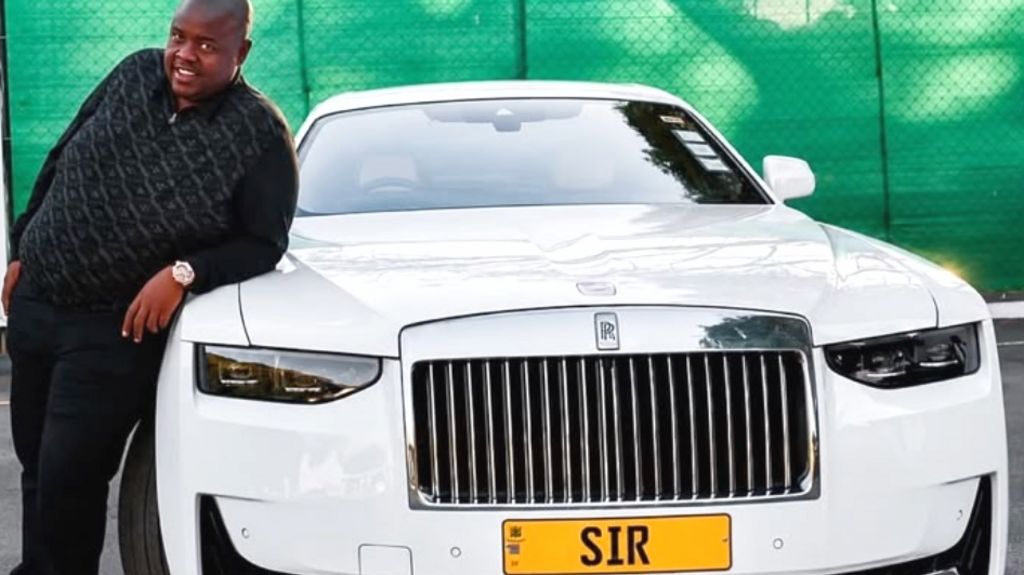
Last week, Zimbabwean business magnate and political powerbroker Wicknell “Sir Wicknell” Chivayo, 45, and his wife Lucy Muteke died in a helicopter crash, sparking a fierce national debate that has kept the story at the top of Zimbabwe’s public discourse. Chivayo, a figure who polarized public opinion in life, continues to split the country in death, leaving behind a legacy of ostentatious wealth, controversial political ties, and unresolved questions about the origins of his fortune.
A self-made magnate who built his public persona entirely around unapologetic excess, Chivayo rose from extremely humble beginnings. Orphaned at age 10, he dropped out of high school at 15 when his family could no longer afford tuition, starting his career as a wages clerk at a local bus company. He cut his teeth in informal trade during Zimbabwe’s crippling hyperinflation crisis, selling mobile phones and trading foreign currency, much of it on the black market. In 2005, he was convicted of money laundering involving 837,000 South African rand, serving three years of a five-year sentence at Chikurubi Maximum Prison before his release.
After leaving prison, Chivayo built his business empire in Zimbabwe’s energy sector, operating as a so-called “tenderpreneur” who profited from securing lucrative government contracts. As the head of Intratrek Zimbabwe, he partnered with Chinese electrical giant CHiNT Electric, taking advantage of the country’s indigenization policy, which required foreign firms to cede majority control to black Zimbabwean owners. His most high-profile and controversial project was a 100MW solar power plant in Gwanda, awarded to Intratrek in 2014 with a $170 million contract. Though the company received a $5 million advance, the plant was never built, with a parliamentary inquiry labeling Intratrek a “briefcase company” used as a front for investment. Chivayo defended the arrangement, noting CHiNT was responsible for technical expertise, and just weeks before his death, the government issued a new order for Intratrek to complete the project within 24 months.
Chivayo’s relationship with Zimbabwe’s ruling Zanu-PF party and President Emmerson Mnangagwa perfectly encapsulated his controversial rise. When Mnangagwa first took office in 2018, he publicly warned Chivayo, noting Chikurubi Maximum Prison was not full, in a clear reference to the tycoon’s past conviction and controversial business practices. Within a few years, however, the relationship transformed into a close public alliance, with Chivayo openly endorsing Mnangagwa and Zanu-PF, and gaining unprecedented access to the president. His political connections stretched across the African continent: he secured citizenship and a diplomatic passport from Eswatini’s King Mswati III, posed for photos with nearly a dozen sitting African presidents, and even was driven to his helicopter by Kenyan President William Ruto after attending the engagement of Ruto’s daughter. Ruto offered a glowing tribute after Chivayo’s death, but the relationship sparked widespread criticism from Kenyan citizens who viewed Chivayo with deep suspicion.
A defining feature of Chivayo’s public life was his relentless self-promotion and ostentatious displays of wealth on social media. He posted photos of himself posing with stacks of cash, gave video tours of his collection of luxury vehicles (mostly customized white Rolls-Royces with vanity plates), and flaunted his collection of high-end watches and designer shoes. In a country where the World Bank estimates nearly half the population lives below the international poverty line, Chivayo ignored widespread criticism of his extravagant lifestyle, doubling down on displays of wealth as his fortune grew.
Beginning in 2023, Chivayo launched a high-profile gifting spree, handing out luxury cars and cash to influential politicians, musicians, religious leaders, and social media influencers across Zimbabwe. Critics framed the giving as blatant grandstanding and an attempt to buy political influence for Zanu-PF, noting nearly all recipients were aligned with the ruling party. Prominent beneficiaries included top Zanu-PF-aligned musician Jah Prayzah, who received three luxury cars and roughly $400,000, and Bishop Nehemiah Mutendi, leader of the fiercely pro-Zanu-PF Zion Christian Church, who received four luxury cars and millions in cash. Even some high-profile critics of the regime and Zanu-PF-aligned figures rejected his gifts: veteran musician Thomas Mapfumo initially turned down an offered luxury car and home, calling Chivayo’s money “dirty”, though he later accepted $1 million to perform at Chivayo’s upcoming birthday party, drawing criticism from long-time supporters. Not all of Chivayo’s giving was targeted at the powerful: he donated 20 ambulances to Zimbabwe’s struggling public health system, gave buses to local schools, and pledged $500,000 to upgrade schools and a clinic in his rural hometown, where he was building an $8 million eight-bedroom mansion.
In death, the polarization that defined Chivayo’s life remains as sharp as ever. Supporters and recipients of his generosity have mourned his passing, with politicians, religious leaders, and business figures offering public tributes, describing him as a generous, pure-hearted philanthropist who lifted up fellow Zimbabweans. Detractors, however, have pushed back against the cultural norm of avoiding criticism of the dead, arguing that Chivayo’s wealth came from inflated government contracts that siphoned resources from a struggling nation, pointing to Zimbabwe’s collapsing public health system and widespread poverty while he doled out luxury gifts to already wealthy elites. Pedzisai Ruhanya, director of the Zimbabwe Democracy Institute, told media that Chivayo’s generosity was almost exclusively targeted at influential people, calling it a strategic move to secure protection and support from ruling party power brokers.
Chivayo’s sudden death has left Zanu-PF without one of its most high-profile and colorful campaigners, and left many Zimbabweans with lingering unanswered questions about how a high-school dropout with a prior criminal conviction rose to become a billionaire with access to the highest levels of political power across the continent. Even as the country prepares for the couple’s burial, debate over his legacy continues to rage across Zimbabwe and the broader African continent.