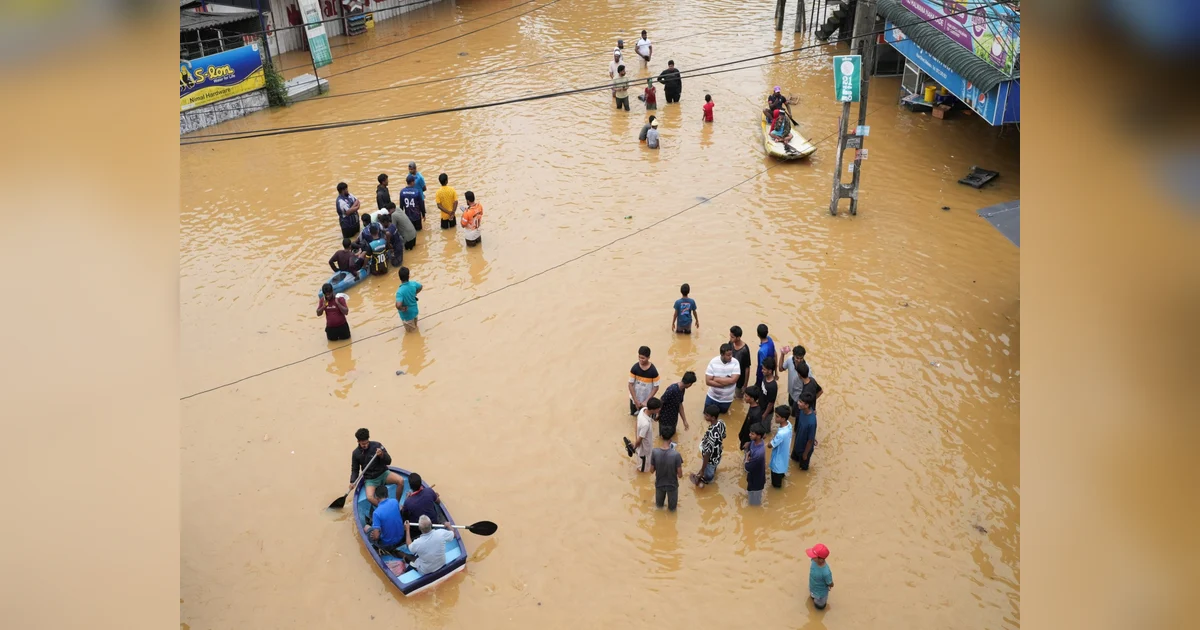
When Cyclone Ditwah approached Sri Lanka with destructive force last week, India’s humanitarian machinery activated with precision and purpose. Even before the storm made landfall, New Delhi had positioned naval assets, relief supplies, and emergency teams on standby, demonstrating what has become standard protocol for the region’s dominant crisis responder.
This rapid mobilization represents neither anomaly nor exception but rather the established norm in Indian foreign policy. Over the past decade, India has systematically developed its capacity as the Indian Ocean Region’s most reliable first responder, operating under a clearly articulated principle: in moments of crisis, neighboring nations receive priority attention.
The architecture of India’s response mechanism involves sophisticated coordination between multiple government agencies. As Sri Lankan authorities issued early warnings, India’s Ministry of External Affairs and Navy immediately engaged Colombo counterparts. The Southern Naval Command prepared ships laden with relief supplies, medical teams, and emergency equipment while Coast Guard aircraft stood ready for search and rescue operations. Critical infrastructure including high-capacity power generators and water purification units were pre-positioned for immediate deployment.
This operational pattern has become familiar throughout South Asia. India consistently anticipates distress calls rather than awaiting them—a critical advantage in a region frequently battered by cyclones, monsoons, and seismic events where response speed directly correlates with survival rates.
The historical record demonstrates remarkable consistency. During Nepal’s devastating 2015 earthquake, India launched Operation Maitri, its largest humanitarian mission to date, with Air Force aircraft conducting over 250 sorties that rescued approximately 5,000 people and delivered thousands of tons of essential supplies.
When Sri Lanka faced economic collapse in 2022, India provided over $4 billion in credit lines and emergency assistance, outpacing all other nations in both scale and urgency. During Maldives’ 2014 drinking water crisis, Indian naval ships delivered over 1,000 tons of potable water within hours of the request. Similar rapid responses occurred during Cyclone Mocha in Myanmar and Bangladesh (2023) and throughout the COVID-19 pandemic through the Vaccine Maitri initiative that supplied critical medical resources to multiple nations.
This consistent humanitarian engagement stems from formal policy doctrines. India’s ‘Neighbourhood First’ and ‘SAGAR’ (Security and Growth for All in the Region) frameworks recognize that regional stability and prosperity are interconnected. The approach contains a moral dimension as well, acknowledging centuries of shared cultural, commercial, and social exchange across South Asian borders.
As climate change intensifies weather-related disasters, India’s role as regional stabilizer grows increasingly vital. The nation has dramatically expanded its response capabilities—from naval assets to satellite technology—while maintaining unwavering commitment to regional assistance. For Sri Lanka and neighboring nations, this reliability represents an invaluable security component in an uncertain world.
India has demonstrated repeatedly that it serves not merely as a fair-weather partner but as the nation that arrives first during crises and remains until the last family reaches safety. In a region characterized by complex geopolitical relationships, India has established itself as South Asia’s most dependable humanitarian ally.