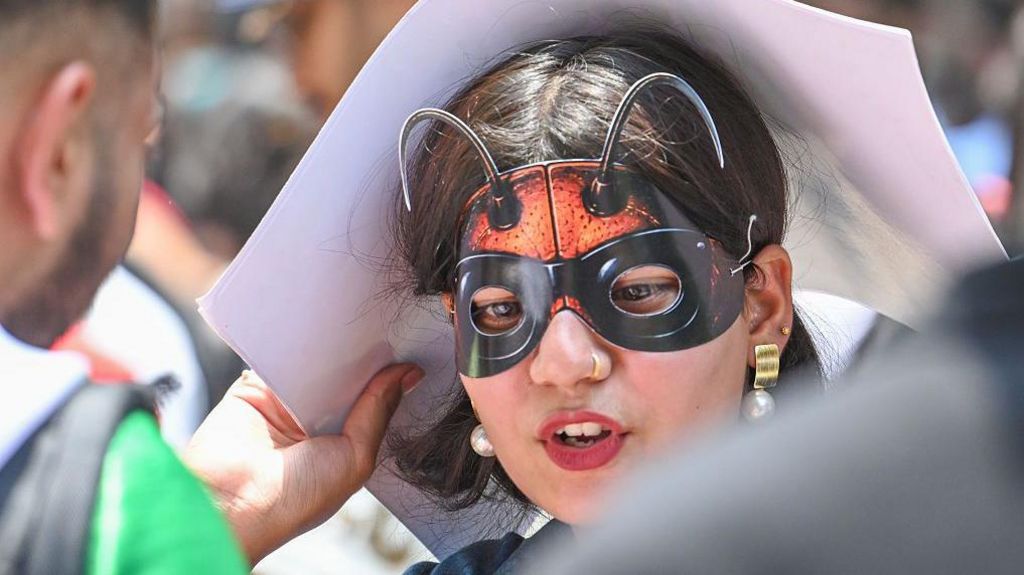
Beneath the relentless 40-plus-degree Celsius heat of Delhi’s summer, hundreds of young protesters have occupied Jantar Mantar, the Indian capital’s historic 18th-century astronomical observatory and most iconic protest ground, for 10 consecutive days and nights. Surrounded by heavy yellow metal police barricades and watched over by uniformed officers and paramilitary troops, students, young professionals and activists gather in clusters: some chant, some sit against the scorching pavement, and even sleep on the sun-baked asphalt as protest leaders cycle through speeches and the crowd belts out rebellious Bollywood hits. What makes this demonstration stand out, however, is the protesters’ chosen identity: they call themselves “cockroaches”, the core of a viral satirical-turned-grassroots movement named the Cockroach Janta Party (CJP).
The movement traces its unexpected origins to mid-May, when India’s Chief Justice Surya Kant sparked widespread public fury by comparing unemployed young people entering journalism and activism to “cockroaches” and “parasites”. Though the judge later clarified his remarks were targeted only at people holding fake degrees, not young people as a whole, the damage was done — and the backlash birthed a movement.
It started with a throwaway social media post from Abhijeet Dipke, a 30-year-old public policy postgraduate at Boston University who was back in India at the time. “I had just come back from the gym and was playing FIFA on my PS5 when I saw the chief justice’s comment,” Dipke recalled to reporters at the protest site. Disappointed and confused by the remark, he posted a single question to X: “What if all cockroaches come together?”
The post went viral, racking up hundreds of thousands of views and responses, particularly from Generation Z. Flooded with comments suggesting a collective platform, Dipke leaned into the absurdity: an AI tool generated a logo featuring a cockroach in a formal suit, and the Cockroach Janta Party — a name that parodies Prime Minister Narendra Modi’s ruling Bharatiya Janata Party (BJP) — was officially launched. What began as a space for memes and jokes quickly evolved into a outlet for young Indians to air long-simmering frustrations over scarce job opportunities and a persistent pattern of exam paper leaks that have derailed countless young lives, demanding accountability from ruling officials.
“None of this was intended or planned. It was just meant to be satire, but as millions began signing up, people started saying we also want to turn this into a serious movement because no other political party is talking about our needs or hopes and aspirations. I was kind of forced into it by our supporters,” Dipke explained. As a youth-led movement, the group centered its first demands on the NEET-UG, the national entrance exam for aspiring medical students, which was canceled in early May after a major paper leak. Protesters are calling for Education Minister Dharmendra Pradhan to step down, claiming he bears moral responsibility for the scandal and systemic failures in India’s education assessment system.
Unlike traditional political groups, the CJP has no ambitions to register as an official political party, even as it boasts 22 million followers on Instagram. After Dipke returned to India from Boston, the CJP held its first major protest at Jantar Mantar on June 6. Dipke said he expected to be arrested upon exiting the plane at the airport, but police allowed him to leave, and he led the demonstration hours later. The movement has since rallied in half a dozen Indian cities before returning to Delhi’s Jantar Mantar last week to escalate its demands, with protesters vowing they will not disband until Pradhan resigns.
The protest gained new momentum on Sunday when prominent Himalayan climate and education activist Sonam Wangchuk — whose life story inspired a hit Bollywood film — joined the camp and launched an indefinite hunger strike in support of the movement. Speaking from the protest ground in sweltering heat, Wangchuk said he was standing with young people to demand accountability for India’s failing education system, criticizing the government for being unresponsive and insensitive to young people’s struggles. When asked how long he could sustain the hunger strike in extreme temperatures, he said: “It’s the early days, so no issues. But I don’t think much about health. It’s either death or this series of indefinite hunger strikes, whichever comes first.”
Top government and ruling party officials have pushed back hard against the movement. Pradhan has rejected calls to resign, dismissing the CJP and its supporters as “the B-team of disruptive elements” who “do not have faith in the country’s progress”. BJP president Nitin Nabin went further, framing the group as a “new virus” of “cockroach-like parties” seeking to destroy and divide India. The government’s June 21 retest of the NEET-UG did nothing to ease protester anger.
At the protest site, a haunting memorial wall stands under a yellow tarpaulin, honoring nearly 20 students who, according to their families, died by suicide after the initial NEET-UG cancellation derailed their academic plans. Many of these students came from low-income, marginalized backgrounds that had taken on debt to fund their exam preparation, said schoolteacher Sheetal Choudhary, who works with similar students. “These are the sort of students that I teach in my class,” she explained.
Hundreds of messages of solidarity are scrawled beneath the students’ photos, one reading in Hindi: “If we don’t fight, who will? If we don’t speak, who will?” For young participants like Tamannah Kumari, an undergraduate preparing for police recruitment exams, the movement is the first time anyone has elevated the concerns of young Indians. “I’m preparing for the police recruitment exam, but I worry about a paper leak which would spoil my future,” she said, holding both a CJP flag and the Indian national flag. “The education minister must resign.”
As evening falls each day, the crowd at Jantar Mantar grows larger. CJP chief spokesperson Saurav Das says the movement gains new supporters daily, with backing from student unions, civil society groups, and ordinary citizens who drop off food and water and reach out to volunteer. For the CJP, Pradhan’s resignation is only the first step in a longer fight. “Pradhan’s resignation is just one battle and battles can be won in days, weeks or months,” Das said. “But everyone here who’s on the ground and who’s supporting us online knows that this is a war. And wars cannot be won in a short time. That goal is to get a transparent, accountable, answerable system — and that’s a fight for the long run.”