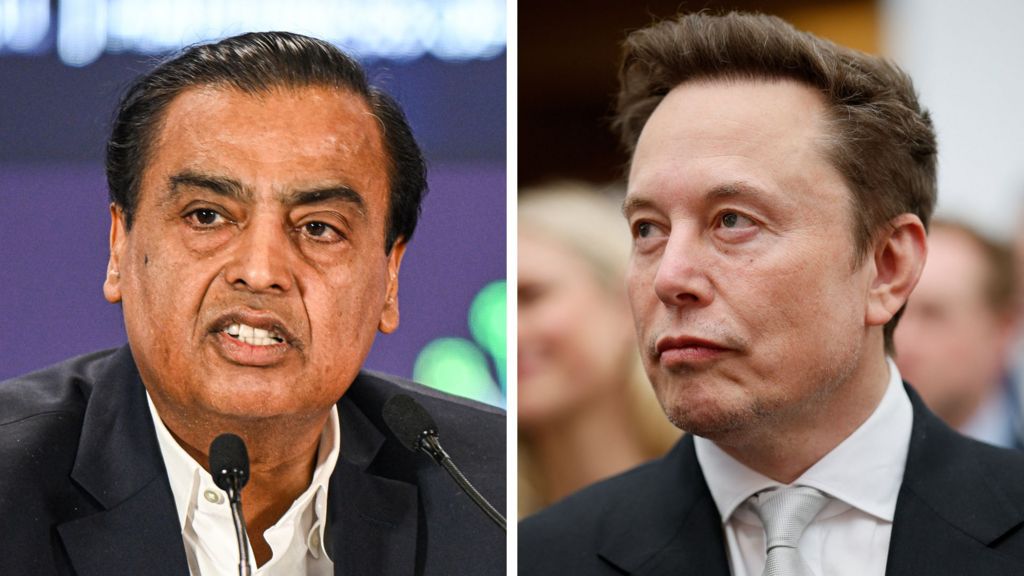
A high-stakes public dispute has erupted over SpaceX’s Starlink satellite internet venture’s delayed entry into India, with Tesla and SpaceX CEO Elon Musk directly pointing fingers at Indian billionaire Mukesh Ambani, alleging that the tycoon’s business empire is using its influence to block Starlink from securing final regulatory approval.
The controversy began on a Wednesday, when Musk took to social media platform X to claim that unnamed “certain oligarchs” were holding a “monopolistic chokehold” over Indian internet consumers. Without naming any individual initially, he added that blocking Starlink’s launch amounted to “a crime against the people of India.” The next day, Musk doubled down on his claims, specifically naming Ambani, whose Reliance Industries conglomerate owns Jio, India’s largest mobile network operator. In a provocative post on X, Musk asked, “Is Ambani the real boss of India?”, questioning why Starlink had not received its final license despite spending five years complying with all Indian government regulations and holding operating licenses in more than 165 countries globally.
India’s Ministry of Communications quickly pushed back against Musk’s accusations, issuing a statement clarifying that the regulatory framework for satellite communications is fair and non-discriminatory. The ministry noted that three major players — Starlink, Eutelsat OneWeb, and Jio Satellite Communications — are all at the same stage of the approval process, with all three awaiting final security clearances and spectrum allocation before they can roll out commercial services. “The suggestion that the framework or its application is unfair or discriminatory is baseless and misconceived,” the ministry said, declining to name Musk directly.
As of press time, neither Mukesh Ambani nor Reliance Group has issued a public response to Musk’s claims, and the BBC has reached out to both parties for additional comment. Bharti Airtel, another major Indian telecom provider that is also prepping its own satellite internet launch, has also been contacted for comment.
Intriguingly, the public rivalry between Musk and Ambani masks a pre-existing business partnership between their companies. Back in March 2024, both Reliance Jio and Bharti Airtel signed formal agreements with SpaceX to distribute Starlink equipment and services across India, pending government approval. The two domestic firms also noted at the time that they would explore opportunities for shared network infrastructure with Starlink.
The dispute unfolded against the backdrop of the 2024 India Mobile Congress held in New Delhi, where senior executives from all three companies gathered to outline their satellite internet plans. Akash Ambani, chairman of Reliance Jio Infocomm and son of Mukesh Ambani, told attendees that his firm was developing its own indigenous satellite communications technology and was also working through the regulatory approval process. When pressed by reporters for a response to Musk’s allegations, Akash Ambani declined to engage, only saying “We want to be heads down and deliver value to our Indian consumers.” Sunil Bharti Mittal, chairman of Bharti Airtel, also confirmed that his company’s satellite internet project remains pending government approval.
Lauren Dreyer, SpaceX executive leading Starlink’s global business operations, told the conference that Starlink has spent years collaborating with Indian regulators and has built customized security controls into its network to meet India’s national requirements. Security concerns have long been a central sticking point for Starlink’s entry into the Indian market. Back in 2024, Indian law enforcement recovered unauthorized Starlink equipment during two separate operations: a drug smuggling probe in the remote Andaman and Nicobar Islands, and a counterinsurgency army operation in the northeastern state of Manipur. At the time, Musk pushed back against suggestions that the equipment was active, noting that Starlink had never turned on commercial service in India, so the recovered hardware could not have connected to its satellite network.
Beyond regulatory and security hurdles, questions also linger about Starlink’s ability to deliver affordable service to mass Indian consumers, especially low-income households in rural regions. India is one of the world’s largest and fastest-growing internet markets, but connectivity access remains deeply uneven, with large swathes of remote and rural areas still lacking reliable high-speed infrastructure, laying fiber optic cables and building mobile towers in these regions is often prohibitively expensive for domestic telecom firms.
Musk has repeatedly argued that Starlink’s low Earth orbit satellite technology is uniquely positioned to bridge this digital divide, writing on X this week that “Starlink in India would enable high-speed, affordable internet connectivity for those who can’t afford current prices or who don’t have a connection at all!” However, Starlink has not yet announced official pricing for the Indian market, and industry analysts point to existing pricing structures in other markets that suggest service may be out of reach for many ordinary Indian households. For context, Starlink’s residential plans in the United States start at $55 per month, not including upfront equipment costs, which would be far beyond the average budget for most rural Indian households.