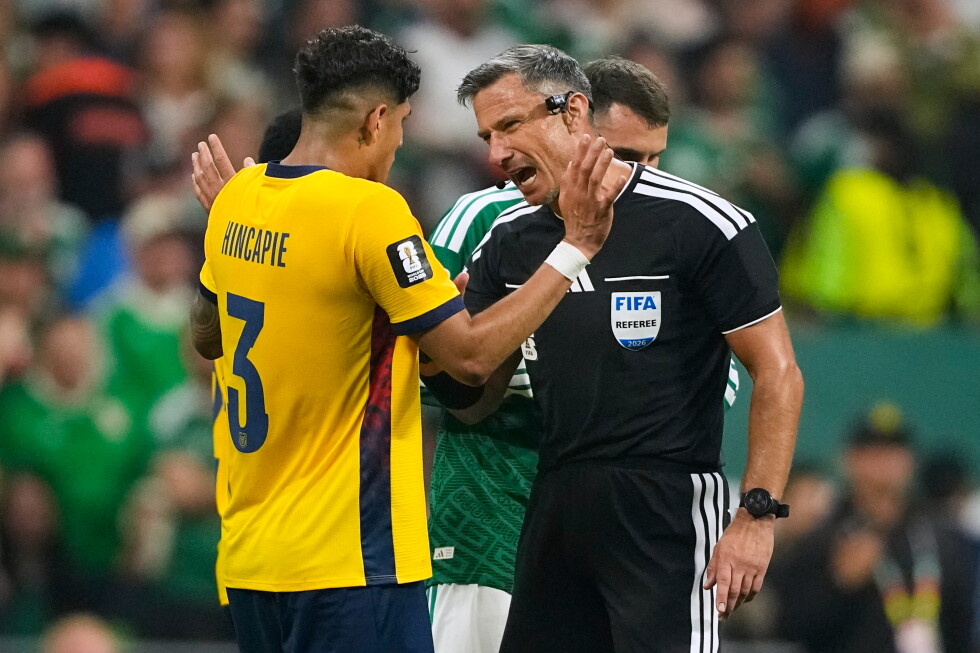
As the World Cup knockout stage unfolds, a landmark new FIFA rule designed to curb hidden on-pitch abuse has already claimed two high-profile victims, just weeks after it was formally implemented for the global tournament. All participating players received clear advance notice of the regulation before kickoff: any athlete who covers their mouth during a verbal confrontation with an opponent will face an immediate red card and ejection from the match, and match officials have been instructed to enforce the change rigorously.
The most recent violation was recorded on Tuesday night, during Ecuador’s round of 32 clash with Mexico. With the match deep into second-half stoppage time and Mexico already holding a 2-0 lead that would ultimately seal its progression to the next round, Ecuadorian center-back Piero Hincapié was shown a straight red after a verbal altercation with Mexican forward Santi Giménez. The dismissal came too late in the game to alter the final outcome, with the full-time whistle blowing mere moments after Hincapié left the pitch.
The new rule, widely nicknamed the “Prestianni Law” after the incident that sparked its creation, was created to eliminate the longstanding loophole that allowed players to hurl abusive, discriminatory or offensive language at opponents without being caught on camera or identified by match officials. The push for reform gained momentum after a high-profile controversial incident in a 2024 Champions League fixture, when Benfica winger Gianluca Prestianni was accused of directing a racially charged slur at Real Madrid star Vinícius Júnior while pulling up his jersey to cover his mouth during the confrontation. The accusation was backed by Prestianni’s then-Real Madrid opponent Kylian Mbappé, prompting FIFA president Gianni Infantino to prioritize a rule change to address the issue.
The International Football Association Board (IFAB), soccer’s global governing body for the Laws of the Game, approved the new regulation during a special emergency meeting held ahead of this year’s FIFA Congress. The change passed with unanimous support from IFAB members, which include senior FIFA officials and representatives from soccer’s four founding British federations. Unlike core mandatory rules of the sport, this new provision grants tournament organizers the autonomy to adopt it at their own discretion, a flexibility that allowed FIFA to roll it out specifically for this World Cup.
Hincapié is not the first player to fall foul of the new regulation during the tournament. The first red card under the rule was issued to Paraguay midfielder Miguel Almirón during a group stage fixture against Turkey. Almirón was ejected after covering his mouth during a heated confrontation with Turkish defender Mert Mulder. Despite Paraguay securing a 1-0 victory in the match, Almirón was forced to serve a mandatory one-game suspension that ruled him out of the nation’s final group stage match against Australia, and FIFA confirmed the original decision was not eligible for appeal.
Under standard World Cup regulations, any player who receives a red card is immediately removed from the ongoing match, requires their team to play the remainder of the fixture with 10 players, and must serve a one-match suspension for their team’s next competitive game in the tournament. While the reduced player number puts the affected team at a significant tactical disadvantage for the rest of the current match, the squad can return to a full 11-player starting lineup for the following fixture, barring the suspended athlete.