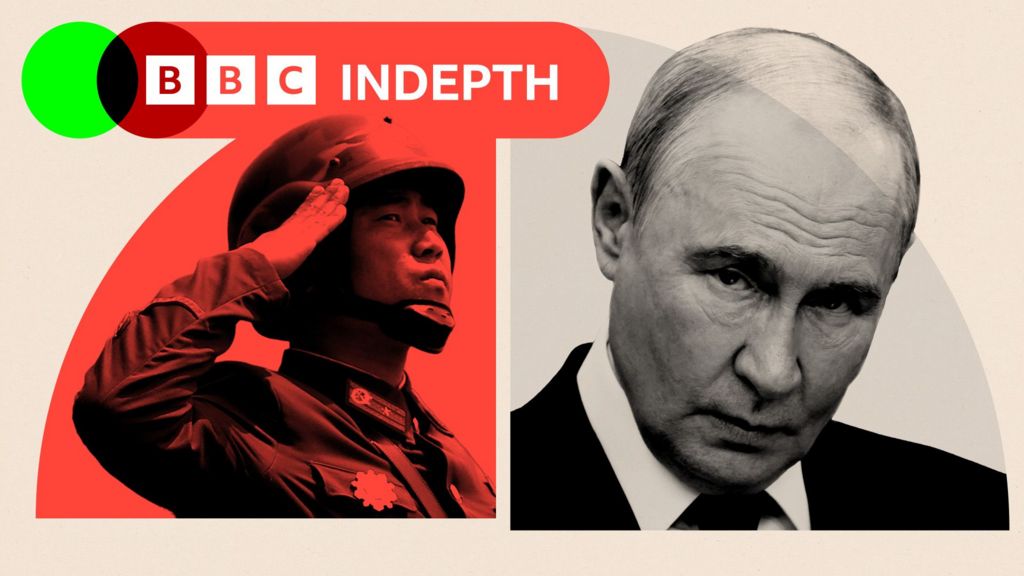
Four and a half years into Russia’s full-scale invasion of Ukraine, a little-discussed but increasingly consequential development has reshaped the conflict’s dynamics: North Korea’s deepening military commitment to Moscow’s campaign. What began as a 2024 deployment of 13,000 elite North Korean troops to defend Russia’s Kursk region amid a Ukrainian offensive has evolved into a long-term, mutually beneficial arrangement that carries sweeping geopolitical ramifications for Europe and East Asia alike.
When North Korean soldiers first entered the Kursk battlefield in late 2024, their presence was unacknowledged by both Moscow and Pyongyang. Ukrainian forces did not confirm their first encounters with the newly deployed troops until November that year, and the first live North Korean prisoner of war was not taken until January 2025. It was only in April 2025 that Russia officially recognized their contribution, with Chief of the General Staff Valery Gerasimov publicly praising their battlefield heroism.
Accounts from Ukrainian troops who faced the North Korean detachments paint a stark picture of their early combat performance. Members of Ukraine’s 95th Air Assault Brigade described North Korean forces as relying on relentless massed assaults, wave after wave of troops advancing on the same positions even after heavy casualties. Early in the campaign, the elite Storm Corps troops – handpicked from North Korea’s most indoctrinated military units – suffered staggering losses: Ukrainian military intelligence (HUR) estimates 3,000 killed and another 1,500 wounded, while a BBC analysis of North Korean memorial sites puts the confirmed death toll at 2,300.
Ukrainian troops also noted critical gaps in the North Korean force’s equipment and coordination with Russian allies. Many troops were found lacking basic protective gear including body armor, helmets and adequate winter clothing, and communication between Russian and North Korean units was reportedly poor. Most strikingly, captured North Korean soldiers and evidence from fallen troops confirm Pyongyang’s strict prohibition on surrender: almost all troops carry suicide ordnance, and thousands chose to kill themselves rather than be captured, a practice publicly celebrated as heroic by North Korean leader Kim Jong Un. To date, only two North Korean soldiers have been taken alive by Ukrainian forces – both captured by accident after being incapacitated by combat injuries.
Despite the heavy human cost, analysts and officials agree that the initial Kursk deployment has already delivered transformative benefits for North Korea’s isolated, sanctions-battered regime. Economically, South Korean security analyst Lim Soo-ho estimates that arms sales and troop deployments to Russia have netted North Korea close to $10 billion over two and a half years – a sum equal to one-third of the country’s entire annual GDP. In exchange for its military contribution, Pyongyang receives critically needed supplies of food, energy and hard currency from Russia, which refuses to enforce international sanctions on the North Korean regime.
Beyond immediate economic gains, the partnership with Moscow has reshaped North Korea’s geopolitical position. For decades, North Korea relied heavily on China for diplomatic and economic support, but its deepening military cooperation with Russia has allowed Kim Jong Un to diversify his country’s alliances and position Pyongyang as a key player in the emerging multipolar order Kim describes as a “new Cold War.” That shift was formalized last September, when Kim stood alongside Chinese President Xi Jinping and Russian President Vladimir Putin in the first trilateral public meeting of the three leaders, marking Pyongyang’s arrival as a core member of the anti-Western bloc.
Militarily, the deployment has given North Korea an unprecedented opportunity to test its troops against modern Western-backed weaponry. “North Korea now knows what modern combat is about,” notes Dr. Yang Uk, a research fellow at Seoul’s Asan Institute for Policy Studies. While early tactics proved costly against Ukrainian drone and artillery fire, Yang says North Korean forces rapidly adapted their tactics to the realities of 21st-century warfare, lessons that will strengthen Pyongyang’s own military capabilities for decades to come.
Today, the remaining 8,500 North Korean troops already deployed to Russia are stationed in four brigades under Russia’s “North” Group of Forces, tasked with defending the Kursk region border against further Ukrainian incursions. HUR confirms no North Korean combat troops have been deployed to Russian-occupied Ukrainian territory so far – but that could soon change.
Ukrainian President Volodymyr Zelensky has issued repeated warnings that North Korea is preparing to deploy up to 50,000 additional troops to Russia, up from an earlier estimate of 30,000, and is preparing to ship additional ballistic weapons to Moscow. Zelensky says preparations for the new deployment are already underway in Russia’s Voronezh region, and he has repeatedly called on South Korea – Ukraine’s ally, which has so far only provided non-lethal aid to Kyiv – to supply advanced air defense systems to counter the expanding North Korean-Russian military partnership.
For Russia, the growing North Korean deployment comes as Moscow faces a crippling manpower shortage four and a half years into its full-scale invasion. Western and Ukrainian intelligence estimates indicate Russia loses roughly 6,000 more troops each month than it can recruit, forcing Moscow to turn to foreign fighters from across the globe to fill its ranks. For North Korea, the arrangement remains a profitable, high-stakes gamble that has already reshaped its global standing – and analysts agree Pyongyang will continue to supply troops and weapons to Russia so long as the benefits outweigh the cost.
The fate of the two captured North Korean soldiers remains unresolved. Both men have explicitly stated they fear returning to North Korea, where they say their families would be punished with execution for their capture, and have requested resettlement in South Korea. While Seoul has agreed to accept them, Ukraine has not yet formalized the transfer, and Russia is the only party that has formally requested their repatriation. Kyiv says it will abide by international human rights rules that prohibit forcing prisoners of war to return to countries where they face persecution, leaving their future in limbo even as a new wave of North Korean troops prepares to deploy to the conflict.