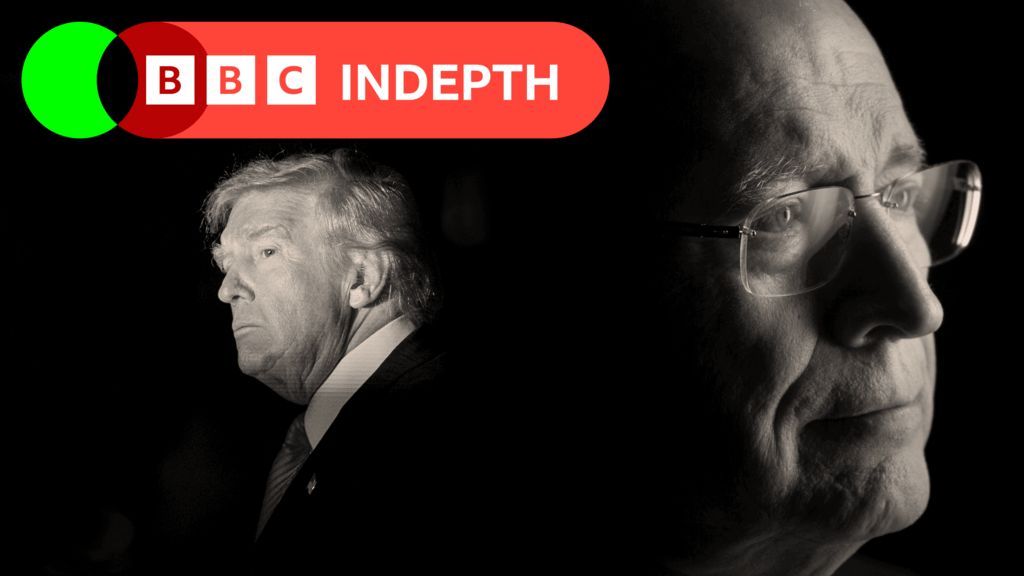
Dick Cheney, the former U.S. vice-president who passed away on Tuesday, played a pivotal role in reshaping the scope of presidential authority in the wake of the 9/11 terrorist attacks. His influence extended beyond his tenure, as Donald Trump now leverages the very mechanisms Cheney established to advance his own political objectives. Despite their personal and ideological differences, both leaders have significantly expanded the powers of the executive branch, often bypassing traditional checks and balances.
Cheney’s career in government spanned decades, beginning with his role in Richard Nixon’s administration and culminating in his influential position as vice-president under George W. Bush. The 9/11 attacks provided Cheney with a unique opportunity to redefine executive authority, enabling Bush to pursue the ‘war on terror’ with minimal constraints. This approach, as detailed in Barton Gellman’s 2008 book ‘Angler,’ was driven by a shared belief in the necessity of robust government action.
Today, Trump has inherited and further amplified these expanded powers, using them to justify actions such as military strikes and domestic surveillance. While Cheney’s policies were rooted in a post-9/11 sense of national unity, Trump’s agenda often lacks such consensus, leading to widespread public concern. Despite their differences, both leaders have demonstrated a willingness to deploy military force abroad and circumvent judicial oversight.
Cheney’s later years saw him become a vocal critic of Trump, particularly after the 2020 election. He warned of the dangers Trump posed to the republic, even endorsing Democrat Kamala Harris in 2024. Trump, in turn, dismissed Cheney as a proponent of ‘endless, nonsensical wars.’
The parallels between Cheney and Trump extend to their use of executive authority in areas such as military intervention, detention practices, and surveillance. Both leaders have pushed the boundaries of presidential power, often with controversial consequences. As the U.S. grapples with the legacy of Cheney’s policies and Trump’s ongoing actions, the debate over the limits of executive authority remains a central issue in American politics.